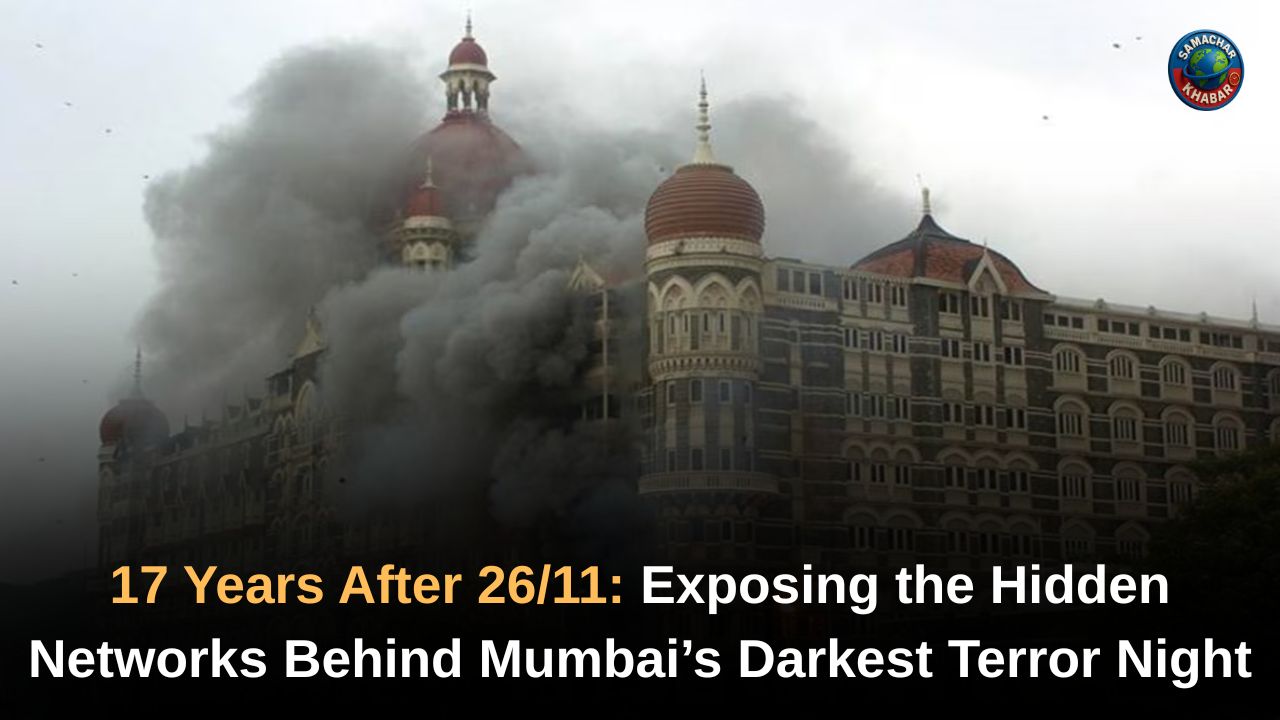
Seventeen years after the 26/11 Mumbai attacks shook India’s financial capital and horrified the world, a complex web of cross-border planning, terror financing, and local support continues to raise painful questions. Despite detailed dossiers, global investigations, and even admissions from Pakistani officials, the masterminds behind the four-day siege that killed 166 people and injured 300 remain untouched.
The story of 26/11 is not just about the brutality of the attack — it is about the unpunished conspiracy that enabled it.
Key Takeaways on the 26/11 Mumbai Terror Attack Anniversary
- Security dossiers and global research confirm a direct ISI–LeT–Al Qaeda nexus, with operations driven by Pakistan’s ISI “S-branch.”
- Osama bin Laden’s alleged involvement surfaced in The Exile, revealing he attended a crucial meeting linked to the 26/11 plot.
- Local support from the Dawood Ibrahim network reportedly guided terrorists through Mumbai’s coastline and routes to their targets.
- The four-day siege resulted in 166 deaths and 300 injuries, with coordinated attacks on CST, Taj, Oberoi-Trident, Nariman House and Leopold Café.
- International tributes continue, with France reaffirming solidarity and condemning terrorism.
- Martyrs including Tukaram Omble, Hemant Karkare, Vijay Salaskar and Ashok Kamte remembered with state honours.
- NIA seeks fresh information from the US regarding mastermind Tahawwur Rana, continuing the long, unfinished journey for justice.
The Cross-Border Architecture of the 26/11 Plot
A 69-page Indian security dossier outlines an extensive terror conspiracy involving Pakistan’s Inter-Services Intelligence (ISI) and its proxy Lashkar-e-Taiba (LeT). The attack was reportedly directed by the ISI’s “S-branch,” which aimed to widen its conflict ambitions beyond Kashmir.
British journalists Cathy Scott-Clark and Adrian Levy, in their investigative book The Exile, cite two former aides of Hafiz Saeed claiming Osama bin Laden travelled to Manshera to attend a key meeting related to the Mumbai attack. They assert the meeting was facilitated by Lashkar, overseen by ISI’s S-wing, and sponsored by Al Qaeda.
Recovered documents after the US raid that killed Bin Laden allegedly confirm his close communication with Hafiz Saeed, revealing deep alignment between LeT’s leadership and Al Qaeda’s top command.
Revelations from Within Pakistan
A major admission came in 2015 when Tariq Khosa, ex-chief of Pakistan’s Federal Investigation Agency (FIA), wrote in Dawn that:
- All ten attackers were confirmed LeT operatives.
- They trained at a camp in Sindh province.
- Forensic evidence and testimonies matched India’s investigation.
- The Karachi control room used to direct the attack had been seized.
Despite these acknowledgments, Pakistan has taken no substantial action against key handlers such as Major Iqbal and Sajid Majeed, continuing to label them “non-state actors.”
Local Support: The Critical Yet Overlooked Layer
Investigations highlight an underreported aspect — local logistical support. Sources indicate that operatives linked to Dawood Ibrahim played an active role in guiding the terrorists from the shoreline to key targets.
Also Read: Birsa Munda Jayanti: PM Modi to Unveil ₹9,700-Cr Tribal Projects in Gujarat
Dawood’s network, deeply rooted in Mumbai’s docks and coastal underbelly, allegedly helped the terrorists evade patrols and land at precise points near Badhwar Park. Local operatives then directed them toward:
- Taj Mahal Palace Hotel
- Oberoi-Trident Hotel
- Chhatrapati Shivaji Terminus (CST)
- Leopold Café
- Nariman (Chabad) House
While David Headley’s reconnaissance was extensive, investigators believe such precision was impossible without ground-level assistance.
How the 60-Hour Siege Unfolded
November 23–26: Journey From Karachi to Mumbai
Ten LeT terrorists left Karachi and hijacked the Indian fishing trawler Kuber on November 23. After killing its crew and forcing the captain to steer toward Mumbai, they later murdered him and moved to inflatable boats, landing at Cuffe Parade and Badhwar Park.
November 26: A Night of Coordinated Carnage
- 9:21 PM — CST: Ajmal Kasab and Ismail Khan opened fire, killing 58 people and injuring over 100.
- Around 9:30 PM — Nariman House: Hostages, including the rabbi and his wife, were killed; their child survived.
- Leopold Café: Terrorists fired indiscriminately, killing around 10 patrons.
- Taj Mahal Palace: Multiple teams stormed through side and main entrances using grenades and automatic weapons.
- Oberoi-Trident: Two militants entered the restaurant and hunted for guests room-to-room.
- 10:30–10:59 PM: Kasab and Khan ambushed senior police officers, killing ATS chief Hemant Karkare, Vijay Salaskar and Ashok Kamte.
Kasab was captured alive shortly after; Khan was killed in the encounter.
November 27–29: NSG Commandos Lead the Counter-Operation
- NSG arrived at 6:30 AM on November 27.
- Hostage rescues at Taj and Oberoi continued through the day.
- Fires erupted under the Taj’s iconic dome.
- November 28: Nariman House taken back; Oberoi-Trident cleared with 30 casualties.
- November 29: Taj secured between 6 and 9 AM after a fierce overnight battle.
The siege officially ended after nearly 60 hours.
Global Response and Tributes
France paid homage through its Ambassador Thierry Mathou, who reaffirmed an “unequivocal condemnation of terrorism” and expressed solidarity with India.
In Mumbai, Chief Minister Devendra Fadnavis, Deputy CM Ajit Pawar and minister Ashish Shelar led floral tributes at the Police Commissioner Office. Families of fallen officers marked the anniversary with prayers and remembrance.
Memorials, Youth Pledges and Renewed Investigations
NSG Mumbai organised a solemn event themed “Neverever”, including:
- A dedicated memorial zone with photos and names of martyrs
- A concept-based “Living Memorial” created from melted homage candles
- Pledge-taking ceremonies across 11 colleges and 26 schools
The Gateway of India was illuminated in tricolour with the word “Neverever” glowing at night.
Meanwhile, the National Investigation Agency (NIA) has sought additional details from the US through the MLAT process concerning mastermind Tahawwur Rana, continuing efforts to deepen the probe into the 26/11 plot.
Spiritual Insight: Reflecting on 26/11 Through the Timeless Teachings of Saint Rampal Ji Maharaj
In the wake of tragedies like 26/11, the teachings of Saint Rampal Ji Maharaj offer a deeper understanding of peace, compassion and the true purpose of human life. His message emphasises that violence, hatred and revenge only multiply suffering, while spiritual knowledge brings clarity, harmony and inner strength.
According to his guidance, rising above anger and fear through devotion to the Supreme God empowers individuals and societies to build a world rooted in non-violence, truth and mutual respect. Seventeen years after the attacks, such spiritual wisdom reminds humanity that lasting peace begins with transforming the mind, not the battlefield.
Seventeen Years Later: The Unfinished Fight for Justice
The 26/11 terror attack fundamentally transformed India’s security landscape, triggering reforms in coastal surveillance, inter-agency coordination and rapid-response capabilities. But for survivors, families of victims, and the nation at large, the emotional wounds remain open.
From bullet-scarred walls at Leopold Café to the heroic sacrifice of ASI Tukaram Omble, who captured Ajmal Kasab alive, Mumbai’s streets still carry the memory of a night that changed India forever. Seventeen years on, the demand for accountability — both across the border and within global terror networks — remains pressing, powerful and deeply unresolved.
FAQs on the 26/11 Mumbai Terror Attack and the Unresolved Conspiracy
1. What is the unresolved conspiracy behind the 26/11 Mumbai attacks?
Investigations link ISI’s S-branch, Lashkar-e-Taiba, Al Qaeda leadership and local Dawood operatives, forming a coordinated cross-border and on-ground network still unpunished.
2. How did the 26/11 terrorists enter Mumbai?
Ten LeT terrorists sailed from Karachi, hijacked the trawler Kuber, killed its crew and landed at Badhwar Park, Cuffe Parade and Sassoon Docks using inflatable boats.
3. Which major locations were targeted during the 26/11 attacks?
The terrorists struck CST, Taj Mahal Palace, Oberoi-Trident, Nariman (Chabad) House, Leopold Café, Cama Hospital and nearby areas over a 60-hour siege.
4. What role did local support play in the 26/11 attacks?
Investigators suggest Dawood Ibrahim’s network helped terrorists evade coastal patrols, land precisely and navigate to the attack sites across South Mumbai.
5. What developments have occurred 17 years after the 26/11 attacks?
India continues memorials, strengthens counter-terror measures, and the NIA has sought fresh details from the US regarding accused mastermind Tahawwur Rana.