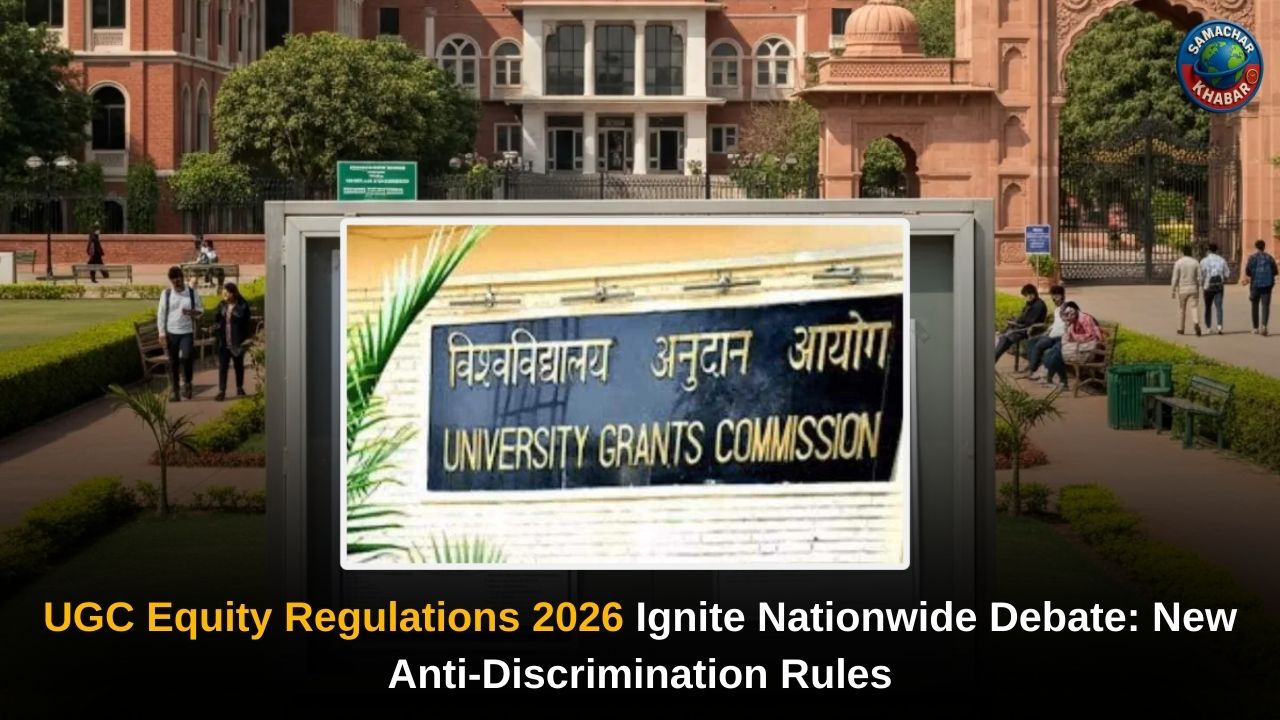
India’s higher education system is at a critical juncture after the notification of the University Grants Commission (Promotion of Equity in Higher Education Institutions) Regulations, 2026. Framed to curb caste-based discrimination and promote inclusion across universities and colleges, the new rules introduce enforceable obligations, strict timelines, and institutional accountability. However, soon after their notification in January 2026, the regulations triggered protests, political reactions, and legal debate.
Supporters see them as a long-overdue corrective to systemic bias on campuses, while critics warn of vagueness, misuse, and imbalance. The controversy now centres on whether the framework can deliver justice without creating fear or procedural overreach.
Key Takeaways on UGC Equity Regulations 2026 and Campus Discrimination Debate
- UGC Equity Regulations 2026 replace the 2012 anti-discrimination framework with legally enforceable rules for all Higher Education Institutions (HEIs).
- Mandatory Equal Opportunity Centres (EOCs) and Equity Committees are introduced to address discrimination complaints.
- The rules define discrimination broadly, covering caste, religion, gender, disability, place of birth, and race.
- Institutional heads are made directly accountable for implementation and compliance.
- Protests by sections of “general category” students and political leaders highlight concerns over false complaints and vague definitions.
- Student bodies and civil society groups remain divided on whether the regulations ensure justice or risk administrative overreach.
What Is the University Grants Commission and Why Do Its Rules Matter?
The University Grants Commission is a statutory body responsible for coordinating, funding, and maintaining standards in higher education in India. Established formally under the UGC Act, 1956, and headquartered in New Delhi, the Commission plays a central role in shaping university governance.
Over the decades, UGC regulations have influenced admissions, funding, academic standards, and grievance redressal mechanisms, making any major regulatory change significant for millions of students and educators nationwide.
UGC Promotion of Equity Regulations 2026: What the New Rules Say
Notified on January 13–14, 2026, the new regulations aim to eliminate discrimination and promote equity in higher education institutions. They apply to all HEIs and cover students, teachers, and non-teaching staff. The regulations prohibit denial of dignity or opportunity on grounds of caste, religion, race, gender, place of birth, or disability, with particular emphasis on protections for Scheduled Castes (SCs), Scheduled Tribes (STs), Other Backward Classes (OBCs), Economically Weaker Sections (EWS), and persons with disabilities.
Unlike earlier advisory guidelines, the 2026 framework converts equity into an enforceable governance obligation, empowering the UGC to impose penalties for non-compliance.
Equal Opportunity Centres and Equity Committees: New Institutional Architecture
Every HEI is required to establish an Equal Opportunity Centre (EOC) as the nodal body for promoting inclusion and handling discrimination complaints. Under the EOC, an Equity Committee must be constituted with representation from SCs, STs, OBCs, women, and persons with disabilities.
Equity Committee composition includes:
- Head of the Institution as ex-officio Chairperson
- Senior faculty members
- One non-teaching staff member
- Civil society representatives
- Student representatives as special invitees
- EOC Coordinator as ex-officio Member Secretary
Members have fixed tenures, and the committee is mandated to meet within 24 hours of receiving a complaint.
How Complaints Are Filed and Addressed Under UGC Act 2026
The regulations allow aggrieved individuals to report discrimination through online portals, written submissions, email, or a dedicated 24×7 equity helpline. Confidentiality of the complainant is assured upon request. If a complaint indicates a prima facie offence under penal law, it must be forwarded to police authorities.
Also Read: UGC Notifies 2026 Regulations to Counter Caste Discrimination in Higher Education
The Equity Committee must submit its report within 15 working days, after which the Head of the Institution is required to initiate action within seven working days. Appeals can be taken to an Ombudsperson if the complainant is dissatisfied with the institutional response.
Why Were the New Regulations Introduced?
The 2026 rules followed a Supreme Court-linked petition concerning the implementation of the 2012 UGC anti-discrimination guidelines. The petition was filed by the mothers of Rohith Vemula and Payal Tadvi, whose deaths were linked to alleged caste-based harassment. These cases intensified scrutiny of campus grievance mechanisms and highlighted systemic failures in addressing discrimination.
Protests and Political Reactions to UGC Equity Regulations 2026
Soon after notification, protests erupted outside UGC headquarters, led by groups such as the “Savarna Sena.” Critics argued that the regulations lack safeguards against false or malicious complaints and do not clearly address grievances of general category students. Uttar Pradesh BJP MLC Devendra Pratap Singh warned that the rules could widen caste divisions, while BJP MP Nishikant Dubey sought to reassure critics, citing the introduction of the 10% EWS reservation under the Narendra Modi-led government.
Also Read: UGC New Rules 2026: Rules Applicable Nationwide, Students and Teachers Concerned
Student unions, including that of Kumaun University, raised concerns about natural justice, fear, and possible misuse, arguing that campus balance could be disturbed.
Student Groups and Civil Society: Support and Criticism
The All India Students Association (AISA) welcomed the regulations as an improvement over the 2012 framework but flagged concerns over institutional independence. AISA pointed to the head of the institution serving as chairperson of the Equity Committee, arguing this could create conflicts of interest. The group also criticised the broad and abstract definition of discrimination, warning that excessive discretion could allow institutions to evade accountability.
AISA cited UGC data showing a significant rise in caste-based discrimination complaints between 2019 and 2024.
Enforcement, Penalties, and the Question of Workability
The UGC has the authority to impose strict penalties on non-compliant institutions, including debarment from UGC schemes, restrictions on academic programmes, and withdrawal of recognition. While this strengthens enforcement, critics argue that the heavy reliance on institutional committees and reporting could result in procedural compliance rather than substantive justice, particularly in under-resourced universities.
Spiritual Perspective on Equality and Human Dignity: The Teachings of Saint Rampal Ji Maharaj Ji
Beyond laws and regulations, the deeper solution to discrimination lies in transforming human thinking. Saint Rampal Ji Maharaj teaches that all human beings are equal because every soul originates from the same Supreme Power. According to his unique spiritual knowledge, caste, class, and social hierarchies are man-made divisions that have no place in true spirituality. He emphasises that discrimination, hatred, and exclusion arise from ignorance of spiritual truth, not from divine law.
When society adopts values of compassion, equality, and brotherhood as taught in true spiritual scriptures, social injustice automatically dissolves. In this context, spiritual awareness complements legal reforms by addressing discrimination at its root—human mindset and moral consciousness.
Equity, Accountability, and the Road Ahead for Indian Campuses
The UGC Equity Regulations 2026 mark a decisive shift in how discrimination is addressed in higher education, moving from advisory norms to enforceable governance. They seek to redefine equity not only as access but as lived experience on campus. Yet, the ongoing protests and debates underscore unresolved tensions around definition, process, and trust.
Whether the regulations evolve into a fair and predictable system or become another layer of paperwork will depend on consistent implementation, transparent oversight, and institutional credibility. The real test lies not in the intent of the rules, but in how quietly and consistently they deliver justice long after the controversy subsides.
FAQs on UGC Equity Regulations 2026 and Campus Discrimination Debate
1. What are the UGC Equity Regulations 2026?
The regulations notified by the University Grants Commission mandate enforceable mechanisms like Equal Opportunity Centres to prevent discrimination and promote equity across all higher education institutions.
2. Why did UGC introduce the Equity Regulations in 2026?
The rules followed court scrutiny and long-standing complaints of caste discrimination, aiming to replace the 2012 advisory framework with legally binding, accountable campus governance mechanisms.
3. What is an Equal Opportunity Centre under UGC Rules 2026?
An Equal Opportunity Centre is a mandatory institutional body that handles discrimination complaints, promotes inclusion, ensures awareness, and oversees equity-related reporting and compliance.
4. Why are there protests against UGC Equity Regulations 2026?
Critics, including some general-category groups, allege vague definitions, lack of safeguards against false complaints, and fear of misuse, while supporters argue the rules are necessary for campus justice.
5. What penalties can institutions face for violating UGC Equity Regulations?
Non-compliant institutions may face withdrawal from UGC schemes, restrictions on academic programmes, or loss of UGC recognition, making the regulations legally enforceable.