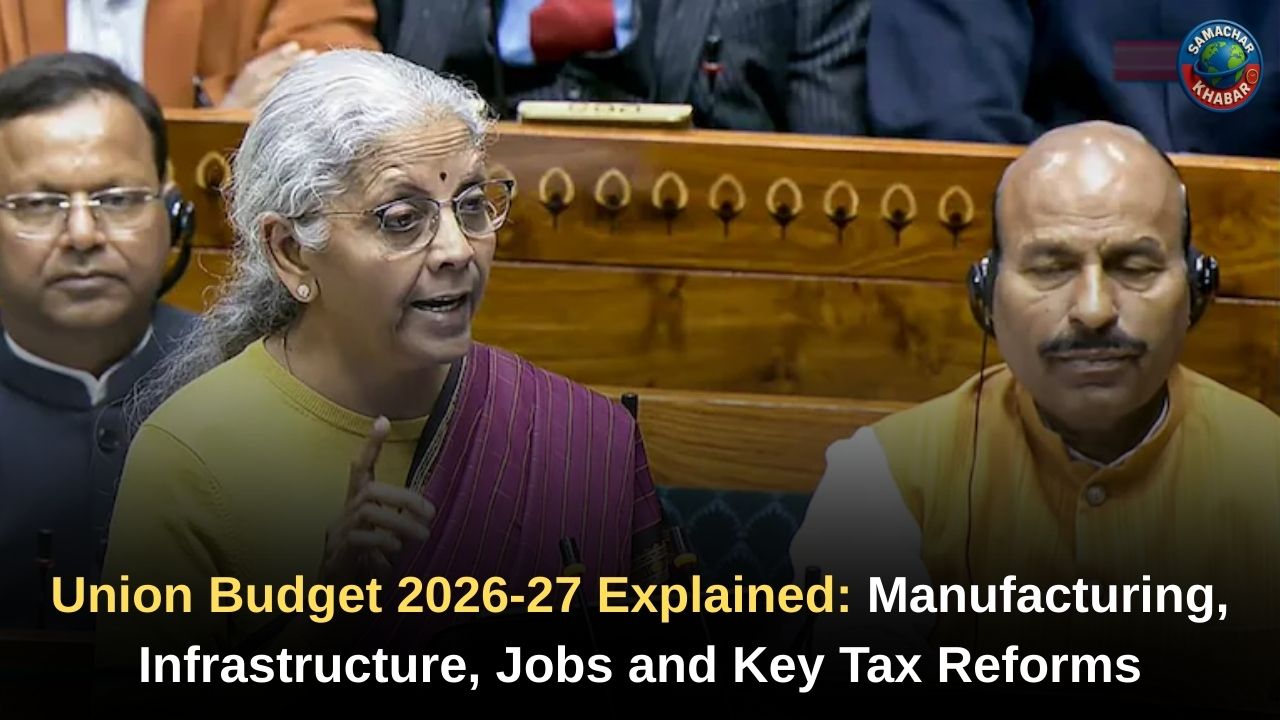
The Union Budget 2026–27, presented by Nirmala Sitharaman, signals a clear policy shift towards long-term economic resilience over short-term tax relief. Framed amid global uncertainty and trade disruptions, the Budget prioritises manufacturing expansion, infrastructure investment, job creation and compliance-friendly tax reforms.
While income-tax rates remain unchanged, the government has announced wide-ranging structural measures across industry, MSMEs, customs, services and urban development. With public capital expenditure raised to ₹12.2 lakh crore and a strong focus on Tier-II and Tier-III cities, Budget 2026–27 lays the groundwork for sustainable growth aligned with the vision of Viksit Bharat @2047.
Union Budget 2026-27 Key Takeaways: Growth, Jobs and Structural Reforms
- Public capital expenditure increased to ₹12.2 lakh crore in FY 2026–27
- Manufacturing-led growth strategy covering electronics, semiconductors, biopharma and capital goods
- No change in income-tax slabs, focus on simplification and trust-based compliance
- Major customs duty rationalisation to support exports, energy transition and ease of living
- Strong push for MSMEs, services sector jobs, skilling and emerging technologies
- Expansion of City Economic Regions to drive Tier-II and Tier-III city growth
Budget 2026-27 in a Volatile Global Economic Environment
The Union Budget 2026–27 is presented at a time when the global economy faces slowing growth, supply-chain disruptions and geopolitical uncertainty. Acknowledging these external pressures, the government has adopted a calibrated strategy that prioritises productivity, competitiveness and resilience rather than immediate consumption-driven stimulus.
After more than a decade of macroeconomic stability, controlled inflation and fiscal discipline, the Budget reinforces India’s dual approach of deeper global integration while reducing import dependence in strategic sectors.
Manufacturing as the Core Growth Engine
Manufacturing forms the backbone of Budget 2026–27’s economic strategy, with targeted interventions across strategic and frontier sectors.
Key Manufacturing Initiatives
- Biopharma SHAKTI launched with an outlay of ₹10,000 crore over five years to position India as a global hub for biologics and biosimilars
- Launch of India Semiconductor Mission (ISM) 2.0, focusing on equipment manufacturing, materials, Indian intellectual property and supply-chain resilience
- Outlay for the Electronics Components Manufacturing Scheme increased to ₹40,000 crore
- Development of Rare Earth Corridors in Tamil Nadu, Kerala, Odisha and Andhra Pradesh
- New schemes for chemical parks, container manufacturing and capital goods
- Integrated, employment-oriented package for textiles, including fibre self-reliance, cluster modernisation and skilling
These measures aim to strengthen domestic value addition, reduce import dependence and generate large-scale employment.
Infrastructure Push Anchored by Record Capital Expenditure
Infrastructure continues to be a central pillar of the government’s growth strategy.
Public capital expenditure has been raised to ₹12.2 lakh crore in FY 2026–27, reinforcing infrastructure-led demand across highways, ports, railways, power and urban development.
Major Infrastructure Announcements
- Creation of an Infrastructure Risk Guarantee Fund to de-risk private investment during the construction phase
- Expansion of Dedicated Freight Corridors and operationalisation of 20 National Waterways
- Coastal Cargo Promotion Scheme to increase the share of inland waterways and coastal shipping from 6% to 12% by 2047
- Announcement of seven high-speed rail corridors connecting major cities
- Recycling of CPSE real estate assets through dedicated REITs
City Economic Regions and Tier-II, Tier-III City Development
Budget 2026–27 places emerging cities at the centre of India’s next growth cycle.
City Economic Regions (CERs) will be developed with an allocation of ₹5,000 crore per region over five years, implemented through reform-linked financing. The initiative is expected to unlock agglomeration benefits, strengthen office markets, boost housing demand and promote balanced regional development, particularly in Tier-II and Tier-III cities.
Income-Tax Reforms: Simplicity Over Rate Cuts
Despite expectations of tax relief, the Budget keeps income-tax slabs and standard deduction unchanged, choosing instead to focus on certainty, simplification and ease of compliance.
Key Income-Tax Measures
- Income Tax Act, 2025 to replace the 1961 law from 1 April 2026
- Simplified rules and redesigned forms to be notified shortly
- Deadline for filing revised returns extended to 31 March
- Automated, rule-based process for lower or nil TDS certificates
- Rationalisation of TDS and TCS, including reduced TCS on overseas travel, education and medical remittances
- Share buyback proceeds to be taxed as capital gains, with an additional levy on promoters
- Decriminalisation of minor offences and conversion of penalties into fixed fees to reduce litigation
Sovereign Gold Bonds: Tax Exemption Narrowed
The Budget clarifies the taxation of Sovereign Gold Bonds (SGBs) by restricting capital gains tax exemption only to bonds subscribed at the time of original RBI issuance and held continuously till maturity.
SGBs purchased from the secondary market will no longer qualify for tax-free capital gains at redemption, even if held till maturity. The 2.5% annual interest on SGBs will continue to be taxed as income.
Customs Reforms to Support Manufacturing and Trade
Customs duty changes under Budget 2026–27 align closely with the Make in India and energy transition agenda.
Major Customs Measures
| Area | Key Change |
| Personal Imports | Duty reduced from 20% to 10% |
| Healthcare | Duty exemption on 17 cancer drugs and medicines for rare diseases |
| Energy & Manufacturing | Exemptions for lithium-ion batteries, critical minerals and nuclear power |
| Aviation & Defence | Duty relief for aircraft manufacturing and defence MRO inputs |
| Trade Facilitation | Customs advance ruling validity extended from 3 to 5 years |
| Digital Customs | Rollout of Customs Integrated System within two years |
GST Reforms: Technical Clarity and Litigation Reduction
While headline GST rates remain unchanged, the Budget introduces technical amendments to reduce disputes and improve consistency. These include changes to intermediary services under the IGST Act, strengthening of advance ruling mechanisms, provisional refunds for inverted duty structures, and tighter norms for credit notes and debit notes.
Insurance, MSMEs and Services Sector Push
A major reform has been announced in the insurance sector, with the FDI limit raised from 74% to 100%, subject to full domestic investment of premiums.
For MSMEs, the Budget proposes:
- A ₹10,000 crore SME Growth Fund to create “Champion MSMEs”
- Mandatory use of TReDS by CPSEs to improve liquidity
- Credit guarantee-backed invoice discounting
The services sector is positioned as a key employment engine through a High-Powered Education-to-Employment and Enterprise Committee, expansion of AVGC labs, tourism skilling initiatives and new design and hospitality institutions.
Cigarettes and Tobacco Products Turn Costlier
From February 1, 2026, cigarettes and tobacco products have become costlier due to the introduction of a 40% sin tax, replacing the earlier GST compensation cess. The revised levy applies to cigarettes, cigars, pan masala and related tobacco products.
Fiscal Discipline Remains Central
Despite the expansionary push, fiscal prudence remains intact.
- Fiscal deficit estimated at 4.3% of GDP for FY 2026–27
- Debt-to-GDP ratio projected at 55.6%, with a medium-term target of around 50% by 2030
Spiritual Perspective: Guiding Material Progress Through the Unique Knowledge of Saint Rampal Ji Maharaj Ji
Beyond economic policy and fiscal numbers, the Union Budget 2026–27 also invites reflection on the deeper purpose of development. Saint Rampal Ji Maharaj emphasises that true national progress is achieved when material growth is aligned with ethical living, social harmony and spiritual awareness. His unique spiritual knowledge highlights that sustainable prosperity arises not only from infrastructure, industry and employment, but also from values such as honesty, self-discipline, compassion and social responsibility.
According to this perspective, when individuals lead principled lives and society follows a righteous path, economic resources are utilised more effectively, inequality reduces naturally, and development becomes inclusive, balanced and long-lasting—benefiting both the nation and humanity as a whole.
A Budget Focused on Building Long-Term Economic Strength
Union Budget 2026–27 reflects a deliberate shift towards building durable economic foundations rather than offering short-term relief. By prioritising manufacturing competitiveness, infrastructure creation, job generation and compliance-friendly reforms, the government has laid out a long-term growth strategy.
The effectiveness of this approach will depend on execution and private-sector participation, but if implemented well, Budget 2026–27 could play a defining role in strengthening India’s productivity, resilience and global economic standing.
FAQs on Union Budget 2026-27 Explained: Manufacturing, Infrastructure, Jobs and Key Tax Reforms
1. What is the main focus of the Union Budget 2026-27?
Union Budget 2026-27 focuses on manufacturing-led growth, higher infrastructure spending, job creation, MSME support, and tax and customs reforms aimed at easing compliance.
2. Has the Union Budget 2026-27 changed income tax slabs?
No, Union Budget 2026-27 keeps income tax slabs unchanged and instead prioritises simplification, extended deadlines, reduced litigation, and trust-based tax compliance reforms.
3. How much capital expenditure has been announced in Budget 2026-27?
The government has increased public capital expenditure to ₹12.2 lakh crore in FY 2026-27 to boost infrastructure, growth and employment generation.
4. What are the key manufacturing initiatives announced in Budget 2026-27?
Key initiatives include Biopharma SHAKTI, Semiconductor Mission 2.0, higher electronics manufacturing outlay, rare earth corridors, chemical parks and container manufacturing schemes.
5. What major customs changes were announced in Union Budget 2026-27?
Customs duty on personal imports was reduced, cancer medicines were exempted, and duty relief was provided for energy, aviation, defence manufacturing and critical minerals.