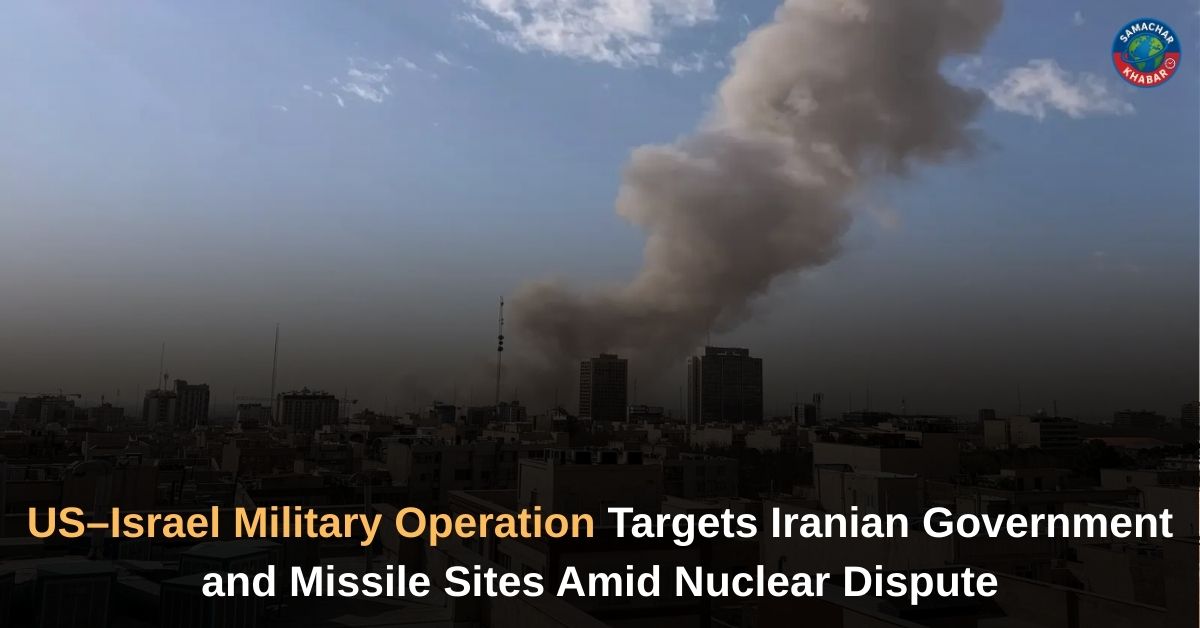
US–Israel Military Operation: The United States and Israel on Saturday launched a coordinated military strike against Iran, targeting government buildings, intelligence headquarters, missile infrastructure, and nuclear-linked facilities across multiple cities. Massive explosions were reported in Tehran and beyond, marking a sharp escalation in already fragile regional tensions.
The operation, described by Israeli officials as pre-emptive and necessary to remove threats, comes amid stalled diplomatic negotiations over Iran’s nuclear and ballistic missile programs. Iran has vowed a “crushing” response, while emergency measures across Israel and airspace closures in the region signal the gravity of the unfolding confrontation.
US–Israel Strike on Iran: Key Developments in the Military Operation
- Joint military action conducted by air and sea.
- Operation planned for months; launch date decided weeks in advance.
- Explosions reported in Tehran, Qom, Isfahan, Kermanshah, Karaj, and Tabriz.
- A presidential building complex reportedly struck.
- Missile launchers, UAV bases, and intelligence facilities targeted.
- Isfahan Nuclear Technology and Research Centre among reported sites hit.
- Iran’s Supreme Leader moved to a secure location.
- No casualty figures released.
- Israel declared a nationwide state of emergency.
- Iran closed its airspace and cut mobile services in parts of Tehran.
- Tehran warned of retaliation against US bases in the region.
Explosions Rock Tehran as Key Government and Military Sites Are Hit
Massive explosions were heard across central, eastern, and northern Tehran. Missiles reportedly struck areas including University Street, the Jomhouri district, and the Seyyed Khandan neighborhood. Thick plumes of smoke rose above the capital, and residents were seen running for cover in several districts.
Among the locations reportedly targeted were the presidential building complex, the Ministry of Intelligence, the Ministry of Defence, the Iranian Atomic Energy Agency, and the Parchin military complex. Iranian media also reported strikes on the Islamic Revolutionary Guard Corps’ intelligence headquarters.
Beyond Tehran, explosions were reported in Isfahan, Qom, Kermanshah, Karaj, and Tabriz. Isfahan, home to Iran’s Nuclear Technology and Research Centre, was identified as a significant site targeted. Tabriz, which hosts a missile base, was also struck. Authorities have not provided casualty information.
Supreme Leader Relocated as Iran Tightens Security
An early strike was reported near offices associated with Ayatollah Ali Khamenei. Officials confirmed that the 86-year-old leader was not in Tehran at the time and had been transferred to a secure location as a precaution. He has reportedly not appeared in public for days.
In response to the strikes, Iran shut down its airspace and cut mobile phone services in eastern and western Tehran. Neighboring Iraq also closed its airspace.
Israel Declares State of Emergency and Suspends Civilian Activity
Israeli Defence Minister Israel Katz described the attack as a pre-emptive measure to neutralise threats.
“The State of Israel launched a pre-emptive attack against Iran to remove threats to the State of Israel,” Katz said.
Sirens sounded across Israel as the military issued proactive alerts warning of potential missile fire toward Israeli territory. Citizens were instructed to stay near protected shelters and avoid non-essential travel. Educational institutions, public gatherings, and workplaces were suspended, with essential sectors exempted. Israeli airspace was closed to civilian flights.
Also Read: Inside the Gaza Flotilla Arrest: Greta Thunberg’s Alleged Ordeal in Israeli Custody
Security officials assessed that an Iranian counterattack could occur within hours, though no missiles had been launched toward Israel at the time of reporting.
US Military Role and Regional Deployment
US officials confirmed American forces participated in the strikes, which were conducted by air and sea. The extent of President Donald Trump’s direct operational involvement remains unclear.
The operation followed a substantial US military buildup in the region. Two aircraft carrier strike groups — representing approximately 15,000 personnel, more than a dozen ships, hundreds of aircraft, and likely submarines — were deployed. Advanced frigates and fighter jets were positioned across Middle Eastern bases. Analysts noted that the scale of preparation was comparable to the military deployments seen ahead of the invasion of Iraq.
The US Embassy in Qatar implemented a shelter-in-place order for personnel and advised American citizens to do the same. Iran had previously warned that countries hosting US forces could become targets if their bases were used to launch attacks.
Nuclear Dispute and Diplomatic Background
The strikes come amid renewed tensions over Iran’s nuclear and ballistic missile programs. Diplomatic negotiations between Washington and Tehran resumed in February in an effort to resolve the decades-long dispute.
Meetings in Geneva involved US representatives including Steve Witkoff and Jared Kushner and Iran’s chief negotiator Sayyid Badr bin Hamad Al Busaidi, Oman’s foreign minister. Additional discussions had been scheduled before the latest escalation.
Israel has maintained that any agreement must dismantle Iran’s nuclear infrastructure entirely and include restrictions on its missile program. Iran has stated it is willing to discuss limits on its nuclear activities in exchange for sanctions relief but has ruled out negotiations over missile capabilities.
In June, the United States joined Israel in Operation Midnight Hammer, a 37-hour mission involving B-2 stealth bombers and Tomahawk cruise missiles aimed at neutralising Iranian defenses protecting nuclear facilities in Isfahan. F-22 fighter jets shielded the bombers as they entered Iranian airspace at high altitude and speed. No shots were fired at US aircraft during that operation. Iran later retaliated by launching missiles toward the US Al Udeid air base in Qatar, causing minor damage and no casualties.
US intelligence assessments indicate Iran could require until 2035 to develop a militarily viable intercontinental ballistic missile, should it pursue that path.
A Spiritual Perspective on Peace Amid Rising Global Conflict
As tensions escalate and nations prepare for retaliation, ordinary people face uncertainty and fear. In such times, spiritual reflection becomes essential.
The unique knowledge of Saint Rampal Ji Maharaj teaches that lasting peace cannot come through weapons or power, but through true devotion based on authentic scriptures. According to his teachings, conflicts arise from ignorance and ego, and only correct spiritual understanding can remove the root causes of violence.
His message emphasizes universal brotherhood, non-violence, and devotion to the Supreme God. This spiritual path highlights inner transformation as the true foundation for global peace.
Region on Edge as Retaliation Threat Looms
Iranian officials said preparations for retaliation were underway and warned that the response would be “crushing.” Tehran also warned that American military personnel and bases across the region could become targets.
With government complexes, missile infrastructure, and nuclear-linked facilities struck, and emergency measures enforced across multiple countries, the Middle East faces another volatile chapter. Diplomatic efforts that had resumed earlier this year are now overshadowed by direct military action, leaving the region bracing for Iran’s next move and the possibility of wider escalation.
FAQs on US–Israel Military Operation Targets Iranian Government and Missile Sites Amid Nuclear Dispute
1. What is Operation Shield of Judah?
Operation Shield of Judah is the codename for the joint US–Israel military strike targeting Iranian government buildings, missile bases, intelligence sites, and nuclear-linked facilities across multiple cities.
2. Why did the US and Israel launch strikes on Iran?
Israeli officials described the operation as a pre-emptive action to remove threats linked to Iran’s nuclear and ballistic missile programs amid stalled diplomatic negotiations.
3. Which Iranian cities were targeted in the operation?
Explosions were reported in Tehran, Isfahan, Qom, Kermanshah, Karaj, and Tabriz, including strikes on government complexes, missile bases, and nuclear research facilities.
4. Was Iran’s Supreme Leader affected by the strikes?
Strikes occurred near offices linked to Ayatollah Ali Khamenei, who was moved to a secure location. No official casualty figures have been released.
5. How has Iran responded to the US–Israel military operation?
Iran warned of a “crushing” retaliation, closed its airspace, cut mobile services in parts of Tehran, and signaled that US bases in the region could become targets.