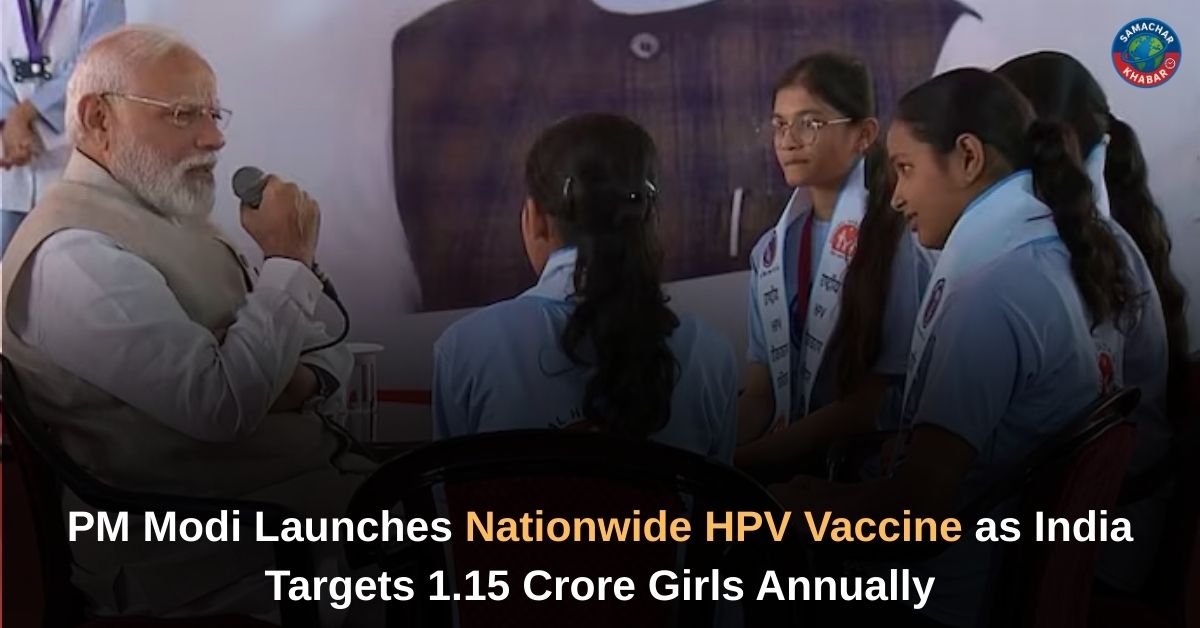
Prime Minister Narendra Modi on February 28 launched India’s nationwide Human Papillomavirus (HPV Vaccine) vaccination programme from Ajmer, marking a major step toward preventing cervical cancer across the country.
The campaign will provide a free single-dose HPV vaccine to 14-year-old girls across all States and Union Territories, targeting approximately 1.15 crore beneficiaries every year. Health authorities describe the initiative as a decisive move in preventive healthcare aimed at reducing India’s cervical cancer burden.
Key Highlights of the Nationwide HPV Vaccination Drive in India
- Nationwide rollout targeting 14-year-old girls
- 1.15 crore girls to be vaccinated annually
- Free single-dose Gardasil 4 vaccine
- Three-month mission mode campaign
- Registration through U-WIN digital platform
- Parental consent mandatory
- Girls turning 15 within three months also eligible
- Vaccine available at government health facilities nationwide
- India joins over 160 countries with HPV vaccination programmes
What Is the HPV Vaccine and Why It Matters
Human Papillomavirus (HPV) is a common sexually transmitted infection. According to the World Health Organization, most sexually active individuals will be infected at some point in their lives, often without symptoms. While many infections resolve naturally, persistent infection with high-risk HPV types can lead to cervical cancer.
Cervical cancer remains the second most common cancer among women in India. As per GLOBOCAN 2022 data:
- Over 1.2–1.25 lakh new cases annually
- Nearly 75,000–80,000 deaths every year
- India accounts for nearly 20% of global cervical cancer cases
Nearly 80–90% of cervical cancer cases are linked to high-risk HPV types, particularly types 16 and 18.
Vaccine Being Used: Single-Dose Gardasil 4
Under the nationwide campaign, the government will administer a single shot of Gardasil 4, a quadrivalent vaccine that protects against:
- HPV types 16 and 18 (linked to cervical cancer)
- HPV types 6 and 11
The vaccine will be provided free of cost at:
- Ayushman Arogya Mandirs (Primary Health Centres)
- Community Health Centres
- Sub-district and District Hospitals
- Government Medical Colleges and Hospitals
Each vaccination session will be supervised by trained Medical Officers and supported by skilled healthcare teams.
Why Is India Using a Single-Dose Strategy?
In 2022, the WHO’s Strategic Advisory Group of Experts on Immunization recommended that a single-dose HPV schedule provides protection comparable to two-dose regimens for girls and young women up to 20 years of age.
Health experts in India have stated that one dose provides a strong and durable immune response in girls aged 9–14, especially when administered before exposure to the virus.
Women above 21 years may require two doses six months apart, while immunocompromised individuals may need three doses where feasible.
Why Not Cervavac Yet?
India’s indigenous HPV vaccine Cervavac, developed by the Serum Institute of India, is not currently being used in the national programme because:
- It is awaiting WHO approval
- Its single-dose effectiveness is still under evaluation
Officials have indicated that a shift may be considered after regulatory clearances in the future.
How to Register: U-WIN Platform and Eligibility Details
Parents must register eligible girls through the U-WIN portal. Age verification documents will be required before booking vaccination appointments at designated government health centres.
The vaccination drive will run in mission mode for three months, during which eligible girls can receive the vaccine daily at participating facilities. After the special drive period, HPV vaccination will continue under routine immunisation schedules.
Officials clarified that girls turning 15 within three months of the campaign launch will also be eligible during the special drive.
In Delhi, the campaign was launched at Guru Teg Bahadur Hospital, where 30 girls received the first shots after coordination with the education department and parental sensitisation.
Safety, Cold Chain and Medical Monitoring
Health authorities have emphasised that HPV vaccines are among the most extensively studied globally, with over 500 million doses administered since 2006.
Scientific evidence demonstrates 93–100% effectiveness in preventing cervical cancer caused by vaccine-covered HPV types.
Each vaccination site will maintain functional Cold Chain Points and will be linked to 24×7 government health facilities to manage any rare Adverse Events Following Immunization (AEFI).
Doctors have clarified that reported side effects are generally minor, including:
- Pain or swelling at injection site
- Mild fever
- Headache
Claims linking HPV vaccination to infertility or early menopause have been refuted by medical experts.
Role of GAVI and Global Experience
India has secured HPV vaccine supply through partnership with GAVI, the Vaccine Alliance.
- 2.6 crore doses allocated for two years
- 1 crore doses already delivered
- Remaining doses to be supplied over this year and next
More than 90 countries are implementing single-dose HPV vaccination schedules. Countries such as Australia have reported significant reductions in HPV prevalence following widespread vaccination.
Also Read: Delhi Lakhpati Bitiya Yojana Launched: Benefits, Eligibility, Amount and Full Details
With this rollout, India joins over 160 countries that have introduced HPV vaccination into national immunisation programmes.
Spiritual Perspective: Unique Knowledge on Protecting Human Life
The nationwide HPV vaccination drive highlights the importance of prevention and protection of human life. Saint Rampal Ji Maharaj Ji teaches that the human body is a rare blessing and must be safeguarded with awareness and responsibility. His spiritual knowledge emphasizes disciplined living, moral conduct and informed decisions for overall well-being.
Protecting health through preventive action aligns with the broader principle that life should be preserved and valued as a sacred opportunity for spiritual growth and meaningful living.
Strengthening Preventive Healthcare Across India
Launching the programme, Prime Minister Narendra Modi stated that the initiative aims to prevent cervical cancer and strengthen the country’s preventive healthcare framework. By targeting 1.15 crore adolescent girls annually, the government seeks to intervene before exposure to HPV, ensuring long-term protection and reducing future disease burden.
The nationwide HPV vaccination campaign reflects a coordinated public health strategy focused on early prevention, equitable access and long-term disease reduction. With free vaccination, digital registration through U-WIN, global vaccine supply partnerships and alignment with WHO recommendations, the programme represents one of India’s largest preventive healthcare initiatives aimed at safeguarding the health of future generations.
FAQs on PM Modi Launches Nationwide HPV Vaccine Drive in India
1. What is the nationwide HPV vaccine drive launched by PM Modi?
It is a national programme providing free single-dose Gardasil 4 vaccine to 14-year-old girls across India to prevent cervical cancer.
2. Who is eligible for the free HPV vaccine in India?
All 14-year-old girls nationwide are eligible. Girls turning 15 within three months of the campaign launch can also receive the vaccine.
3. Which vaccine is being used in the government HPV programme?
The government is administering single-dose Gardasil 4, protecting against HPV types 16, 18, 6 and 11.
4. How can parents register their daughters for vaccination?
Parents must register eligible girls on the U-WIN portal, submit age verification documents and book appointments at government health facilities.
5. Is one dose of HPV vaccine enough for girls?
Yes. WHO guidelines state that a single dose provides strong and durable protection for girls aged 9–14 years.