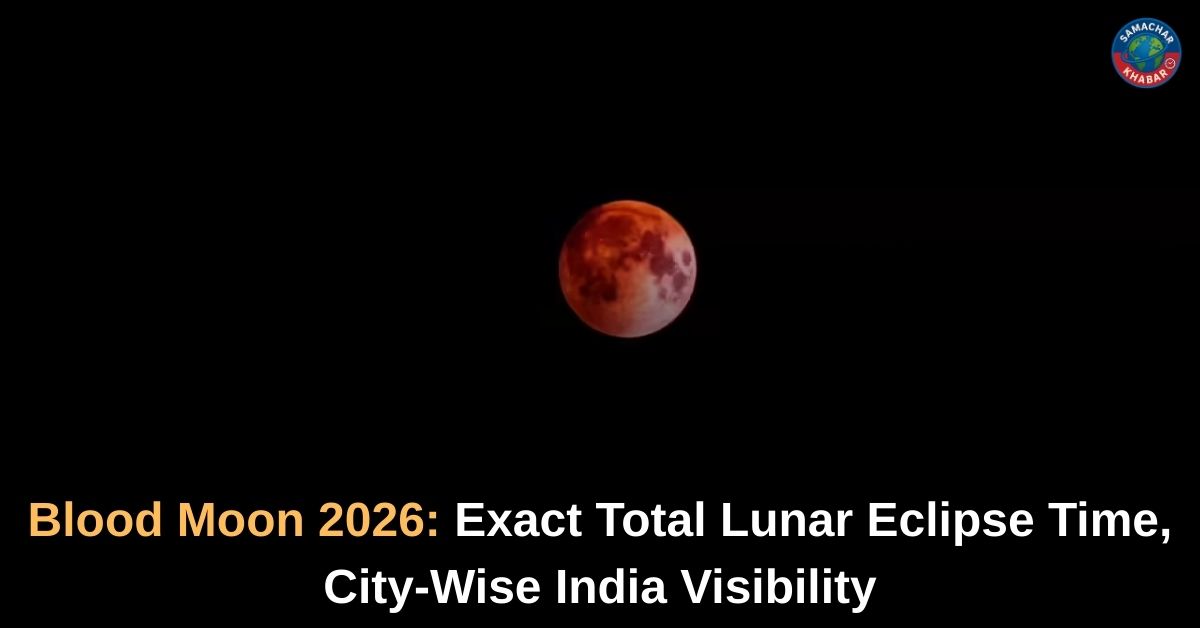
A rare Blood Moon 2026 will illuminate the sky on March 3, 2026, as a total lunar eclipse unfolds across several continents. This will be the last total lunar eclipse visible anywhere on Earth until late 2028, making it one of the most anticipated celestial events of the decade. While viewers in North America, the Pacific region, Australia and eastern Asia will witness the full red glow, most parts of India will see only the final partial phase at moonrise — coinciding with the festival of Holi. Here is a complete guide covering exact timings, global visibility, U.S. viewing strategy, and city-wise details for India.
Key Highlights of the March 3, 2026 Blood Moon Total Lunar Eclipse
- Date: March 2–3, 2026
- Type: Total Lunar Eclipse
- Totality Duration: Approximately 58 minutes
- Entire Eclipse Duration: About 5 hours 39 minutes
- Over 40% of the world’s population can witness the total phase
- Last total lunar eclipse anywhere on Earth until New Year’s Eve 2028–2029
- Best visibility: North America, Pacific region, Australia, eastern Asia
- India: Mostly partial visibility at moonrise
- Safe to observe with naked eyes
Exact Total Lunar Eclipse Timeline (U.S. Time Zones)
The eclipse unfolds gradually over several hours.
| Phase | Eastern Time (EST) | Pacific Time (PST) |
| Penumbral begins | 3:44 a.m. | 12:44 a.m. |
| Partial begins | 4:50 a.m. | 1:50 a.m. |
| Totality begins | 6:04 a.m. | 3:04 a.m. |
| Peak | 6:33 a.m. | 3:33 a.m. |
| Totality ends | 7:03 a.m. | 4:03 a.m. |
| Partial ends | 8:17 a.m. | 5:17 a.m. |
| Penumbral ends | 9:23 a.m. | 6:23 a.m. |
Totality — when the Moon appears fully red — lasts about 58 minutes.
U.S. Viewing Guide: East Coast vs West Coast
Western U.S. and Hawaii — Full Experience
Western states and Hawaii will see the entire sequence, including totality high in a dark sky. This region offers the best viewing conditions.
Central U.S. — Strong Visibility
Cities such as Denver and Chicago will see the full red phase clearly before sunrise.
Eastern U.S. — Limited Window
New York, Boston and Miami will see totality very low in the western sky. For many East Coast viewers, the red phase will be visible for only 20 to 30 minutes before moonset. A clear western horizon is essential.
Weather may also influence visibility. Historically, the U.S. Southwest and northwest Mexico offer some of the best odds for clear pre-dawn skies, while East Coast conditions can be more variable.
Global Visibility: Where the Blood Moon Will Be Seen
Full Total Eclipse Visible In:
- North America
- Central America
- Western South America
- Pacific region
- Australia
- Eastern Asia
- New Zealand
Partial Eclipse Visible In:
- Central Asia
- Much of South America
- Most of India
Not Visible In:
- Europe
- Africa
According to NASA, between four and seven eclipses occur each year. The March 3 lunar eclipse comes two weeks after the February 17 annular solar eclipse, often called a “ring of fire,” marking an active eclipse season.
Why the Moon Turns Red During a Blood Moon
During a total lunar eclipse, Earth moves between the Sun and the full Moon, casting its central shadow — the umbra — across the lunar surface. Instead of going completely dark, the Moon turns coppery red.
This happens because Earth’s atmosphere bends and filters sunlight. Blue light scatters, while red and orange wavelengths are redirected into the shadow. The result is a reddish glow, often described as the projection of all the world’s sunrises and sunsets onto the Moon.
Unlike solar eclipses, lunar eclipses are completely safe to watch without special equipment.
India Visibility: Partial Chandra Grahan on March 3, 2026
Although the total eclipse occurs globally in the afternoon and early evening (IST), most parts of India will see only the final partial phase because the Moon rises while the eclipse is already underway.
Eclipse Timeline in IST
- Penumbral phase reference: Around 2:16 PM IST
- Eclipse begins (broader phase reference): Around 3:20 PM IST
- Totality (global phase): Approximately 4:35 PM – 5:33 PM IST
- Maximum eclipse: Around 6:33 PM – 6:40 PM IST
- Eclipse ends: Around 6:47 PM IST
- Final penumbral phase ends: Around 8:52 PM IST
Since moonrise occurs in the evening across India, visibility depends on city-specific moonrise times.
Also Read: December 2025 Full Cold Supermoon in Gemini Set to Trigger Major Shifts for Mutable Zodiac Signs
City-Wise India Visibility Guide
Better Viewing Locations
- Kolkata (moonrise around 5:59 PM IST)
- North-East India including Assam, Arunachal Pradesh, Meghalaya, Nagaland, Manipur, Mizoram and Tripura
- Chennai (approximately 30 minutes of eclipse visibility after moonrise)
Limited Visibility
- Delhi (around 6:29 PM IST)
- Bengaluru (around 6:22 PM IST)
- Patna (around 6:11 PM IST)
- Mumbai (around 6:41 PM IST)
- Nagpur and Pune (brief partial view)
In many regions, viewers will see the Moon rising while Earth’s shadow is already receding.
Phases of the Total Lunar Eclipse
- Penumbral Eclipse – Subtle dimming begins as the Moon enters Earth’s outer shadow.
- Partial Eclipse – A dark “bite” appears as the Moon moves into the umbra.
- Totality – The entire Moon turns reddish-orange.
- Partial Exit – The red fades as the Moon exits the umbra.
- Penumbral Exit – The eclipse gradually concludes.
Observers may also notice that constellations appear more visible during totality because the Moon’s brightness is reduced. During this eclipse, the Moon will be positioned in the constellation Leo.
Cultural and Historical Perspective
Historically, lunar eclipses were viewed as omens. In Shakespeare’s works, eclipses symbolized disorder and dramatic turning points. Today, astronomy explains the phenomenon with precision, yet the sight of a red Moon still carries emotional impact.
In India, the eclipse coincides with Holi, adding cultural significance to the event. Traditional practices during Chandra Grahan include prayer, meditation, avoiding food during the eclipse period, and ritual bathing afterward.
The Spiritual Perspective: the Unique Knowledge of Saint Rampal Ji
While astronomy explains a lunar eclipse as a precise alignment of the Sun, Earth and Moon, the deeper spiritual meaning of such events is often discussed in the teachings of Saint Rampal Ji Maharaj. According to His spiritual knowledge, celestial events like Chandra Grahan are part of the natural cosmic system governed by Supreme God’s established laws, not signs of fear or superstition.
Saint Rampal Ji Maharaj explains that eclipses should not create panic but should inspire self-reflection and remembrance of God. Instead of focusing solely on ritual practices, He emphasizes true devotion based on authentic scriptures, chanting of the correct Satnaam, and living a righteous life. Temporary darkness in the sky symbolizes the transient nature of worldly disturbances, while spiritual knowledge brings permanent inner light.
Through His teachings, devotees are encouraged to use such moments for meditation, recitation of God’s true name, and strengthening their connection with Supreme God Kabir Sahib. The message remains clear: celestial events come and go, but only true spiritual knowledge leads the soul beyond the cycle of birth and death.
A Rare Celestial Event Before 2028
The March 3, 2026 Blood Moon is more than a striking astronomical display. It is the last total lunar eclipse visible anywhere on Earth until late 2028, and the next one visible from the United States will not occur until 2029.
With over 40% of the global population able to witness at least part of totality, this eclipse offers a rare opportunity to observe the precise alignment of the Sun, Earth and Moon. Whether seen high in a dark western sky or briefly at moonrise in India, the event underscores the predictable yet awe-inspiring rhythm of celestial mechanics.
FAQs on Blood Moon 2026 Total Lunar Eclipse
1. What time is the Blood Moon total lunar eclipse on March 3, 2026?
Totality occurs from 6:04 a.m. to 7:03 a.m. EST (3:04–4:03 a.m. PST) on March 3, 2026, lasting about 58 minutes.
2. Will the Blood Moon 2026 be visible in India?
Most parts of India will see only the final partial phase at moonrise on March 3, 2026, not the full total lunar eclipse.
3. Why does the Moon turn red during a total lunar eclipse?
The Moon appears red because Earth’s atmosphere filters blue light and bends red and orange wavelengths into the shadow during totality.
4. Where will the March 3, 2026 total lunar eclipse be fully visible?
The total lunar eclipse will be fully visible in North America, the Pacific region, Australia, eastern Asia and New Zealand.
5. When is the next total lunar eclipse after 2026?
The next total lunar eclipse visible anywhere on Earth will occur on New Year’s Eve 2028–2029, with the next U.S.-visible total eclipse in June 2029.