Jurisprudence in India underwent major changes in the wake of the Emergency (1975-77). Public Interest Litigation (PIL) made its appearance in the Supreme Court around this time, promoted by justices PN Bhagwati and VR Krishna Iyer, and became an instrument in the hands of socially conscious lawyers to advocate policy interventions that had either been ignored or escaped the attention of the executive. Since the late 1970s, the Supreme Court has adopted an expansive vision of public interest and has mostly responded favourably to activists compelled to seek an ally in the judiciary to direct the legislature and the executive to act in matters of liberties and rights, which now includes the right to a clean environment.
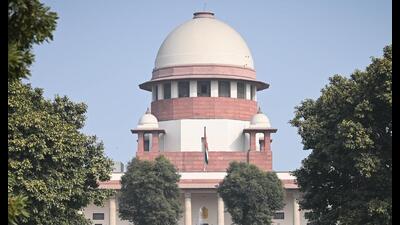
Forty years after Mehta first raised his voice for environmental justice, the Supreme Court on Thursday disposed of his PIL that led to continuous judicial oversight on pollution control in Delhi. (Sanchit Khanna/HT Photo)
It is against this backdrop that MC Mehta, in 1985, filed his landmark PIL that, in the course of time and continuous mandamus, transformed environmental jurisprudence in the country and introduced policy guardrails to staunch the assault on the Capital’s air. Mehta’s other PILs led to interventions that saved the Taj Mahal (toxic emissions from industries were causing a discolouring of the marble edifice) and attempted to clean up the Ganga. The right to clean air and water has since become embedded in the right to life, forcing the political class (under the court’s watch) to take action to safeguard urban environments and protect natural resources. Landmark cases such as Vellore Citizens Welfare Forum (1996) against pollution from tanneries in Vellore, Tamil Nadu, which saw the Court invoke the polluter pays principle, and the TN Godavarman Thirumulpad (1995) on protection of forests, have deepened the notion that industrialisation and development can’t ignore the impact on the environment and citizens’ well-being. The idea of public good has to embrace ecological equity and justice.
Forty years after Mehta first raised his voice for environmental justice, the Supreme Court on Thursday disposed of his PIL that led to continuous judicial oversight on pollution control in Delhi — from the conversion of the city’s bus fleet to CNG to restrictions on firecrackers and the phasing out of older commercial vehicles. However, the battle has to continue. Mehta’s singular crusade is a great study in the possibilities of civic activism. That it didn’t manage a complete turnaround of Delhi also points to the limitations of volunteerism and judicial activism. Ironically, judicial vigilance has not always been backed or followed up by public action, which may be necessary to demand accountability from the executive. Air pollution continues to be a debilitating threat to life in the National Capital, and despite the Court’s best efforts, progress has been incremental. The same could be said of the pollution in the Yamuna. Thankfully, pollution has now become an important part of public conversation, civic action (including protests), and political mobilisation, even making it to election manifestos and campaigns. The challenge is to translate these into effective policies and implement them in a time-bound manner with provisions to enforce accountability.
Mehta’s PIL led to the constitution of the Environment Pollution (Prevention and Control) Authority (EPCA) in 1998, which submitted regular reports to the Supreme Court regarding Delhi’s environment and pollution. The Commission for Air Quality Management (CAQM) replaced EPCA in 2020, but the Court has continued to do its job as a watchdog. The efforts of pioneers like Mehta should not be wasted on account of populist demands (such as relaxing the norms on the use of firecrackers) or misplaced notions of development (the Aravallis case); stricter norms and greater vigilance over compliance are the need of the hour.
Samachar Khabar - Stay updated on Automobile, Jobs, Education, Health, Politics, and Tech, Sports, Business, World News with the Latest News and Trends