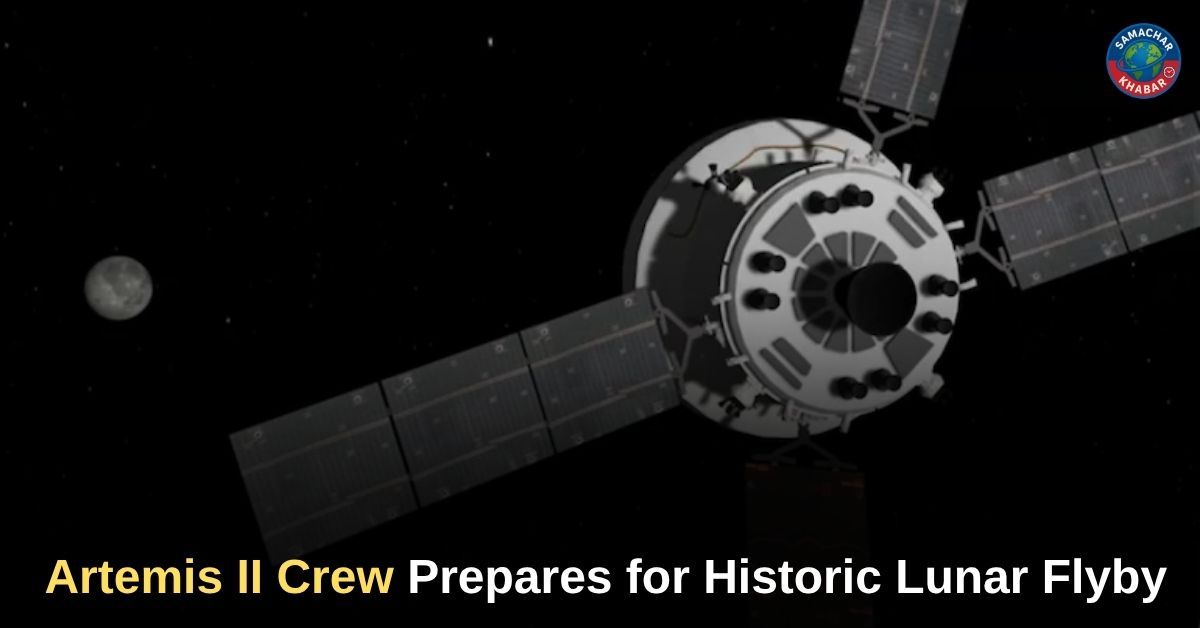
The Artemis II mission has entered a decisive phase as its crew prepares for a historic lunar flyby scheduled for April 6. Aboard the Orion spacecraft, astronauts are conducting spacesuit tests, reviewing science targets, and making final trajectory adjustments. The mission has already reached a key milestone by entering the Moon’s gravitational sphere of influence, marking the first such event for humans since 1972 and setting the stage for record-breaking achievements in deep space exploration.
Key Takeaways: Artemis II Flight Day 5
- Orion entered the lunar sphere of influence at 12:41 a.m. EDT on April 6
- Crew is testing Orion Crew Survival System spacesuits
- Final science targets include Orientale and Hertzsprung basins
- A trajectory correction burn is scheduled for 11:03 p.m. EDT
- Artemis II is expected to surpass Apollo 13’s distance record
- Closest approach to the Moon will be 4,070 miles
- A 40-minute communication blackout is expected behind the Moon
- Observations include a solar eclipse and Earthrise/Earthset events
Mission Status: Entering the Lunar Sphere of Influence
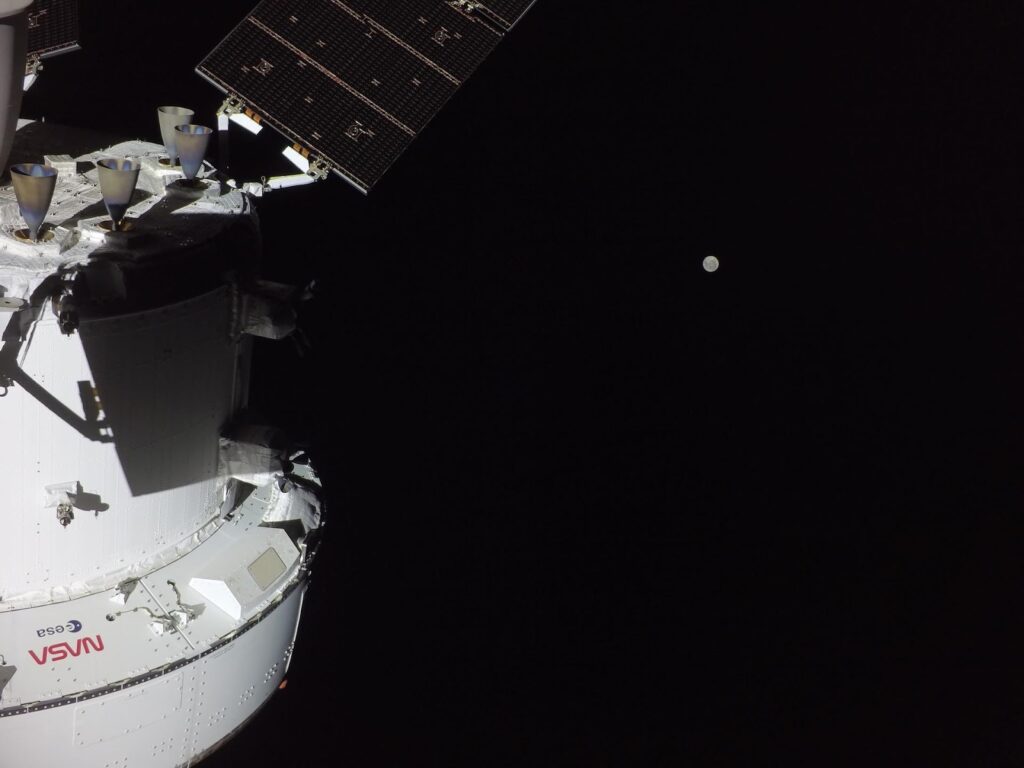
The Orion spacecraft entered the lunar sphere of influence at approximately 12:41 a.m. EDT on April 6, at a distance of 41,072 miles from the Moon. This marks a significant milestone, as it is the first time astronauts have entered this region since the Apollo 17 mission in 1972.
The lunar sphere of influence is not a physical boundary but a mathematical region where the Moon’s gravitational pull becomes stronger than Earth’s. According to NASA flight director Rick Henfling, crossing this threshold represents a major achievement in the mission.
Spacesuit Testing and Crew Safety Evaluations
Crew members are actively testing the Orion Crew Survival System spacesuits. These suits are designed to protect astronauts during dynamic phases of flight and provide life support in emergency situations.
Testing Activities Include:
- Leak checks to ensure airtight integrity
- Simulated seat entry procedures
- Mobility assessments
- Evaluating the ability to eat and drink while suited
These suits are critical for:
- Launch and re-entry phases
- Cabin depressurization scenarios
- Survival operations after splashdown
The suits can provide astronauts with a breathable environment for up to six days if the spacecraft loses pressurization.
Trajectory Correction Burn and Navigation Precision

A key maneuver, known as the outbound trajectory correction (OTC) burn, is scheduled for 11:03 p.m. EDT. This burn will refine Orion’s path toward the Moon.
Interestingly, earlier planned trajectory correction burns were cancelled because Orion remained on a precise path. A 14-second engine burn was executed later to maintain the correct trajectory.
Mission specialists Christina Koch and Jeremy Hansen are reviewing procedures for the burn, with Hansen monitoring spacecraft configuration and navigation data.
Final Science Targets for Lunar Observation
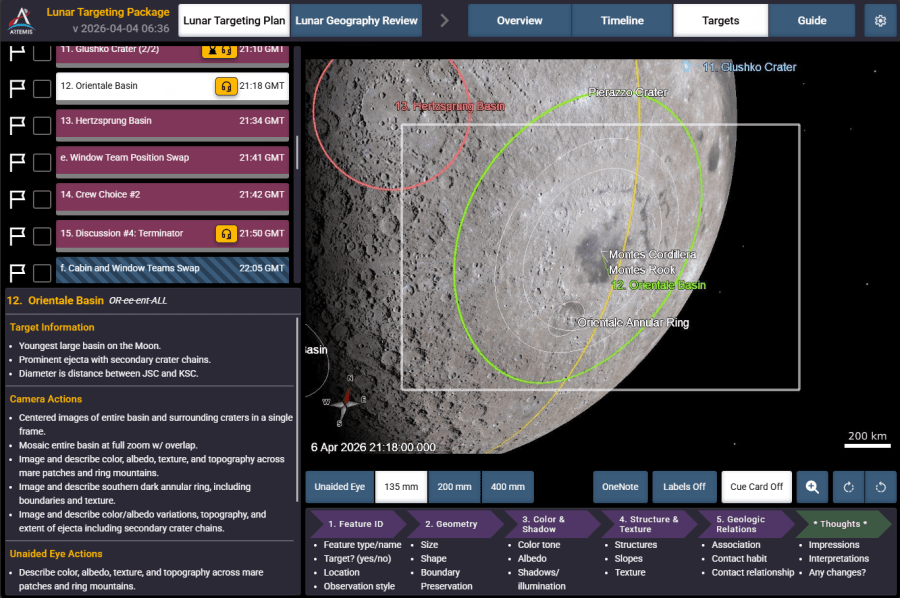
Mission control has provided the crew with a final list of 30 lunar surface targets for observation and photography during the flyby.
Key Targets:
| Target Name | Description |
| Orientale Basin | Nearly 600 miles wide, 3.8 billion years old, with well-preserved ring structures from a major impact |
| Hertzsprung Basin | Nearly 400 miles wide, older and more degraded, located on the Moon’s far side |
The crew will compare these basins to study how lunar features evolve over geological timescales. Orientale’s clear structure contrasts with the more eroded Hertzsprung basin, offering insights into impact history and surface changes.
Detailed Timeline of the Lunar Flyby
Monday, April 6
- 12:41 a.m. – Orion enters lunar sphere of influence
- 1:30 p.m. – Science briefing by mission control
- 1:56 p.m. – Expected to surpass Apollo 13 distance record
- 2:45 p.m. – Lunar observations begin
- 6:44 p.m. – Communication blackout begins
- 6:45 p.m. – Earthset observed
- 7:02 p.m. – Closest approach (4,070 miles above Moon)
- 7:07 p.m. – Maximum distance from Earth reached
- 7:25 p.m. – Earthrise and communication restored
- 8:35–9:32 p.m. – Solar eclipse observed
- 9:20 p.m. – Lunar observations conclude
Tuesday, April 7
- 1:25 p.m. – Orion exits lunar sphere of influence
Record-Breaking Distance from Earth
During the flyby, Orion is expected to reach a maximum distance of 252,760 miles from Earth. This will surpass the record set by Apollo 13 in 1970, which reached 248,655 miles.
At approximately 1:56 p.m. EDT on April 6, the Artemis II crew is expected to officially break this record, marking the farthest distance humans have ever traveled from Earth.
Communication Blackout Behind the Moon
As Orion passes behind the Moon, a planned communication blackout of about 40 minutes will occur. The Moon will block radio signals between the spacecraft and NASA’s Deep Space Network.
Such blackouts are expected and have occurred during previous missions, including Artemis I and Apollo missions. Communication will be restored once Orion reemerges from behind the Moon.
Scientific Observations and Unique Opportunities
The crew will conduct approximately seven hours of lunar observations, capturing images using Nikon D5 and Nikon Z9 cameras.
Observations Include:
- Previously unseen areas of the Moon
- Comparative analysis of lunar basins
- Solar eclipse from space
- Possible visibility of Mercury, Venus, Mars, and Saturn
- Observing the Sun’s corona during eclipse conditions
NASA lunar science lead Kelsey Young described the schedule as “jam-packed,” while also allowing flexibility for astronauts to make real-time observational decisions.
A Milestone Moment for Human Space Exploration
The Artemis II mission represents a significant step in returning humans to deep space exploration. From entering the lunar sphere of influence to preparing for record-breaking distances, the crew’s activities on Flight Day 5 highlight both scientific ambition and operational precision.
As the mission progresses through its lunar flyby, it not only advances scientific understanding but also re-establishes human presence in regions of space not visited for more than half a century.
Spiritual Reflection on Human Exploration
The Artemis II mission reflects humanity’s continuous effort to explore beyond known boundaries, guided by curiosity, discipline, and collective purpose. As astronauts travel farther from Earth than ever before, such journeys also invite reflection on the deeper questions of existence, purpose, and the vastness of creation.
In this context, the teachings of Tatvdarshi Saint Rampal Ji Maharaj emphasise understanding the ultimate truth of the universe through true spiritual Knowledge. According to Him, while scientific exploration reveals the physical dimensions of creation, spiritual understanding helps individuals comprehend the deeper purpose of life and existence.
This perspective does not diminish scientific achievement but complements it, suggesting that exploration, whether external or internal, remains an essential part of human progress. As missions like Artemis II expand the horizons of space exploration, they also subtly remind humanity of the importance of seeking both material and spiritual understanding in a balanced and thoughtful manner.
For more information visit our:
- Website: www.jagatgururampalji.org
- YouTube: Sant Rampal Ji Maharaj
- Facebook: Spiritual Leader Saint Rampal Ji
- X (Twitter): @SaintRampalJiM
FAQs on Artemis II Flight Day 5
1. What is the lunar sphere of influence?
It is the region where the Moon’s gravity dominates over Earth’s, guiding spacecraft motion near the Moon.
2. Why are spacesuits being tested during the mission?
They ensure astronaut safety during emergencies, including depressurization and survival after splashdown.
3. What record will Artemis II break?
It will surpass Apollo 13’s record for the farthest distance traveled by humans from Earth.
4. Why does communication blackout occur?
The Moon blocks radio signals, preventing contact with Earth-based communication systems.
5. What are the main science targets?
The Orientale and Hertzsprung basins, studied to understand lunar surface evolution.