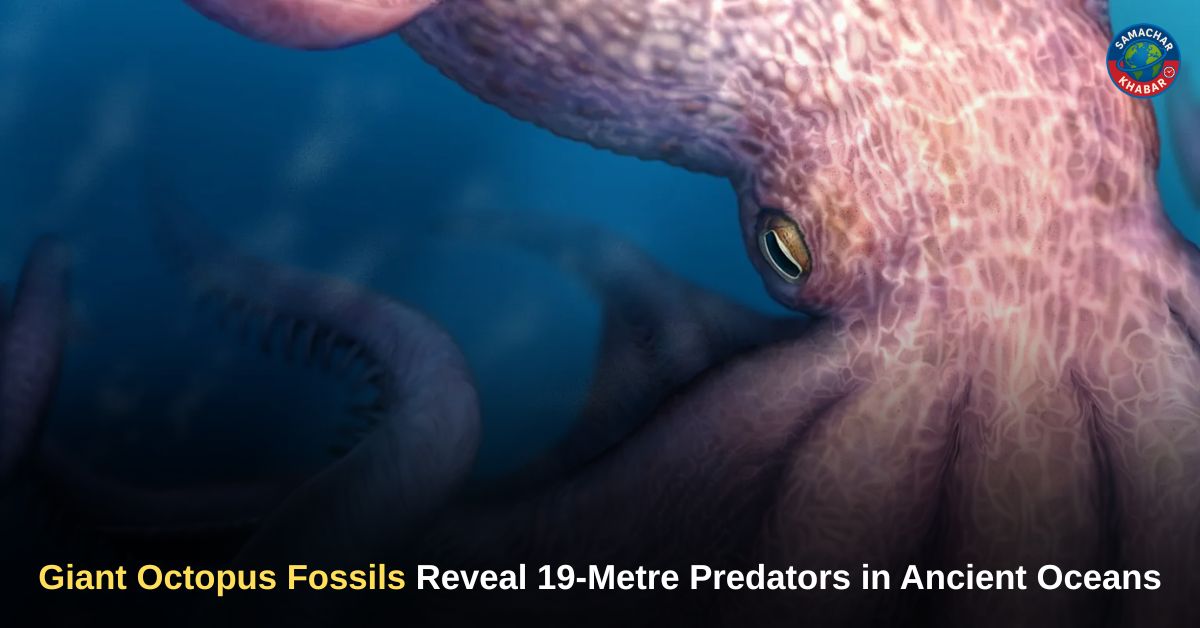
Giant Octopus Fossils: New fossil research suggests that giant octopus-like creatures existed in Earth’s oceans around 100 million years ago during the dinosaur period. Scientists studying exceptionally preserved fossil jaws have found that these animals may have reached lengths of up to 19 metres when their arms are included. The discovery challenges long-held beliefs about ancient marine ecosystems, indicating that these intelligent invertebrates may have rivalled top predators of their time, though many aspects of their biology remain unknown.
Key Takeaways: Giant Octopus Fossil Discovery
- Giant octopus-like creatures lived around 100 million years ago
- Estimated size ranged from 1.5 to 4.5 metres (body) and 7 to 19 metres (total length)
- Fossil jaws reveal bone- and shell-crushing ability
- Evidence suggests advanced intelligence and behavioural patterns
- Discovery challenges the idea that only vertebrates dominated ancient oceans
- Many details about appearance, swimming, and diet remain unknown
Giant Octopus Fossil Discovery: Rewriting Ocean Predator History
Evidence From Ancient Fossils
New research shows that octopus-like creatures existed in Earth’s oceans about 100 million years ago during the dinosaur period. Researchers studying ancient octopus fossils, which exist as some of the world’s oldest specimens, discovered that these animals reached much larger sizes than commonly believed.
According to a report by the BBC, scientists from Hokkaido University discovered exceptionally preserved fossil jaws that provide key insights into these creatures. These fossils have become the primary evidence due to the soft-bodied nature of octopuses, which rarely fossilise.
Also Read: The Story of Joan of Arc: From Peasant Girl to Saint
Size and Physical Capabilities
The research suggests that these ancient octopuses ranged in size from about 1.5 to 4.5 metres in body length. However, when their long arms are included, their total length could have reached between 7 and an impressive 19 metres.
Even at the lower end of this range, the animals would have been enormous compared to modern species.
Estimated Size Overview
| Feature | Measurement Range |
| Body Length | 1.5 – 4.5 metres |
| Total Length | 7 – 19 metres |
These findings suggest that they may have been among the largest invertebrates to have existed, sharing ancient seas with vertebrate species such as fish and marine reptiles.
Predatory Behaviour and Hunting Mechanisms
The fossils reveal that these creatures were not passive organisms but active predators. Their strong muscular arms were used to capture prey, while their beak-like jaws had the ability to break through shells and even bone material.
Scientists believe they could chew on the hard shells and skeletons of large fish and marine reptiles, indicating a powerful feeding mechanism.
The research also suggests that these animals glided through the oceans while hunting, using their physical strength and specialised jaws to dominate their environment.
Signs of Intelligence in Ancient Octopuses
One of the most striking findings is related to behavioural patterns. The fossilised jaws show uneven wear from left to right, suggesting that the animals may have favoured one side while feeding.
In living animals, this type of side preference is associated with advanced brain function.
Modern octopuses are known for their intelligence, learning ability, and complex hunting techniques. The findings indicate that similar cognitive traits may have been present in these ancient species as well.
Comparison With Modern Species
The Giant Pacific Octopus stands as the heaviest existing octopus species today and is known to reach massive dimensions.
Also Read: 99-Million-Year-Old Zombie Fungus Discovered in Amber
Scientists have documented this species using its powerful arms and suction cups to capture large animals such as sharks more than a metre long. This comparison highlights the potential capabilities of their ancient counterparts, which were significantly larger.
Challenging Long-Held Scientific Beliefs
For decades, palaeontologists believed that the largest ocean predators were vertebrates with backbones, such as fish and marine reptiles. Invertebrates like octopuses and squid were considered to play supporting roles in marine ecosystems.
However, this new research challenges that view. The findings suggest that giant octopus-like creatures may have rivalled top marine predators of their time, reshaping scientific understanding of prehistoric ocean life.
What Scientists Still Do Not Know
Despite these discoveries, many questions remain unanswered.
Scientists still do not know:
- The complete appearance of these creatures
- Their exact swimming techniques
- The structure of their fins
- Their precise eating habits
No fossils have yet been discovered containing stomach contents, which could provide direct evidence of their diet.
Researchers believe these animals likely hunted ammonites extensively, but they may have consumed a variety of available prey, similar to modern octopuses that are opportunistic feeders.
Ongoing Research and Future Discoveries
The increasing discovery of rare fossil evidence is providing scientists with new opportunities to study these ancient creatures. Each finding adds more detail to a previously unknown chapter of marine history.
Researchers emphasise that further discoveries are needed to fully understand the biology, behaviour, and ecological role of these giant octopus-like predators.
A New Perspective on Prehistoric Marine Life
The fossil evidence offers a glimpse into a complex and competitive ancient ocean ecosystem where both vertebrate and invertebrate species coexisted as powerful predators. These findings highlight that intelligence, adaptability, and physical strength were not limited to backbone-bearing animals. As research continues, scientists are gradually uncovering the role of these giant octopus-like creatures, revealing a more diverse and dynamic picture of life in Earth’s prehistoric oceans.
Intelligence Beyond Form And Perception
The discovery of giant octopus-like creatures highlights that intelligence, adaptability, and behavioural complexity were present in unexpected forms of life, even among invertebrates. Such findings reflect a broader perspective that knowledge and capability are not limited by physical structure alone. In spiritual understanding, this aligns with the idea that deeper awareness exists across creation, often beyond human perception.
Tatvdarshi Sant Rampal Ji Maharaj emphasises that true Knowledge helps individuals understand the deeper realities of existence, encouraging a balanced and thoughtful view of life and nature. Such perspectives inspire a sense of humility and curiosity when observing the diversity and complexity of the natural world.
For more information visit our
Website: www.jagatgururampalji.org
YouTube: Sant Rampal Ji Maharaj
Facebook: Spiritual Leader Saint Rampal Ji
X (Twitter): @SaintRampalJiM
FAQs on Giant Octopus Fossil
1. When did giant octopus-like creatures exist?
They lived around 100 million years ago during the dinosaur period.
2. How large were these ancient octopuses?
Their body length ranged from 1.5–4.5 metres, with total length up to 19 metres.
3. What evidence supports their existence?
Exceptionally preserved fossil jaws discovered by scientists provide key evidence.
4. Were these creatures predators?
Yes, they used strong arms and beak-like jaws to capture and crush prey.
5. What remains unknown about them?
Their full appearance, swimming style, and exact diet are still unclear.