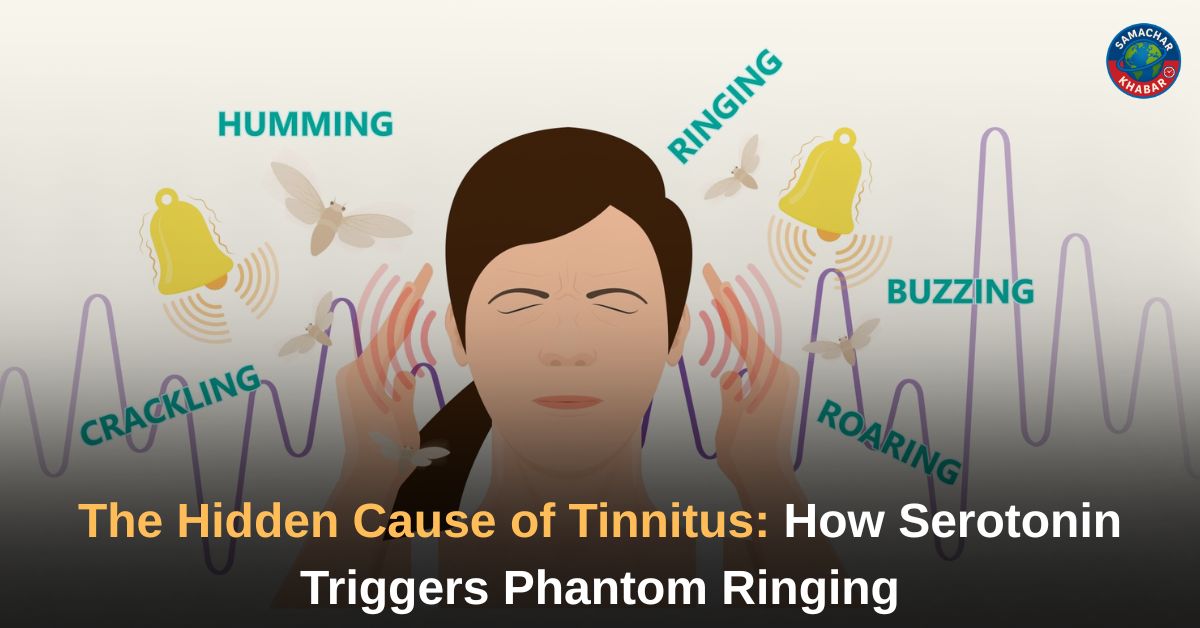
Imagine trying to fall asleep in a quiet room, but instead of silence, your mind is dominated by a relentless, high-pitched whine that simply refuses to stop. For millions of people worldwide suffering from tinnitus, this phantom noise is a waking nightmare. Up until now, medical science has struggled to offer a definitive cure, often treating it as a mechanical issue within the ear.
However, a groundbreaking study published this week is entirely changing how we view this neurological disorder. Research conducted jointly by scientists in the United States and China has discovered that the phantom ringing might not just be an ear problem, but a brain chemistry problem. Surprisingly, the culprit seems to be serotonin the exact neurotransmitter we usually associate with happiness and mood regulation. As the medical community digests this data heading into the final week of April, it is becoming clear that our current treatments for the anxiety caused by tinnitus might actually be making the condition worse.
Key Points at Glance
- The Serotonin Link: Researchers have discovered a direct pathway where increased serotonin signaling actually triggers tinnitus-like behaviors.
- Brain Over Ear: The study proves that in many cases, the phantom noise is generated purely in the brain’s auditory system, independent of physical ear damage.
- The Antidepressant Paradox: Standard treatments for the depression associated with tinnitus often involve SSRIs (which increase serotonin), potentially exacerbating the ringing.
- The Mouse Experiment: Using light and drugs to stimulate specific neurons in mice, scientists successfully induced and subsequently silenced tinnitus symptoms.
- Targeted Future Therapies: The breakthrough paves the way for new, region-specific drugs that can treat anxiety without flooding the auditory cortex with serotonin.
The Invisible Agony and the Brainstem
Tinnitus is notoriously difficult to treat because it is invisible. While some cases are linked to physical trauma like earwax blockages or loud noise exposure, a vast majority of patients have perfectly healthy eardrums. The noise—whether it manifests as a hiss, a buzz, or a throbbing pulse—is being manufactured entirely inside the head.
Neurologists have long suspected that serotonin played a role in the auditory system, but the exact mechanism was a mystery. To crack the code, a research team from Oregon Health & Science University and Anhui University mapped out a very specific neurological highway. They traced a path from the dorsal raphe nucleus, a region deep in the brainstem that acts as a major factory for serotonin, directly to the dorsal cochlear nucleus, which acts as the brain’s main switchboard for processing sound.
Proving the Phantom Noise
To test their theory, the scientists turned to genetically modified mice. Because you cannot simply ask a mouse if its ears are ringing, researchers rely on a clever behavioral test known as gap detection. Normally, a mouse can easily perceive a brief moment of silence hidden within a continuous background noise. However, if the mouse is experiencing a phantom ringing in its head, that internal noise “fills in” the silent gap, making the animal behave as if the silence never happened.
When the researchers artificially stimulated the serotonin-releasing neurons in the mice, the animals suddenly failed the gap detection test. Their auditory centers lit up with activity, confirming they were experiencing the classic symptoms of subjective tinnitus.
The most exciting part of the experiment came next. When the researchers completely shut off this specific serotonin-to-auditory circuit, the tinnitus-like behavior in the mice dropped significantly. Even when they exposed the mice to loud, damaging noises that typically cause permanent ringing, blocking this specific serotonin pathway provided immediate relief.
The SSRI Dilemma: Are We Making It Worse?
This discovery brings a massive, uncomfortable paradox to the forefront of audiology and psychiatry. Living with a constant, inescapable noise takes a devastating psychological toll. It is incredibly common for tinnitus patients to develop severe depression, crippling anxiety, and insomnia.
When these patients visit a psychiatrist, the standard protocol is to prescribe a Selective Serotonin Reuptake Inhibitor (SSRI) like Prozac or Zoloft. These drugs work by blocking the brain from reabsorbing serotonin, effectively leaving more of the “happy chemical” floating around to boost the patient’s mood.
But based on this new research, prescribing an SSRI to a tinnitus patient might be akin to throwing gasoline on a fire. By increasing the overall serotonin levels in the brain, these drugs might inadvertently hyper-stimulate the auditory circuit, turning the volume of the phantom ringing up even higher. It creates a cruel cycle where the medicine meant to heal the mind is torturing the ears.
The Road to a Quiet Mind
The medical implications of this study are profound. It proves that the human brain requires an incredibly delicate chemical balance. You cannot simply flood the entire nervous system with a neurotransmitter without unintended side effects.
Moving forward, the goal is not to stop prescribing antidepressants to those who desperately need them. Instead, pharmaceutical developers are now looking at creating highly localized, region-specific drugs. If scientists can design a medication that elevates serotonin in the mood-regulating sectors of the brain, while actively blocking it from entering the auditory processing centers, they could finally offer patients the best of both worlds.
For the millions of individuals desperate for a moment of true quiet, this breakthrough is the most promising beacon of hope in decades. It shifts tinnitus from being an unsolvable mystery of the ear to a treatable chemical imbalance of the brain.
FAQs About Brain’s ‘Happy Chemical’
1. What is the newly discovered link between serotonin and tinnitus?
Researchers have found a specific brain circuit connecting the serotonin-producing region to the auditory processing center. When serotonin signaling increases in this pathway, it directly induces the phantom ringing noises associated with tinnitus.
2. Can antidepressants make my tinnitus worse?
It is highly possible. Many common antidepressants are SSRIs, which work by increasing serotonin levels in the brain. The new study suggests that this excess serotonin can stimulate the auditory circuit, potentially making the phantom ringing louder.
3. Does this mean tinnitus is a brain issue rather than an ear issue?
Yes, in many cases. While earwax buildup or loud noise can cause physical damage, subjective tinnitus is often a neurological disorder where the brain’s auditory cortex generates sound even when there is absolute silence in the environment.
4. How did scientists prove this theory?
Researchers used genetically altered mice and behavioral gap-detection tests. By using light and specific drugs to stimulate serotonin neurons, they observed the mice behaving exactly as if they were experiencing internal ringing, which stopped when the circuit was deactivated.
5. Will there be a cure for tinnitus soon?
While a total cure is not available immediately, this breakthrough offers a clear path forward. Pharmaceutical companies can now focus on developing region-specific drugs that can selectively block serotonin in the auditory centers while maintaining its beneficial effects elsewhere.