[ad_1]
Who inherits the last morsels of grain and scarce onions, when farmers have dropped in the fields from the heat, and the crops have wilted beyond rescue anyway?

What survives when mercy is gone, and morals; when survival requires savagery, and even that barely gets the job done?
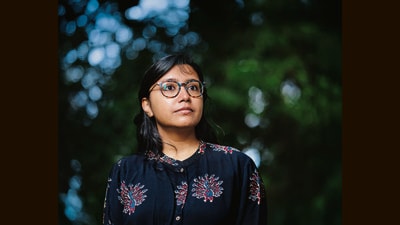
Megha Majumdar’s second novel, A Guardian and a Thief, has been longlisted for the 2026 Women’s Prize for Fiction. It is set in a future Kolkata where a woman is fighting to feed her two-year-old daughter and elderly father. She has been keeping them fairly healthy by stealing supplies from the charity she heads. Now, their climate visas have arrived and they can finally join her husband in the US, which remains a land of milk and honey, if a troubled one.
Majumdar, 38, crossed over from Kolkata to New York herself, as a student. There, she switched from anthropology to storytelling.
Her debut novel, A Burning (2020), won a Whiting Award and the Sahitya Akademi Yuva Puraskar. It follows three characters: an ambitious Muslim girl from Kolkata’s slums who finds herself facing charges under anti-terror laws over a comment shared on Facebook; a hijra who may be able to help her; and an ambitious right-wing politician.
A Burning was dark; A Guardian and a Thief is far darker.
There is little hope in this version of the world, and what little there is must be snatched from others, defended violently, and gobbled up while starving multitudes look on.
As the plot unfolds, Majumdar the anthropologist’s intricate research glimmers through. The details she weaves into her tale, to indicate how Kolkata got to this point, are inspired by a real-world report released in 2021 by the Intergovernmental Panel on Climate Change (IPCC), which predicts that Kolkata could be, on average, 4.5 degrees Celsius hotter (than pre-industrial 1850s levels) by the turn of the century, with sea levels rising by as much as 60 cm.
“It is incredibly sad to read such dire predictions about the future of your hometown,” Majumdar says. Excerpts from an interview.
* What was it like to navigate, in the IPCC report, the idea of this dystopic future for Kolkata?
I read the report and thought about the Kolkata I knew: the conductor on my bus from school with the banknotes in his fingers; the gaggle of kids outside school eating phuchka and ice-cream; my family and our kitchen with its stash of nimki; the feeling of coming home on a hot day and having fresh shorbot; the beautiful markets and restaurants and old movie theatres.
I wrote the book in part to locate the city’s resilience in its people. The networks of reliance we have are so strong. The jokes people make, their sense of humour in the face of challenges and crises, are an enormous strength. I wanted to explore all this: the love, humour, unbreakable bonds among city dwellers, in a time of crisis.
* Yet this is a dark, dark world you envision.
Well, fiction of the climate crisis is ultimately fiction of love, of family, of what matters to us and how we confront its loss. In Claire Vaye Watkins’s Gold Fame Citrus (2015), a drought-struck California is reimagined. In Charlotte McConaghy’s Migrations (2020), a researcher is bent on following the last of the Arctic terns. And in one of my favourite climate-fiction novels, Lydia Kiesling’s Mobility (2023), a young woman moves from Azerbaijan to Texas as she figures out whether to work in the oil and gas industry, and what this means for her sense of herself as an ethical person in the world.
* In the novel, Ma and Dadu struggle to be kind or moral in the face of adversity. How do you view morality in our world?
A fascinating question for me is: How do we live a moral life today? What does it mean to do the right thing, to make the right choice, to live in accordance with our ethics, while acknowledging the systems we live within? Is it possible to be a moral person?
If, as a parent, I am caught between love for my child — and therefore a need to protect my child, feed my child — and a sense of obligation to my neighbours and fellow city dwellers, what do I do? What happens to my sense of ethical self?
I have no answers… but fiction is where I go to ask these questions that matter to me.
* Food is a focal point in your novel, representing a deep kind of loss.
As waters warm and fish migrate, as pests proliferate and floods and droughts severely affect harvests, the matter of what foods will be available becomes frightening to consider. What will we do when we go to the market and, instead of our familiar vegetables, there is, perhaps, flour derived from crickets? How will the emotional texture of nutrition, and a meal, change?
* There is pain associated with migrating, in the novel; you refer to it as a wound. How do you view your position as a migrant?
It’s a complicated thing… You leave behind your family, your language, your hometown. And in return you gain some degree of freedom to be who you want to be.
New York has been an invigorating place to be a writer. I love how ambitious the people around me are. You go to a coffee shop or library and see people writing or drawing, engaged in their own journey. There is terrific theatre here, fantastic museums, writers travel through with their new books, musicians stop by on their tours. You have pride in the life you make, and yet you live always with the loss too.
The loss exists always in your distance from your family. It exists in your sense of the other person you might have been, had you continued to live at home.
I am one of many writers thinking through what it means to migrate. I am thinking of books by Dina Nayeri (of Iran), Jason De Leon (a Mexican-Filipino American), Shubha Sunder (of India)… a mix of fiction and nonfiction, all of it offering different pathways through this field of experience and reflection.
* You trained in anthropology but eventually turned to storytelling…
Anthropology is terrific training for a fiction writer. It’s a discipline that teaches you to be profoundly curious about the lives of others, to attend to complexity in their lives, to never settle for simplistic explanations.
While I was an anthropology student, I did a research project on how students and teachers were using computers that were newly installed in their schools in Dakar, Senegal. I spoke with students who felt excited about researching scholarships and higher education; I spoke with teachers who procured plastic covers to protect desktop computers from dust.
In combining my experiences, I realised I loved story more than theory, and that was one of the moments that led me to take writing fiction seriously.
* Like many Indians, you had a difficult relationship with English and yet you choose to write in it. Why?
In the beginning, I was afraid of English. In kindergarten, when I was learning English, I found it terrifying and unpleasant. Despite that fear, I tried and tried to read. A strange contradiction, it now seems to me, but I was drawn to the stories that lived in that language.
As I read in English, it became the language of my thought and imagination. Bengali remained the language of home and family, and English became the language of my inner life.
I do often feel that my Bengali nourishes my English. The capacity of Bengali to hold pathos, sentiment, as well as great humour… these qualities, I hope, arise in my English.
[ad_2]
Source link