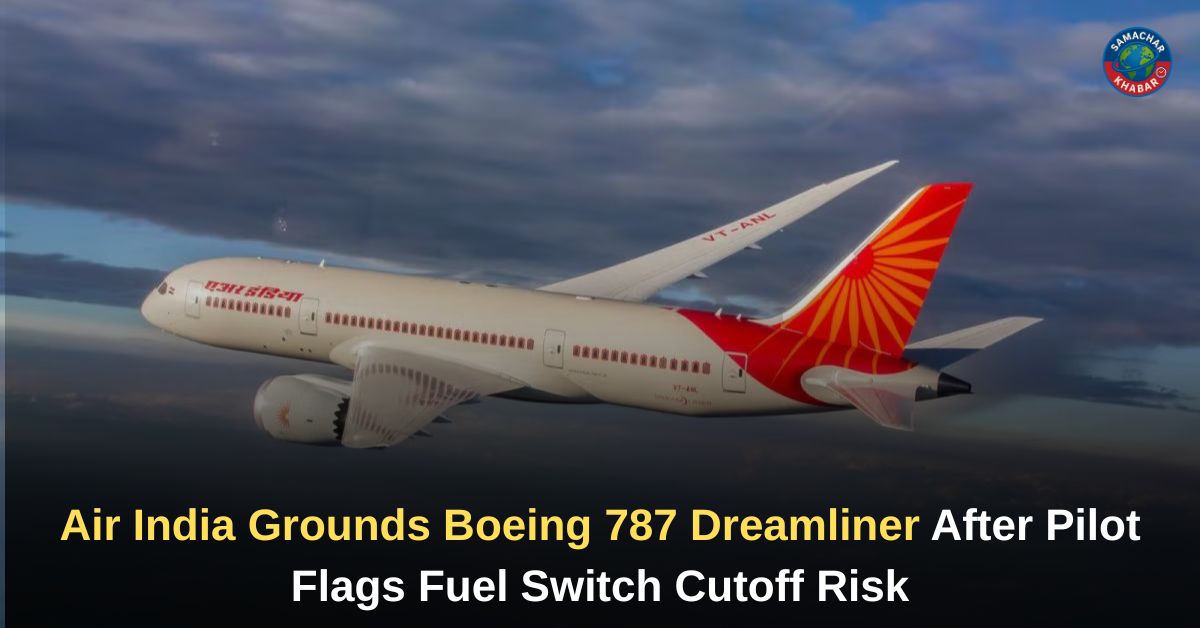
Air India has grounded a Boeing 787-8 Dreamliner after a pilot reported abnormal behaviour of the aircraft’s left engine fuel control switch, which repeatedly moved from ‘RUN’ to ‘CUTOFF’ during engine start-up. The aircraft, operating Flight AI132 from London Heathrow to Bengaluru, was withdrawn from service as a precaution.
The development has drawn heightened scrutiny because fuel control switches were central to the investigation into the deadly Ahmedabad Dreamliner crash of June 2025, which killed 260 people. While no direct link has been established, aviation safety bodies, pilots’ groups, and regulators are now under pressure to examine the issue with the highest level of scrutiny.
Key Highlights: Air India Boeing 787 Fuel Switch Issue at a Glance
- Air India grounds Boeing 787-8 Dreamliner after pilot flags fuel switch malfunction
- Left engine fuel control switch failed to remain locked in ‘RUN’ position
- Aircraft VT-ANX operating Flight AI132 (London–Bengaluru) withdrawn from service
- OEM Boeing engaged; DGCA informed of the incident
- Safety Matters Foundation demands highest level of scrutiny
- Federation of Indian Pilots says “history has repeated”
- Incident revives focus on Ahmedabad crash of Flight AI171 to London Gatwick
- Supreme Court petitions pending over Ahmedabad crash investigation
What the Pilot Reported on Flight AI132
The issue came to light after an Air India pilot reported unusual behaviour involving the left engine fuel control switch of a Boeing 787-8 Dreamliner. The aircraft, registered as VT-ANX and nine years old, had been operating a scheduled long-haul flight from London Heathrow to Bengaluru.
According to the aviation safety advocacy group Safety Matters Foundation, the abnormal behaviour was observed during engine start-up procedures. On two attempts, the left engine fuel control switch failed to remain locked in the ‘RUN’ position and instead moved toward ‘CUTOFF’. Sources said the pilot noted that the switch slipped from ‘RUN’ to ‘CUTOFF’ if pushed down slightly and was not locking properly in its position.
Try this Tool for Free: Free Flight Time & Distance Calculator: Check Route Durations Instantly
Although questions were raised publicly about why the flight proceeded if the issue was observed during engine start, Air India clarified that the malfunction was reported to the airline after the aircraft had landed safely in Bengaluru. More than 200 passengers were on board the flight.
Air India, Boeing, and DGCA Respond
Following the pilot’s report, Air India withdrew the aircraft from service as a precautionary measure. The airline said the matter had been communicated to the aviation regulator, the Directorate General of Civil Aviation (DGCA), and that it was engaging the original equipment manufacturer on a priority basis.
An Air India spokesperson stated that the airline had previously checked fuel control switches across its entire Boeing 787 fleet after a DGCA directive and had found no issues during those inspections. Passenger and crew safety, the airline reiterated, remains its top priority.
Aircraft manufacturer Boeing confirmed it is in contact with Air India and is supporting the review of the matter. The fuel control switches installed on the aircraft are manufactured by Honeywell.
How Fuel Control Switches Work on Boeing 787 Aircraft
Fuel control switches regulate the flow of fuel into an aircraft’s engines and are used by pilots to start or shut down engines on the ground, or to manually shut down or restart an engine during flight if required.
On Boeing 787 aircraft, the switches are located below the thrust levers on the cockpit’s central console. Each engine has its own dedicated switch, independent wiring, and power supply. The switches are spring-loaded and designed to remain firmly in position. To move a switch between ‘RUN’ and ‘CUTOFF’, a pilot must first pull the switch upward before repositioning it.
Aviation experts have said that accidental movement is not expected due to this guarded design. However, if a switch transitions to ‘CUTOFF’, the effect is immediate, cutting off fuel supply and rapidly reducing engine power.
Why the Ahmedabad Crash Has Returned to the Spotlight
The incident has revived intense scrutiny because fuel control switches were central to the investigation into the crash of Air India Flight AI171, a Boeing 787-8 Dreamliner bound for London Gatwick, which crashed shortly after take-off from Ahmedabad on June 12, 2025.
In July 2025, the Aircraft Accident Investigation Bureau (AAIB) released a preliminary report stating that seconds after take-off, the fuel control switch for one engine transitioned from ‘RUN’ to ‘CUTOFF’. One second later, the switch for the second engine followed. With both engines suddenly deprived of fuel, the aircraft experienced an immediate loss of thrust during the critical climb phase.
Cockpit voice recordings revealed confusion in the flight deck. One pilot was heard asking the other why the fuel had been cut off, to which the response was that he had not done so. Moments later, the switches were returned to the ‘RUN’ position, and investigators later found both switches set to ‘RUN’ at the crash site.
What Investigators Have Ruled Out
The AAIB’s preliminary findings stated that investigators found no evidence of sabotage, bird strikes, or fuel contamination. The report also explained that when fuel control switches are moved from ‘CUTOFF’ back to ‘RUN’ during flight, the engine control system automatically initiates a relight and thrust recovery sequence.
Despite these automated processes, the engines did not recover sufficient thrust to prevent the crash. The investigation remains ongoing, with the final report expected in the coming months.
Regulatory Action, FAA Advisories, and Past Warnings
After the Ahmedabad tragedy, the DGCA ordered inspections of fuel control switches across nearly all Boeing aircraft operating in India. Air India said it completed inspections on its Boeing 787 and Boeing 737 fleets and reported no defects.
In 2018, the Federal Aviation Administration (FAA) issued an advisory bulletin highlighting the potential disengagement of locking mechanisms on certain fuel control switches installed on Boeing aircraft, including the 787. As the bulletin was advisory and not mandatory, several airlines, including Air India, did not carry out inspections at the time.
According to reports cited in the provided sources, the FAA and Boeing had also issued private notifications stating that fuel switch locking mechanisms on Boeing aircraft were considered safe.
Pilots’ Body and Safety Groups Raise Fresh Concerns
The Federation of Indian Pilots said it has repeatedly called for checks of Dreamliner electrical systems following the Ahmedabad crash and described the latest incident as one where “history has repeated.” The pilots’ body suggested that the malfunction may have occurred at Heathrow itself and reiterated its demand that all Boeing 787 aircraft be grounded and checked for electrical systems.
Safety Matters Foundation urged the “highest level of scrutiny,” stating that while no connection is implied, the repeated emergence of issues involving a critical flight control system on the same aircraft type demands closer examination. The group has called for transparent disclosure of inspection findings and a reassessment of precautionary checks.
Supreme Court Petitions and Government Response
There are currently three petitions before the Supreme Court related to the Ahmedabad crash. These include one filed by Captain Amit Singh of Safety Matters Foundation, another by Pushkar Raj Sabharwal, the father of the pilot in command of the ill-fated AI171 flight, and a third petition filed by a student.
Responding in the Rajya Sabha, Minister of State for Civil Aviation Murlidhar Mohol said the AAIB probe is ongoing. He stated that all probable causes leading to the accident are being thoroughly investigated and that efforts are being made to complete the investigation in a time-bound manner. He also clarified that the AAIB’s preliminary report contains factual findings based on evidence available at the time and does not include interim safety recommendations.
Spiritual Perspective: Safety, Accountability, and the Teachings of Saint Rampal Ji Maharaj
Beyond technical investigations and regulatory scrutiny, incidents affecting human lives invite deeper reflection on responsibility and awareness. Saint Rampal Ji Maharaj Ji’s unique spiritual knowledge emphasises that human safety is inseparable from ethical conduct, discipline, and accountability in every sphere of action.
According to his teachings, when decisions are guided by integrity, truth, and concern for human life, risks born from negligence or complacency reduce significantly. In the context of aviation safety, this perspective highlights the moral duty of institutions and individuals to prioritise life above all else, remain vigilant, and act transparently—principles that align closely with the need for rigorous safety checks, honest reporting, and responsible governance in modern society.
Why This Grounding Has Intensified Aviation Safety Debate
The grounding of Air India’s Boeing 787-8 Dreamliner has once again placed fuel control switch integrity at the centre of aviation safety discussions. Although no official link has been established between the latest pilot report and the Ahmedabad crash, the recurrence of similar concerns has intensified demands for deeper scrutiny from regulators, safety bodies, and pilot associations.
With investigations ongoing, Supreme Court petitions pending, and regulators under pressure to ensure transparency, the episode highlights the critical importance of system reliability, inspection protocols, and regulatory oversight in maintaining confidence in long-haul aviation operations.
FAQs on Air India Boeing 787 Fuel Switch Cutoff Incident
Q1. Why did Air India ground its Boeing 787 Dreamliner?
Air India grounded the aircraft after a pilot reported the left engine fuel control switch repeatedly moving from RUN to CUTOFF during engine start-up.
Q2. Which flight was involved in the fuel switch issue?
The issue was reported on Air India Flight AI132 operating from London Heathrow to Bengaluru using a Boeing 787-8 Dreamliner.
Q3. What is a fuel control switch and why is it critical?
Fuel control switches regulate fuel flow to aircraft engines. Any unintended movement to CUTOFF can immediately reduce engine power or shut down the engine.
Q4. How is this incident linked to the Ahmedabad Dreamliner crash?
Fuel control switches were central to the Ahmedabad crash investigation, where both engines lost fuel seconds after take-off, leading to a fatal loss of thrust.
Q5. What action have regulators and manufacturers taken?
The aircraft has been grounded, DGCA informed, and Boeing engaged to examine the issue, while investigations into past and present incidents continue.