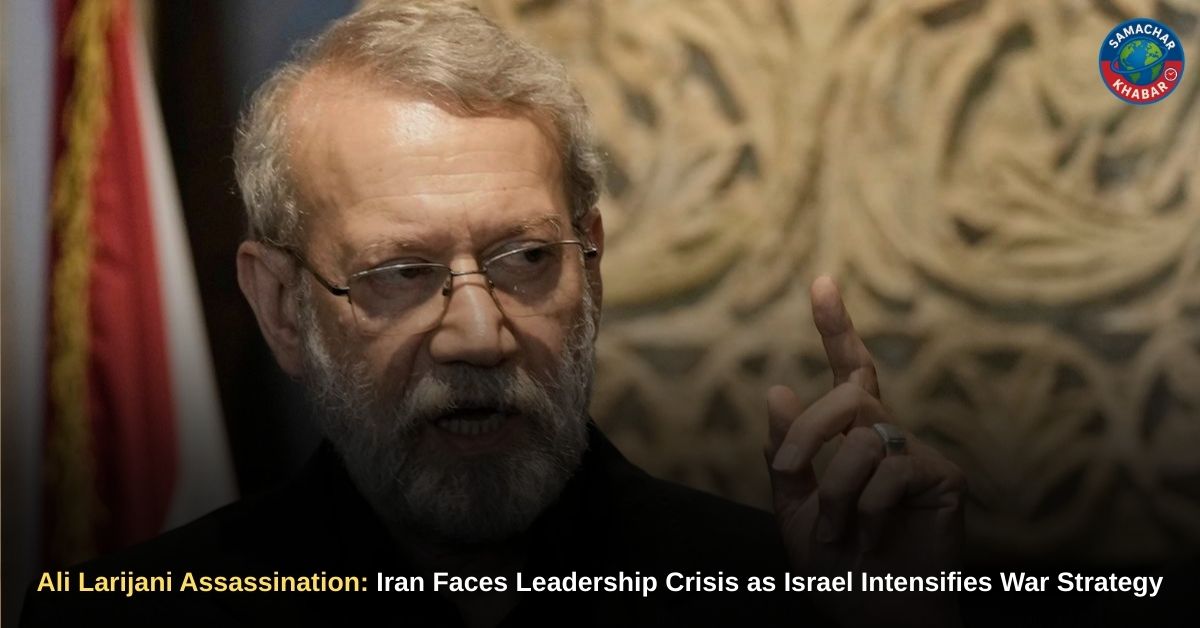
The assassination of Ali Larijani, Iran’s top security official, in an Israeli airstrike marks one of the most critical turning points in the ongoing Iran–Israel conflict. Killed at his daughter’s home in Pardis near Tehran alongside his son, deputy, and bodyguards, Larijani’s death comes just weeks after the killing of Supreme Leader Ayatollah Ali Khamenei. The back-to-back elimination of senior leadership figures has intensified the war, weakened Iran’s political structure, and raised serious concerns about regional stability, nuclear risks, and global energy security.
Key Developments in Ali Larijani Assassination and Iran–Israel War
- Ali Larijani was killed at his daughter’s residence in Pardis along with his son Morteza, deputy Alireza Bayat and bodyguards
- Israel described him as a “de facto leader” after Khamenei’s death
- Basij chief Gholam Reza Soleimani was also killed in the same wave of strikes
- Iran retaliated with missile and drone attacks across Israel and Gulf countries
- Strait of Hormuz tensions threaten global oil supply and shipping routes
- Leadership vacuum deepens as multiple senior Iranian officials are eliminated
How the Strike Happened: Targeting Iran’s Inner Circle
Iran confirmed that Ali Larijani was killed in an early morning airstrike when Israeli forces targeted his daughter’s home in Pardis, northeast of Tehran. The strike also killed his son Morteza Larijani, his deputy Alireza Bayat, and several bodyguards.
Israeli officials described Larijani as a central decision-maker and “de facto leader” of Iran following the death of Khamenei. His killing was part of a broader campaign aimed at dismantling Iran’s leadership structure during wartime.
A De Facto Leader at the Core of Iran’s System
Following the assassination of Ayatollah Ali Khamenei, Larijani emerged as one of the most powerful figures in Iran, widely seen as guiding the country’s wartime strategy.
As secretary of the Supreme National Security Council, he stood at the center of Iran’s strategic decision-making apparatus, coordinating military, political, and diplomatic actions.
He was widely recognized as a bridge between the military and political establishment, capable of aligning hardliners and moderates. His ability to manage competing factions made him indispensable to Iran’s leadership.
Opposition to Mojtaba Khamenei’s Succession
A critical aspect of Larijani’s political stance was his opposition to the elevation of Mojtaba Khamenei as Supreme Leader.
He believed hereditary succession conflicted with the principles of the Islamic Republic, placing him at the center of internal power debates during a period of war and instability.
His assassination removes a key voice in Iran’s leadership transition, further deepening uncertainty at the top.
Iran’s Retaliation: Missiles, Drones, and Escalation
Iran responded to Larijani’s killing with a barrage of missile strikes targeting central Israel, including Tel Aviv, resulting in civilian casualties.
Some attacks reportedly involved multiple-warhead or cluster-style munitions, increasing their destructive impact.
Iran also expanded its response regionally:
- Drone attacks targeted the US Embassy in Baghdad
- Missile interceptions were reported in the UAE
- Air defense systems were activated in Saudi Arabia and Qatar
These actions reflect Iran’s strategy of widening the conflict across multiple fronts.
Strait of Hormuz Crisis and Global Impact
| Factor | Impact |
| Strait control | Iran tightening grip |
| Oil flow | Nearly 20% global supply at risk |
| Ships affected | Multiple vessels struck |
| Global reaction | Rising oil prices and military deployments |
Iran’s control over the Strait of Hormuz has triggered global concern, as disruptions to oil supply threaten international markets and economic stability.
Leadership Decapitation: A System Under Strain
Larijani’s assassination is part of a broader pattern of targeted killings of Iran’s senior leadership.
Key figures killed include:
- Ayatollah Ali Khamenei
- Ali Larijani
- Gholam Reza Soleimani
- Ali Shamkhani
- Mohammad Pakpour
- Aziz Nasirzadeh
- Abdolrahim Mousavi
These losses have significantly weakened Iran’s leadership structure and reduced its pool of experienced decision-makers.
Shift Toward Military Dominance
With key political figures eliminated, Iran’s power structure is increasingly shifting toward military leadership.
Authorities have granted broader authority to armed forces, allowing quicker decisions but reducing coordination between political and diplomatic institutions.
This shift raises the risk of more aggressive and less controlled responses.
Mojtaba Khamenei’s Low Profile Leadership
After assuming leadership, Mojtaba Khamenei has remained largely out of public view.
Also Read: Iran wants a deal but ‘I won’t accept’: Trump’s fresh claim after Kharg Island attacked
Despite limited visibility, he has reportedly taken a firm stance against de-escalation, rejecting ceasefire proposals and emphasizing continued resistance.
This has added to uncertainty within Iran’s leadership during a critical phase of the conflict.
Diplomatic Setback: Loss of a Key Negotiator
Larijani played a crucial role in Iran’s international diplomacy. He:
- Led nuclear negotiations with Western powers
- Maintained ties with Russia and China
- Helped secure approval for the 2015 nuclear deal
His absence significantly weakens Iran’s ability to negotiate and reduces the chances of a diplomatic resolution.
Crackdown on Protests and Sanctions
Larijani was sanctioned by the United States for his alleged role in suppressing anti-government protests.
Reports indicate that 6,488 civilians were killed, with more than 11,000 cases under review, highlighting the scale of the crackdown.
These actions contributed to his controversial image internationally.
Personal Background and Intellectual Profile
Born in 1958 in Najaf, Iraq, into a prominent clerical family, Larijani had a strong academic background.
- Studied computer science and mathematics
- Trained in philosophy
- Authored works on Immanuel Kant
His intellectual profile contributed to his reputation as a sophisticated strategist.
Internal Political Conflicts and Career Journey
Larijani had notable tensions with former president Mahmoud Ahmadinejad, reflecting divisions within Iran’s leadership.
He stepped down from the Supreme National Security Council in 2007 and was later barred from running for president twice.
Despite setbacks, he remained a key insider and influential figure in Iranian politics.
US Reward and Final Public Appearance
In the days before his assassination, Larijani appeared at a large rally in Tehran.
Shortly afterward, the United States announced a $10 million reward for information on Iranian leaders, including him.
His killing soon after marked a dramatic escalation in targeted operations.
Nuclear Risks and Expanding Conflict
A strike near Iran’s Bushehr nuclear facility raised concerns about potential nuclear risks, prompting international warnings.
The conflict has expanded across Iran, Israel, and Lebanon, with rising casualties and widespread destruction, underscoring the growing danger of further escalation.
Spiritual Insight: Timeless Guidance from the Unique Knowledge of Saint Rampal Ji Maharaj Ji
Amid rising conflicts, power struggles, and uncertainty, the teachings of Saint Rampal Ji Maharaj Ji offer a deeper perspective on human life and governance. His spiritual knowledge explains that worldly power, authority, and dominance are temporary, and those who rely solely on material strength ultimately face downfall.
According to his teachings, true peace cannot be achieved through war, violence, or political control, but only through adherence to true spiritual knowledge and devotion to the Supreme God. He emphasizes that human beings must rise above ego, anger, and greed to establish lasting harmony.
In a world witnessing repeated cycles of conflict and destruction, this wisdom highlights the need for inner transformation and spiritual awakening as the only path toward real and permanent peace.
A War Redefining Iran’s Future and Regional Stability
Ali Larijani’s assassination represents a decisive moment in the Iran–Israel conflict. His death removes a central figure who connected Iran’s political authority, military strategy, and diplomatic engagement.
With leadership fragmented, military influence rising, and diplomatic channels weakened, Iran faces a period of deep uncertainty. At the same time, escalating attacks, global energy concerns, and nuclear risks indicate that the conflict is entering a more dangerous and unpredictable phase with far-reaching consequences.
FAQs on Ali Larijani Assassination and Iran–Israel War
1. Who was Ali Larijani and why was he important in Iran?
Ali Larijani was Iran’s top security official and a key decision-maker, acting as a bridge between political, military, and diplomatic institutions within the Islamic Republic.
2. How was Ali Larijani killed?
Ali Larijani was killed in an Israeli airstrike at his daughter’s home in Pardis near Tehran, along with his son, deputy Alireza Bayat, and several bodyguards.
3. Why is Ali Larijani’s assassination significant?
His death deepens Iran’s leadership crisis, removes a key strategist, and weakens coordination within the government during an already escalating conflict with Israel and the United States.
4. How did Iran respond to Ali Larijani’s killing?
Iran launched missile and drone attacks targeting Israel and Gulf countries, escalating regional tensions and signaling its commitment to continued retaliation despite leadership losses.
5. What impact does this have on the Iran–Israel war?
The assassination increases instability, reduces chances of diplomacy, strengthens military control in Iran, and raises global concerns over oil supply, regional security, and nuclear risks.