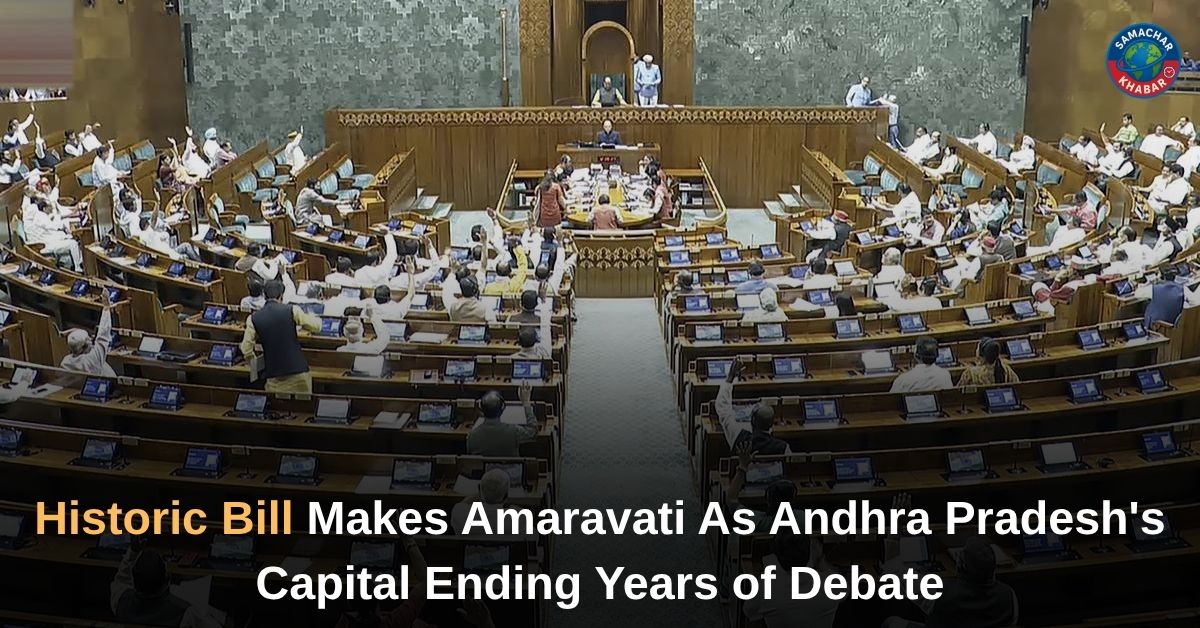
In a significant legislative development, the Amaravati capital bill was passed in the Lok Sabha, officially recognizing Amaravati as the sole and permanent capital of Andhra Pradesh. This move provides statutory clarity and ends years of political debate over the state’s capital structure.
The bill, passed via voice vote with support from both the NDA and Congress, ensures that no future government can alter the capital status of Amaravati, making it a legally binding decision effective June 2, 2024.
What the Amaravati Capital Bill Means
The Andhra Pradesh Reorganisation (Amendment) Bill amends Section 5 of the 2014 Act to formally include Amaravati as the capital.
Key Highlights
- Amaravati becomes the only capital of Andhra Pradesh
- Decision effective from June 2, 2024
- Prevents future changes to capital status
- Provides legal backing to state assembly resolution (March 28)
- This marks the first instance in independent India where Parliament has passed a law to declare a specific city as a state capital.
Background: From Three Capitals to One
The capital issue has been politically contentious since Andhra Pradesh’s bifurcation.
Timeline Overview
| Year | Development |
| 2014 | Andhra Pradesh Reorganisation Act passed |
| 2014-2024 | Hyderabad served as joint capital (temporary) |
| 2019 | Proposal for three capitals (Visakhapatnam, Amaravati, Kurnool) |
| 2024 | Amaravati reinstated as sole capital |
| 2026 | Lok Sabha passes Amaravati capital bill |
Earlier, the YSR Congress Party proposed a three-capital model:
- Visakhapatnam – Administrative
- Amaravati – Legislative
- Kurnool – Judicial
However, the current government led by N Chandrababu Naidu reversed this approach, advocating for a single capital to ensure administrative efficiency and economic growth.
Political Reactions and Debate
The bill witnessed strong political engagement during a two-hour debate.
Support for the Bill
- Congress backed the legislation but demanded special status for Andhra Pradesh
- BJP leaders termed the three-capital model “illogical”
- TDP leaders emphasized stability, investment, and growth
Opposition Concerns
The YSR Congress Party (YSRCP) opposed the bill and staged a walkout.
Key objections included
- Lack of clear timeline for farmer compensation
- Concerns over 34,000 acres of acquired land
- Questions about funding sources for capital development
YSRCP leaders argued that without safeguards for farmers, the bill lacks practical value.
Also Read: India’s First World-Class City: Andhra Pradesh Unveils ₹64,000 Cr Plan for Amaravati Capital
Impact on Development and Governance
Declaring Amaravati as the permanent capital is expected to bring:
Administrative Benefits
- Centralized governance system
- Reduced policy ambiguity
- Faster decision-making
Economic Implications
- Boost to real estate and infrastructure investments
- Increased investor confidence due to policy stability
- Potential to develop Amaravati like major cities such as Bengaluru, Chennai, and Hyderabad
Infrastructure Development
The bill acknowledges ongoing efforts in Amaravati, including:
- Administrative buildings
- Legislative infrastructure
- Urban planning initiatives
Data & Legal Context
According to the Andhra Pradesh Reorganisation Act, 2014:
- Hyderabad was designated as a temporary capital for up to 10 years
- Andhra Pradesh was required to establish a new capital
The current amendment ensures:
- Legal clarity
- Alignment with the state assembly resolution
- Long-term governance stability
The Search for a Permanent Foundation
The declaration of Amaravati as the permanent capital of Andhra Pradesh marks a significant milestone in regional governance and urban planning. It promises stability, a centralized hub for administration, and a “permanent” home for the state’s aspirations. However, in a world where political landscapes shift and even the most grandly designed cities eventually face the toll of time, we must pause to consider a deeper reality.
Can any earthly structure truly be called “permanent”? We invest immense resources into building cities that we hope will stand for centuries, yet history is a graveyard of “eternal” capitals that now lie in ruins. If the very land we build upon is subject to change and decay, where can we find a foundation that never shakes? This leads us to wonder: is our obsession with physical permanence just a reflection of a deeper, spiritual longing for a home that never fades?.
Satlok: The Only Truly Permanent Capital of the Soul
Jagatguru Tatvdarshi Sant Rampal Ji Maharaj provides the profound answer to this human quest for stability. He reveals that while we strive to build “permanent” capitals on Earth, this entire realm—the 21 universes of Kaal Brahm—is inherently temporary and destined for dissolution. True permanence cannot be found in a world governed by the cycle of birth, death, and decay.
The only truly eternal “capital” is Satlok, the immortal abode of Supreme God Kabir. Unlike our earthly cities, Satlok is a realm of absolute abundance and everlasting peace, untouched by time or destruction. As Sant Garibdas Ji Maharaj explains:
“Drishti pade so dhokha re. Khand pind brahmand chalenge thir nahi rahsi loka re. thir nahi rahsi loka re.”
By following the scripture-based worship granted by Sant Rampal Ji Maharaj, a soul can settle its karmic debts and attain a permanent residence in that divine home. Don’t just settle for a temporary address in this mortal world; seek the eternal citizenship of the soul.
Website: www.jagatgururampalji.org
YouTube: Sant Rampal Ji Maharaj
Facebook: Spiritual Leader Saint Rampal Ji
‘X’ handle: @SaintRampalJiM
FAQs on Amravati Recognition As Capital
Why was Amaravati declared the capital of Andhra Pradesh?
Amaravati was selected to provide a centralized administrative hub and ensure long-term governance stability.
When will Amaravati officially become the capital?
It will be effective from June 2, 2024, once the bill becomes law.
What happened to the three-capital proposal?
The proposal was scrapped by the current government, which reinstated Amaravati as the sole capital.
What are the concerns related to the bill?
Opposition parties raised issues about farmer compensation, land acquisition, and funding for development.