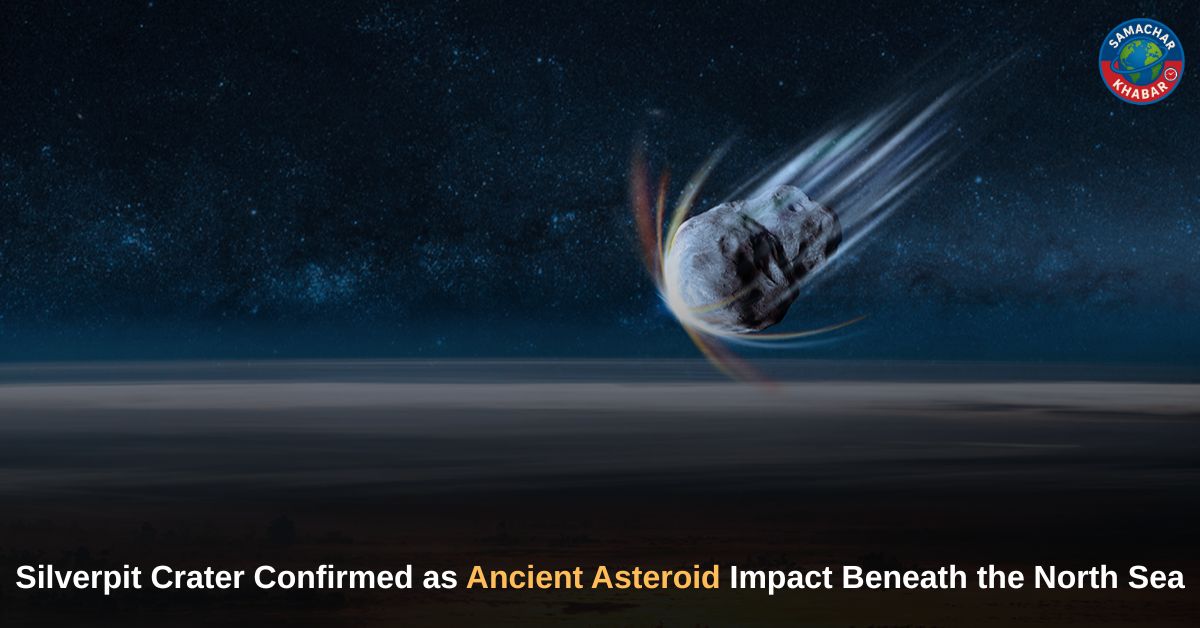
Ancient Asteroid: A long-standing scientific mystery surrounding the Silverpit Crater beneath the North Sea has finally been resolved. New research confirms that the structure was created by a massive asteroid impact roughly 43–46 million years ago. The findings, published in Nature Communications and cited by ScienceDaily, were led by Dr Uisdean Nicholson of Heriot-Watt University in Edinburgh with support from the Natural Environment Research Council (NERC).
Scientists identified shocked quartz and feldspar crystals, microscopic minerals formed only under extreme pressures, providing strong evidence that a high-velocity asteroid struck the seabed. Researchers say the impact likely triggered a towering tsunami across the region.
Key Takeaways: Silverpit Crater Asteroid Impact
- The Silverpit Crater beneath the North Sea was formed by an asteroid impact about 43–46 million years ago.
- The crater lies 700 metres beneath the seabed and about 80 miles off the coast of Yorkshire, United Kingdom.
- Scientists discovered shocked quartz and feldspar crystals, which form only under extreme pressures from asteroid impacts.
- The asteroid was estimated to be about 160 metres wide and struck the seabed at a shallow angle from the west.
- The collision likely triggered a tsunami more than 100 metres high across the ancient North Sea.
- Research findings were published in Nature Communications and cited by ScienceDaily.
- The study was led by Dr Uisdean Nicholson of Heriot-Watt University with support from Natural Environment Research Council (NERC).
- The discovery ends a more than two-decade scientific debate over the crater’s origin.
What Is the Silverpit Crater Beneath the North Sea?
The Silverpit Crater is a geological structure located beneath the southern North Sea. It lies approximately 700 metres below the seabed and around 80 miles off the coast of Yorkshire in the United Kingdom, near Hull.
The crater was first identified by geologists in 2002. Scientists found that the structure measures about three kilometres wide and is surrounded by a ring of circular faults stretching nearly 20 kilometres across.
Because of its unusual shape, the formation quickly became the subject of scientific debate. Its circular form, central peak and surrounding concentric faults resemble features commonly seen in impact craters formed by asteroid collisions.
However, the structure’s origin remained uncertain for many years, leading researchers to explore different geological explanations.
Why Scientists Debated the Crater’s Origin
For more than two decades, scientists disagreed about whether the Silverpit structure was truly the result of an asteroid impact.
Some researchers argued that its shape strongly suggested an impact crater. They pointed to several features typically associated with known impact sites on Earth, including:
- A circular crater structure
- A central peak
- Surrounding concentric faults
However, other scientists proposed alternative explanations based on geological processes beneath the seabed. These included:
- Salt tectonics, where underground salt movement distorts rock layers
- Volcanic collapse, where volcanic activity could cause the seabed to sink
The debate became so intense that geologists even held a vote on the issue in 2009. According to a report in the December 2009 issue of Geoscientist magazine, most participants rejected the asteroid impact explanation at the time.
The latest research, however, has now overturned that earlier conclusion.
New Evidence That Confirms the Asteroid Impact
The new study cited by ScienceDaily analysed advanced seismic imaging data and geological samples collected from beneath the North Sea.
Researchers also examined samples obtained from an offshore oil well.
During this investigation, scientists discovered “shocked” quartz and feldspar crystals at the same depth as the crater floor.
These microscopic minerals are extremely rare and are formed only under extreme pressure generated during high-velocity asteroid impacts.
Dr Uisdean Nicholson explained that these mineral structures cannot be produced by normal geological processes.
As he told ScienceDaily:
“We were exceptionally lucky to find these — a real ‘needle-in-a-haystack’ effort. These prove the impact crater hypothesis beyond doubt, because they have a fabric that can only be created by extreme shock pressures.”
The presence of these shocked minerals provided the clearest evidence yet that a space object struck the seabed millions of years ago.
How the Asteroid Impact Triggered a Massive Tsunami
Scientists believe the impact occurred when an asteroid roughly 160 metres wide struck the seabed of the ancient North Sea.
According to the research team:
- The asteroid approached at a shallow angle from the west
- It struck the seabed at extremely high velocity
- The collision caused a violent explosion on the ocean floor
The impact instantly threw up a 1.5-kilometre-high curtain of rock and water.
Also Read: Understanding The key Difference Between Comets, Asteroids, and Meteors
When this massive curtain collapsed back into the sea, it likely generated a tsunami exceeding 100 metres in height.
Researchers note that such a wave would have been taller than Big Ben, the iconic London landmark that stands at 96 metres.
The tsunami would have spread powerful waves across the surrounding region of the ancient North Sea.
Why Silverpit Is Important for Scientists
Researchers say the Silverpit crater is a rare and exceptionally well-preserved hypervelocity impact crater.
Impact craters are relatively uncommon on Earth because natural processes gradually erase them over time. These processes include:
- Plate tectonics
- Erosion
- Sediment movement
Scientists estimate that there are:
| Type of Impact Crater | Estimated Number |
| On land | Around 200 |
| Beneath oceans | About 33 |
Because Silverpit remained buried beneath layers of seabed sediment, its structure has been preserved remarkably well.
This preservation allows scientists to study how asteroid impacts shape planetary surfaces.
Comparison With Other Known Impact Craters
The confirmation of Silverpit as an asteroid impact site places it among a small group of well-known impact structures on Earth.
Some of the notable examples include:
- Chicxulub Crater in Mexico, widely linked to the extinction of the dinosaurs
- Nadir Crater off the coast of West Africa, another underwater impact structure identified in recent years
However, scientists note that the Silverpit crater is nowhere comparable in scale to the Chicxulub crater in North Mexico, which resulted in a mass extinction of 75 per cent of plant and animal species.
Despite its smaller size, Silverpit provides valuable information about how asteroid impacts affect Earth’s geological history.
What the Discovery Means for Future Planetary Research
Researchers say the new findings provide valuable insights into how asteroid impacts shape planetary surfaces both above and below oceans.
By analysing Silverpit’s structure and impact patterns, scientists hope to improve models that predict how similar collisions could affect Earth in the future.
The research highlights the importance of advanced seismic imaging and geological analysis in uncovering hidden evidence of ancient cosmic events.
As Dr Nicholson told The Guardian:
“Silverpit is exceptionally preserved and important. We can use these findings to understand how asteroid impacts shaped our planet throughout history, as well as predict what could happen should we have an asteroid collision in the future.”
Spiritual Reflection on Cosmic Events
Scientific discoveries about ancient cosmic impacts remind humanity of the immense forces that shape the universe and life on Earth. Events such as the asteroid impact that formed the Silverpit Crater highlight the vast scale of natural processes that operate far beyond human control.
Spiritual teachings often encourage reflection on humanity’s place within this larger cosmic order. According to the spiritual teachings shared by Tatvdarshi Saint Rampal Ji Maharaj, true understanding of existence emerges through True Spiritual Knowledge given by a True Guru, guiding individuals to reflect on creation, nature, and the deeper purpose of human life with humility and awareness.
For more information visit our
Website:www.jagatgururampalji.org
YouTube: Sant Rampal Ji Maharaj
Facebook: Spiritual Leader Saint Rampal Ji
X (Twitter): @SaintRampalJiM
FAQs on Silverpit Crater Asteroid Impact
1. What is the Silverpit Crater?
The Silverpit Crater is a geological structure beneath the North Sea formed by an asteroid impact about 43–46 million years ago.
2. Where is the Silverpit Crater located?
It lies around 700 metres beneath the seabed, about 80 miles off the coast of Yorkshire in the United Kingdom.
3. What evidence confirms the asteroid impact?
Scientists discovered shocked quartz and feldspar crystals, minerals that form only under extreme pressure during asteroid impacts.
4. How large was the asteroid that formed Silverpit?
Researchers estimate the asteroid was about 160 metres wide.
5. What impact did the asteroid create?
The collision likely generated a tsunami exceeding 100 metres high across the ancient North Sea.