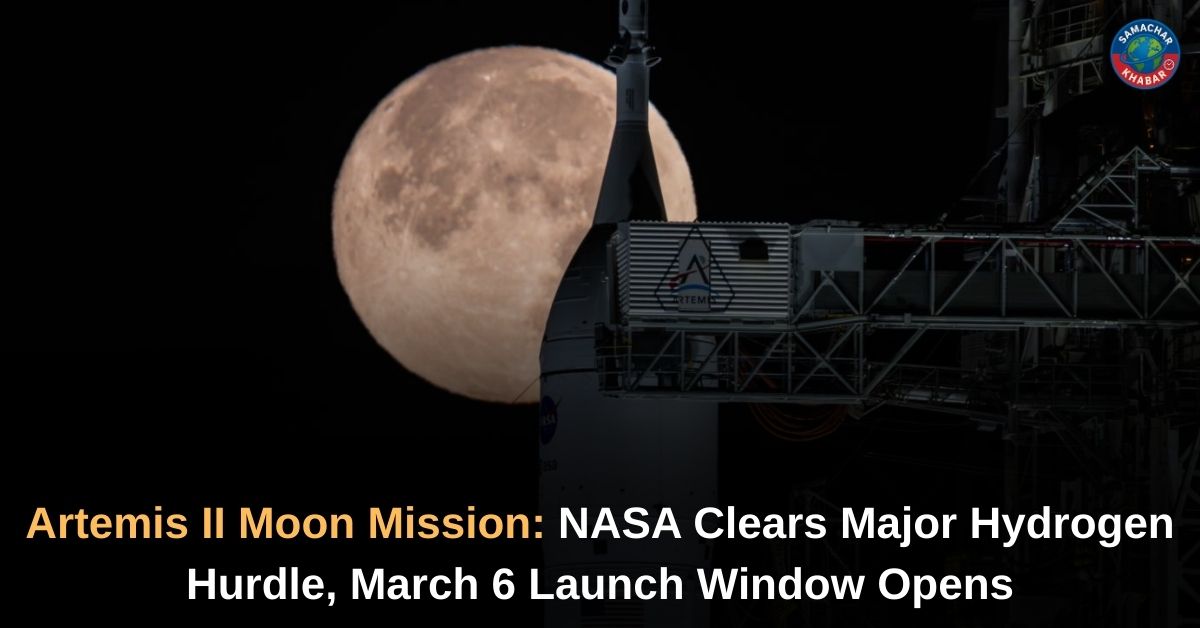
NASA has moved a decisive step closer to launching astronauts around the Moon for the first time in more than 50 years. After weeks of scrutiny over hydrogen leaks that halted an earlier rehearsal, engineers successfully fueled the Space Launch System (SLS) rocket during a second wet dress rehearsal at Kennedy Space Center in Florida.
The test demonstrated that the hydrogen leak issues have been resolved within safety limits, allowing NASA to target March 6 as the earliest possible launch date for the Artemis II Moon Mission. If cleared during the upcoming flight readiness review, four astronauts will embark on a 10-day journey around the far side of the Moon and back to Earth — marking humanity’s return to deep space since 1972.
Key Developments in the Artemis II Moon Mission and March Launch Timeline
- NASA loaded more than 700,000 gallons (approximately 730,000 gallons / 2.6–2.76 million liters) of liquid hydrogen and liquid oxygen into the 322-foot SLS rocket.
- Hydrogen leak concentrations remained under allowable ground safety limits after seal replacements and filter repairs.
- Countdown simulations reached T-33 seconds and later T-29 seconds before concluding as planned.
- Earliest launch opportunity: March 6, with additional windows through March 9 and March 11; another window opens in early April.
- The four-member U.S.-Canadian crew has entered a two-week quarantine to preserve flexibility in the March launch window.
- Artemis II will be the first crewed mission beyond low Earth orbit since Apollo 17 in 1972.
Second Wet Dress Rehearsal Resolves Hydrogen Leak Concerns
NASA’s first attempt at a full fueling rehearsal earlier this month was halted after liquid hydrogen escaped from an interface between the rocket and the mobile launcher’s tail service mast. The same area had caused delays during Artemis I in 2022.
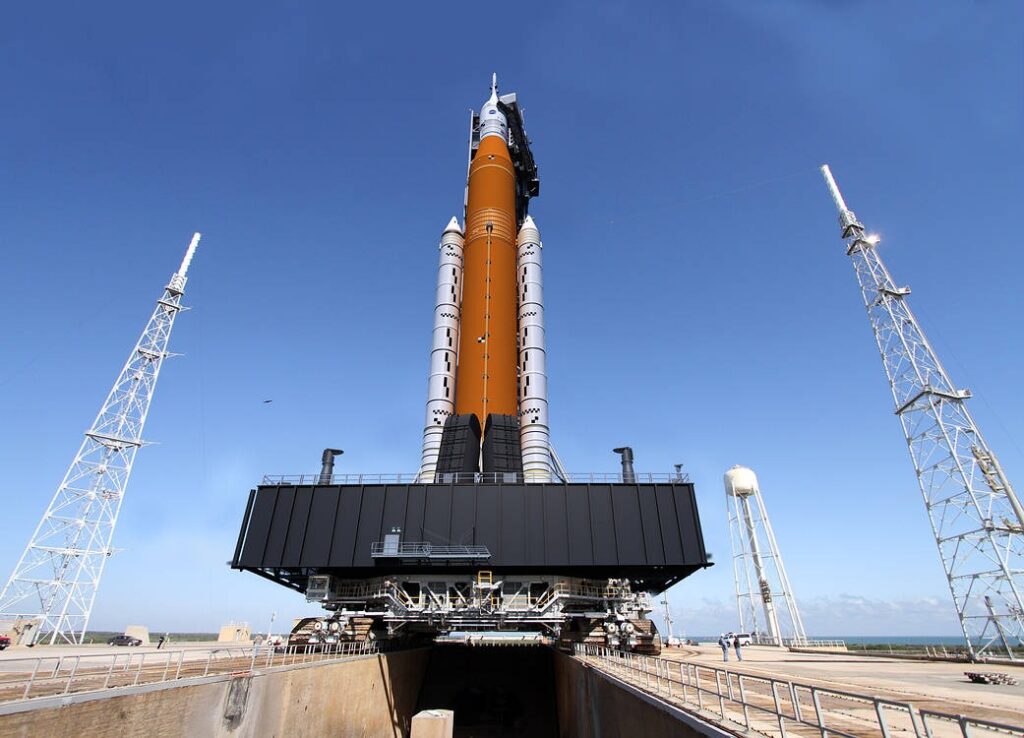
Engineers replaced two seals and a clogged filter in ground support equipment. A partial fueling test on Feb. 12 indicated improvement, and during the full rehearsal, teams successfully filled both the core stage and the interim cryogenic propulsion stage without exceeding hydrogen safety limits.
Hydrogen has long posed challenges for NASA, dating back to the space shuttle era. The first Artemis mission in November 2022 experienced months of delays due to similar leaks before finally launching uncrewed. This time, officials described the results as a positive sign that corrective actions were effective.
Inside the Countdown: From Chilldown to Terminal Count
Fueling operations began with chilldown procedures to cool propellant lines before loading super-cold liquid hydrogen at minus 423 degrees Fahrenheit and liquid oxygen at minus 297 degrees Fahrenheit.
After slow fill and fast fill phases, the tanks were transitioned into replenish mode to replace propellant lost through natural boil-off. Once fueling stabilized, the team entered terminal count — the final 10 minutes of a simulated launch countdown.
During the first run, the clock paused at T-33 seconds. The team recycled the countdown back to T-10 minutes and conducted a second terminal count, stopping at T-29 seconds. The rehearsal concluded at 10:16 p.m. EST.
There were minor issues. Ground communications were temporarily lost in the Launch Control Center, requiring backup systems. A booster avionics system voltage anomaly briefly paused the second terminal count. Both issues were resolved without affecting overall progress.
Crew Enters Quarantine as Launch Review Approaches
The Artemis II crew includes NASA astronauts Reid Wiseman, Victor Glover and Christina Koch, along with Canadian Space Agency astronaut Jeremy Hansen.
Three of the astronauts observed portions of the fueling test from the Launch Control Center. Following the successful rehearsal, the crew entered a roughly 14-day quarantine at Johnson Space Center in Houston to reduce the risk of illness before launch.
A multi-day flight readiness review scheduled for late next week will determine whether the mission proceeds toward the March 6 launch target.
NASA Administrator Jared Isaacman emphasized that safety remains the agency’s highest priority, stating the mission will not launch unless every system meets required standards. He also indicated plans to redesign fuel connections ahead of Artemis III to reduce long-term hydrogen risks.
Artemis II Mission Profile: A 600,000-Mile Journey Beyond the Moon
The Artemis II Moon Mission will send four astronauts on an approximately 600,000-mile round trip. After launch, the crew will spend their first day in orbit around Earth before heading toward lunar distance.
The Orion spacecraft — built by Lockheed Martin — will travel 6,500 to 9,500 kilometers (4,000 to 6,000 miles) above the lunar surface and about 4,700 miles (7,600 kilometers) beyond the Moon’s far side. This trajectory will surpass the distance record set by Apollo 13 in 1970.
The astronauts will dedicate several hours to observation and imaging before beginning their four-day return to Earth, concluding with a splashdown in the Pacific Ocean.
Unlike Artemis III, Artemis II will not attempt a landing. Instead, the mission is designed to test systems, hardware and operational readiness for future deep-space expeditions.
Broader Context: Artemis III, Starliner Findings and Global Competition
Artemis II is a preparatory step toward Artemis III, currently targeted for 2028, which aims to land astronauts near the Moon’s south pole. NASA has contracts with SpaceX to develop a lunar lander, while also asking Blue Origin to propose accelerated plans.
The successful fueling test comes amid heightened scrutiny following a report on Boeing’s Starliner capsule program, classified as a “Type A mishap.” The report detailed hardware failures and leadership shortcomings that left two astronauts aboard the International Space Station for months. NASA has stated it will not fly another crew aboard Starliner until technical issues are fully understood and corrected.
Meanwhile, China is aiming for a lunar landing by 2030. Both the United States and China are targeting the Moon’s south pole, an area believed to contain valuable resources for future lunar bases.
Spiritual Perspective: The Unique Knowledge of Saint Rampal Ji Maharaj
As humanity prepares to travel farther into space through missions like Artemis II, spiritual thinkers often remind us that physical exploration is only one dimension of progress. According to the teachings of Saint Rampal Ji Maharaj, true advancement lies not just in reaching distant planets, but in understanding the deeper purpose of human life.
His spiritual knowledge emphasizes that while science expands the boundaries of the physical universe, self-realization expands inner consciousness. The pursuit of the Moon and Mars reflects human curiosity and courage, yet lasting peace and liberation, as explained in his discourses, come through understanding divine knowledge and devotion.
In this broader context, space exploration showcases humanity’s technical brilliance, while spiritual wisdom highlights the path toward eternal fulfillment — suggesting that the ultimate journey is not only outward into space, but inward toward truth.
A Critical Turning Point for Humanity’s Return to Lunar Distance
NASA’s successful second fueling test has restored confidence in the Artemis II Moon Mission and reopened the path to a March launch. By resolving hydrogen leak concerns and completing a full countdown simulation, engineers have demonstrated measurable progress after weeks of uncertainty.
The final decision now rests with the flight readiness review. If approved, four astronauts will soon embark on a mission that reconnects the present generation with the legacy of Apollo 17 in 1972 and sets the stage for humanity’s next chapter on and around the Moon.
FAQs on Artemis II Moon Mission
1. When is the Artemis II Moon Mission launch date?
NASA is targeting March 6 as the earliest launch date, with additional windows through March 9 and March 11, pending final flight readiness review approval.
2. What was the purpose of NASA’s second fueling test for Artemis II?
The wet dress rehearsal tested full rocket fueling, countdown procedures, and hydrogen leak fixes to ensure the Space Launch System is safe and ready for launch.
3. Who are the astronauts flying on the Artemis II Moon Mission?
The crew includes NASA astronauts Reid Wiseman, Victor Glover, Christina Koch, and Canadian Space Agency astronaut Jeremy Hansen.
4. Will Artemis II land astronauts on the Moon?
No. Artemis II is a 10-day flyby mission designed to test systems for future landings. It will not orbit or land on the lunar surface.
5. How far will Artemis II travel during the mission?
Artemis II will travel about 600,000 miles round trip, flying approximately 4,700 miles beyond the Moon’s far side before returning to Earth.