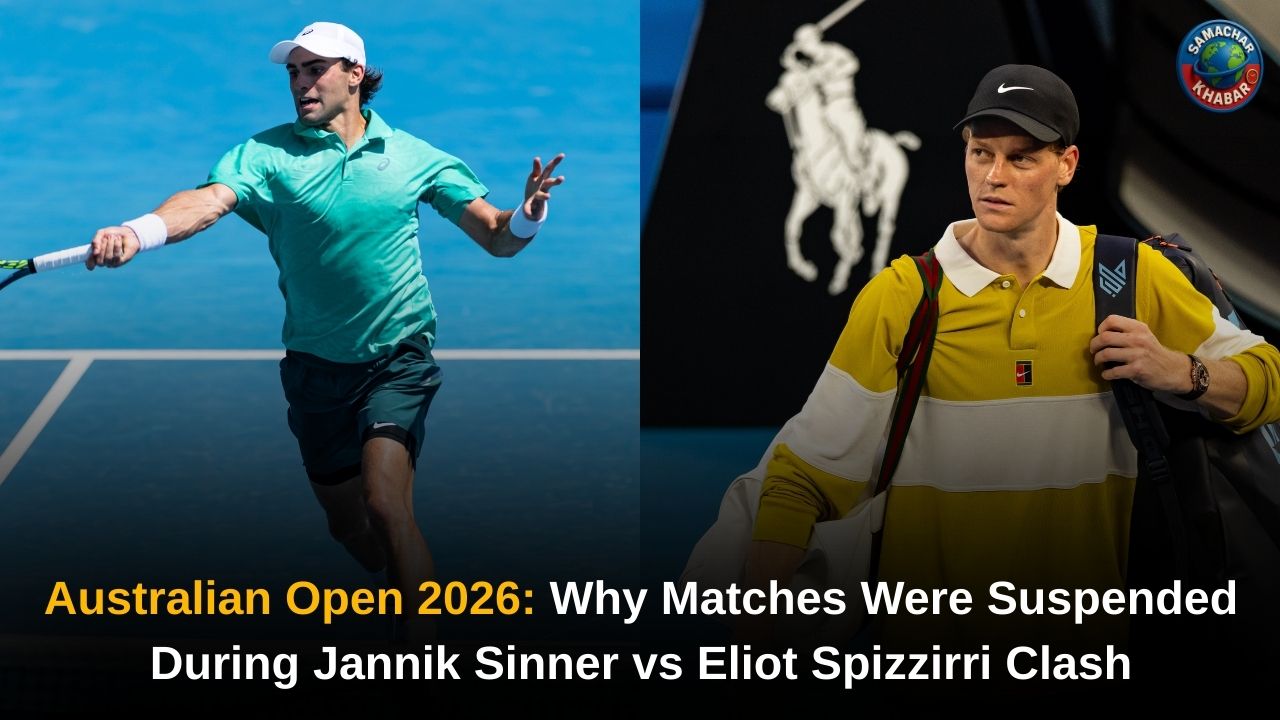
The Australian Open 2026 witnessed dramatic scenes in Melbourne as extreme heat forced officials to suspend multiple matches, including the gripping third-round clash between defending champion Jannik Sinner and American qualifier Eliot Spizzirri. With temperatures climbing towards 40°C, the tournament’s Heat Stress Scale reached its highest danger level, prompting a temporary halt in play and roof closures on the main showcourts.
The suspension came at a critical moment when Sinner was physically struggling with cramps and trailing in the third set, sparking debate among fans while highlighting the Australian Open’s strict heat-safety protocols.
Key Takeaways on Australian Open 2026 Heat Suspension and Sinner vs Spizzirri Match
- Australian Open 2026 matches were suspended after the Heat Stress Scale reached Level 5
- Jannik Sinner vs Eliot Spizzirri was halted mid-third set due to extreme heat
- Roofs were closed on Rod Laver Arena, Margaret Court Arena and John Cain Arena
- Officials followed mandatory heat rules, not discretionary decisions
- Sinner was visibly struggling with cramps before the suspension
- Cooler indoor conditions changed the momentum of the match
- The incident underlined growing concerns over extreme heat at Grand Slam events
Extreme Heat Brings Australian Open 2026 to a Standstill
Melbourne’s notorious summer conditions once again played a decisive role at the Australian Open 2026. On Saturday, January 24, temperatures surged between 35°C and 40°C, pushing players, officials and spectators to their limits.
Tournament organisers had already taken preventive steps by starting play earlier than usual, but by early afternoon, conditions worsened rapidly. The Australian Open’s Heat Stress Scale — which monitors air temperature, radiant heat, humidity and wind speed — climbed to Level 5, its most dangerous threshold.
At that point, officials were required to suspend all outdoor matches and initiate roof closures on arena courts.
What Happened During Jannik Sinner vs Eliot Spizzirri?
The third-round match between Sinner and Spizzirri inside Rod Laver Arena was one of the most physically demanding encounters of the tournament.
Sinner lost the opening set 6-4 but responded by taking the second set 6-3. However, as the heat intensified, the Italian began to show clear signs of physical distress. He struggled with movement, applied ice packs during changeovers and relied on cooling devices on the bench.
In the third set, Spizzirri broke serve and moved ahead 3-1. Shortly after, chair umpire Fergus Murphy asked both players to step aside as the Heat Stress Scale officially reached Level 5, triggering a suspension of play lasting approximately ten minutes.
Australian Open Heat Rule Explained
The Australian Open introduced the Heat Stress Scale (HSS) in 2019 to better protect player health during extreme weather.
How the Heat Stress Scale Works:
- Levels 1–3: Play continues with monitoring
- Level 4: Referee may allow a 10-minute break between sets
- Level 5:
- All outdoor matches are suspended
- Roofs on major showcourts are closed
- Play resumes only under safer, cooler conditions
- All outdoor matches are suspended
Once Level 5 was reached on Saturday afternoon, officials had no discretion. The rules required immediate action.
Official Statement Confirms Mandatory Suspension
Tournament organisers released a statement during the stoppage, confirming the enforcement of the heat policy:
“The AO Heat Stress Scale is above 5.0. Play is suspended for all matches and practice on outside courts. The roofs on RLA, MCA and JCA will close and remain closed for the remainder of the match.”
Fans inside the venue were advised to seek shade and apply cooling measures as the heat continued to rise across Melbourne Park.
Suspension Proves a Turning Point in the Match
When play resumed under closed-roof conditions, the temperature inside Rod Laver Arena dropped significantly into the low-20s. The cooler environment immediately benefited Sinner, who appeared physically refreshed despite earlier cramps.
He broke Spizzirri’s serve soon after the restart, regained control of the rallies and went on to claim the third set 6-4. Although Spizzirri again surged ahead in the fourth set, Sinner’s experience and composure prevailed as he broke serve twice to seal a four-set victory.
The final scoreline read 4-6, 6-3, 6-4, 6-4, after nearly four hours of intense tennis.
Debate and Fan Reaction After the Suspension
The timing of the stoppage sparked discussion among fans and commentators, with some suggesting the interruption disrupted Spizzirri’s momentum. However, officials maintained that the decision was purely rule-based and applied uniformly across all courts.
The same heat protocols were enforced on other matches, including those on Margaret Court Arena and John Cain Arena, where play was briefly paused to allow roofs to close.
Other Matches Affected by the Heatwave
The extreme conditions reshaped the entire Saturday schedule. Outdoor courts remained suspended until at least 5:30 pm local time, while players on arena courts benefited from indoor conditions.
Defending women’s champion Madison Keys embraced the heat earlier in the day, dispatching Karolína Plíšková 6-3, 6-3 in just 75 minutes to book a last-16 clash with Jessica Pegula.
Elsewhere, Amanda Anisimova advanced comfortably, continuing her strong recent form.
What Lies Ahead for Jannik Sinner
With the win, Sinner moved into the fourth round, where he is set to face fellow Italian Luciano Darderi. The defending champion remains on course in his pursuit of a third consecutive Australian Open title, though the physical toll of Melbourne’s heat remains a looming concern.
Why the Australian Open 2026 Heat Incident Matters
The Sinner-Spizzirri suspension once again highlighted how extreme weather has become a defining factor at the Australian Open. As Melbourne summers grow more intense, tournament organisers are increasingly forced to balance competitive integrity with player safety.
The events of Day 7 underlined the importance of clear heat protocols, strict enforcement and adaptive scheduling — measures that may soon become even more critical in the future of Grand Slam tennis.
FAQs on Australian Open 2026 heat suspension
1. Why were matches suspended at the Australian Open 2026?
Matches were suspended after the Heat Stress Scale reached Level 5, forcing officials to halt play and close arena roofs to protect players from extreme heat.
2. Why was Jannik Sinner vs Eliot Spizzirri stopped mid-match?
The match was paused when extreme heat caused safety concerns, with Sinner struggling physically and the Heat Stress Scale hitting its highest danger level.
3. What is the Australian Open Heat Stress Scale?
It is a five-level system measuring temperature, humidity, radiant heat and wind to decide when play should continue, pause, or be suspended.
4. How long was play suspended during the Sinner vs Spizzirri match?
Play was halted for about 10 minutes to allow the roof to close and create cooler indoor conditions before the match resumed.
5. Did the heat suspension affect other Australian Open 2026 matches?
Yes, all outdoor matches were suspended, and roofs were closed on Rod Laver Arena, Margaret Court Arena and John Cain Arena due to extreme heat.