Education in India is entering a powerful new phase. In 2026, Artificial Intelligence (AI) is no longer optional for students – it has become an everyday learning companion.
From AI tutors that explain difficult concepts in simple language to tools that organize notes, summarize lectures, and improve writing, AI is transforming how students learn, revise, and perform.
Recent surveys and academic discussions indicate that many Indian colleges and universities in India are increasingly allowing the controlled use of AI tools for learning and assignments.
This marks a huge shift in mindset – from fear of technology to acceptance and smart use.
This blog explores the best AI tools for students in 2026, how they are changing education in India, and why learning AI skills today is essential for tomorrow’s careers.
Why AI Tools Matter for Students in 2026
AI is not replacing education – it is enhancing it.
Students today face heavy syllabus, competitive exams, constant assessments, and pressure to perform. AI tools help reduce stress while improving understanding and productivity.
Learning Becomes Personalized
Every student learns differently. AI tools adapt to individual learning speed, strengths, and weaknesses.
A student struggling in mathematics can receive step-by-step explanations, while another can revise quickly using summaries and quizzes.
This personalization was not possible earlier at such a scale.
Saving Time, Increasing Focus
AI tools handle repetitive tasks like formatting, proofreading, summarizing, and organizing.
This allows students to focus more on:
- Understanding concepts
- Practicing questions
- Creative thinking
- Time saved becomes time invested in real learning.
Supporting Teachers, Not Replacing Them
AI does not replace teachers. Instead, it supports both students and educators by:
- Providing instant doubt clarification
- Helping with revision
- Enabling better classroom engagement
Human guidance remains central.
Top AI Tools Students Should Use in 2026
These tools are widely used, trusted, and suitable for Indian students across streams.
ChatGPT – Your 24×7 AI Learning Assistant
ChatGPT has become one of the most popular AI tools for students worldwide.
It helps students:
- Understand complex topics
- Get explanations in simple language
- Practice answers
- Brainstorm ideas for projects
The Study Mode feature helps break problems into steps, making learning easier and more structured.
It is useful for science, arts, commerce, competitive exams, and skill learning.
Notion AI – Smart Notes & Study Planning
Notion AI helps students organize their academic life.
It converts scattered notes into clean summaries and helps manage:
- Study schedules
- Assignment deadlines
- Revision plans
Students preparing for exams find it especially useful for long-term planning.
Grammarly – Improving Writing Confidence
Good writing is essential for exams, assignments, and future jobs.
Try this Tool: Master Your Reflexes with the Ultimate Reaction Time Test
Grammarly helps students:
- Correct grammar and spelling
- Improve sentence clarity
- Adjust tone for academic writing
It is highly useful for essays, emails, reports, and internship applications.
QuillBot – Paraphrasing & Research Support
QuillBot helps students rewrite content clearly while maintaining originality.
It is useful for:
- Avoiding plagiarism
- Improving vocabulary
- Creating concise summaries
Research students and college learners benefit greatly from its citation tools.
Otter.ai – Lecture Recording & Transcription
Otter.ai records and transcribes lectures in real time.
This is extremely helpful for:
- Online classes
- Fast-paced lectures
- Revision before exams
Students can revisit lectures anytime, reducing dependency on handwritten notes.
QANDA – AI Math Tutor
Mathematics often becomes a fear for many students.
QANDA provides:
- Step-by-step solutions
- Concept-based explanations
- Practice assistance
It helps students understand logic rather than memorizing formulas.
Canva AI – Visual Projects Made Easy
Presentations and visual assignments are common in modern education.
Canva AI helps students create:
- Presentations
- Posters
- Infographics
Without needing design skills, students can submit professional-quality work.
Education Is Adopting AI
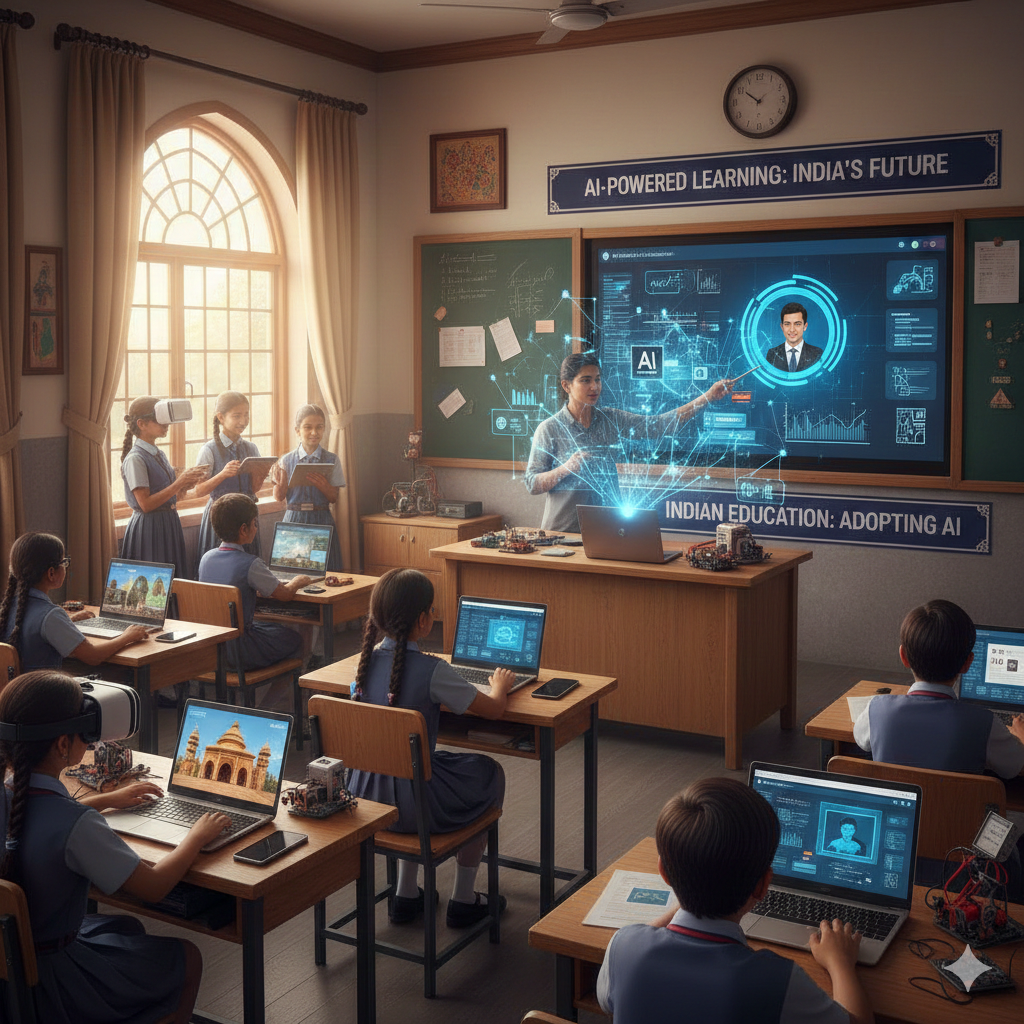
India is actively integrating AI into education at multiple levels.
AI in Colleges and Universities
Many colleges across cities like Chennai, Bengaluru, and Pune are introducing:
- AI labs
- AI electives
- Practical projects
These initiatives prepare students for industry needs.
AI in School Curriculum
NCERT has introduced AI awareness modules, pilot programs, and teacher-training initiatives to familiarize students with artificial intelligence and responsible technology use.
- Basic AI concepts
- Logical thinking
- Responsible technology use
This ensures early exposure and skill development.
Conferences & Academic Innovation
Events like ICDMAI 2026 bring educators, researchers, and technologists together.
These platforms encourage innovation, ethical AI use, and policy discussions in education.
AI Tools & Future Careers: Skills Students Gain Beyond the Classroom
In 2026, employers are not just hiring degrees – they are hiring skills. Students who actively use AI tools during their education gain practical, job-ready abilities that go far beyond textbooks. Let’s explore how AI tools help shape future-proof careers.
Also Read: ChatGPT Introduces ‘ChatGPT Health’ With Enhanced Privacy and Physician-Guided Intelligence
Critical Thinking & Smart Decision-Making
AI tools encourage students to think deeper, not blindly accept answers. When students ask AI tools for explanations, multiple perspectives, or alternative solutions, they learn to analyze information, question accuracy, and make informed decisions.
For example, comparing AI-generated answers with textbooks or teacher guidance builds judgment and reasoning skills – a top requirement in leadership, research, and management roles.
Digital Collaboration & Remote Work Skills
Modern workplaces operate digitally – and AI tools train students for this reality early. Tools like collaborative AI platforms, cloud-based documents, and project assistants teach students how to:
- Work in virtual teams
- Share ideas across platforms
- Manage tasks efficiently
These skills are especially valuable for careers in IT, startups, multinational companies, and freelancing, where remote collaboration is the norm.
Data Literacy & Information Management
In an AI-driven world, understanding data is as important as reading and writing. AI tools expose students to:
- Interpreting data insights
- Organizing large volumes of information
- Understanding patterns and trends
- This builds data literacy, a skill in high demand across fields like business analytics, finance, marketing, research, and governance.
Problem-Solving & Logical Thinking
AI tools don’t just give answers – they often show how a solution is reached. Students learn step-by-step problem-solving methods, whether in mathematics, coding, case studies, or real-life scenarios.
This habit strengthens logical thinking and adaptability, essential for careers in engineering, law, medicine, policy-making, and entrepreneurship.
Creative Communication & Content Creation
AI supports creativity by helping students draft ideas, refine language, design visuals, and present thoughts clearly. Students learn how to:
- Communicate complex ideas simply
- Create engaging presentations and content
- Express originality with clarity
These abilities are crucial for media, marketing, teaching, design, content creation, and leadership roles.
AI Fluency: A Competitive Career Advantage
AI fluency means knowing how to use AI responsibly and effectively. Students who understand AI tools gain confidence in adapting to new technologies – a quality employers highly value.
Whether entering tech, business, research, government services, or creative industries, AI-literate students stand out as adaptable, efficient, and future-ready professionals.
Preparing for Jobs That Don’t Exist Yet
Many future jobs are still being created – and AI familiarity prepares students to learn continuously and evolve. Instead of fearing automation, students equipped with AI skills learn how to work alongside technology, making them resilient in a rapidly changing job market.
Tips for Smart AI Use
- Treat AI as a learning assistant, not a replacement for your effort.
- Always verify AI outputs for accuracy before using them.
- Blend AI with your own thinking and research.
- Follow your institution’s academic integrity rules, especially for exams and major assignments.
AI as a Learning Partner, Not a Shortcut
AI tools are transforming education in India.
When used wisely, they:
- Improve understanding
- Reduce stress
- Build future-ready skills
Students who learn to work with AI, not depend on it blindly, will thrive in academics and careers.
The future belongs to those who combine technology with wisdom.
True Knowledge in the Age of AI:
Sant Rampal Ji Maharaj teaches that true knowledge is not merely collecting information, but understanding how to apply it with truth, discretion, and a higher moral purpose. In today’s AI-driven education system, this teaching becomes even more relevant. While AI tools can quickly provide answers, real wisdom lies in using them as a means for self-improvement, deeper understanding, and righteous action.
According to Sant Rampal Ji Maharaj’s knowledge, education should refine the intellect while nurturing human values such as honesty, discipline, and responsibility. AI, when used ethically, can support this journey by helping students learn efficiently – but it should never become a shortcut that weakens effort or understanding. In an era where AI tools are widely accessible, Sant Rampal Ji Maharaj reminds students to seek knowledge that leads to wisdom, wisdom that leads to character, and character that serves society.
This balanced approach ensures that technology becomes a tool for growth, not a replacement for conscience.
FAQ: Best AI Tools for Students in 2026
Q1. What AI tools should students in India use in 2026?
Popular choices include ChatGPT, Notion AI, Grammarly, Otter.ai, QuillBot, Photomath/QANDA, and Canva AI for learning, productivity, and creativity.
Q2. Can AI tools replace teachers or classroom learning?
No. AI tools cannot replace teachers. They act as support systems that help students understand concepts, revise efficiently, and practice better. Human teachers remain essential for guidance, mentoring, and value-based education.
Q3. Can AI replace teachers?
No-AI enhances learning with personalization and support, but teachers provide mentorship, guidance, and human insight that AI can’t replicate.
Q4. Is AI good for exam preparation?
Yes-it summarizes topics, explains concepts, creates quizzes, and offers tailored study plans to strengthen understanding.
Q5. How do students use AI ethically?
Use it to build knowledge and check your work. Always cite AI help if required and adhere to school/university policies on integrity.