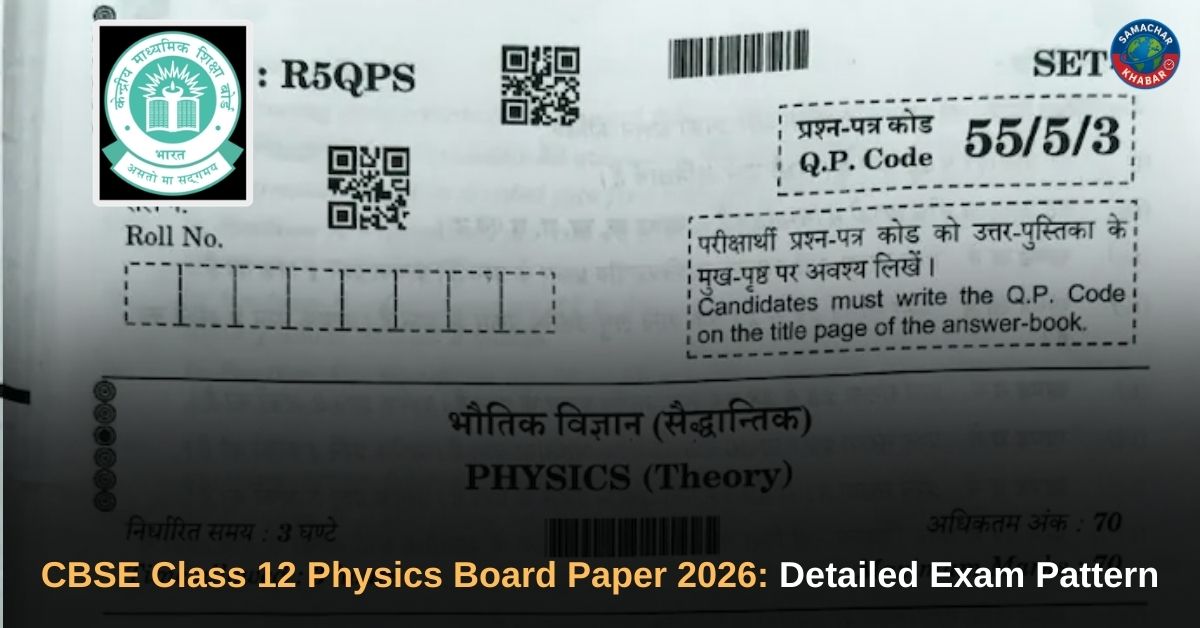
The CBSE Class 12 Physics Board Examination 2026 concluded on 20 February 2026, bringing relief and reflection for thousands of students across India and abroad. Conducted from 10:30 AM to 1:30 PM in offline pen-and-paper mode, with a 15-minute reading time beginning at 10:15 AM, the 70-mark paper followed the prescribed CBSE pattern and remained strictly aligned with the NCERT syllabus.
Early reactions from students and expert reviews suggest that the paper was moderate in difficulty but noticeably lengthy. While theory questions were largely direct and familiar, several application-based numericals and derivation-heavy sections required focused attention and careful time management.
CBSE Class 12 Physics Board Paper 2026: Key Highlights
- Exam Date: 20 February 2026
- Duration: 3 Hours (plus 15-minute reading time)
- Total Marks: 70
- Mode: Offline (Pen and Paper)
- 33 compulsory questions
- Five Sections (A to E)
- Strictly NCERT-based
- Moderate overall difficulty
- Lengthy due to calculation-heavy numericals
- Derivation-focused long answer section
- No out-of-syllabus questions reported
The paper was conducted in India and 26 countries abroad, with lakhs of students appearing for the Class 12 board examinations this year.
Detailed CBSE Class 12 Physics Exam Pattern 2026
The examination followed the structured blueprint prescribed by the board.
| Section | Question Type | No. of Questions | Marks per Question | Total Marks |
| A | MCQs & Assertion-Reason | 16 | 1 | 16 |
| B | Very Short Answer | 5 | 2 | 10 |
| C | Short Answer | 7 | 3 | 21 |
| D | Case Study | 2 | 4 | 8 |
| E | Long Answer | 3 | 5 | 15 |
| Total | 33 | 70 |
Internal choices were provided in Section B, Section C, and all questions in Section E. Calculators were not allowed inside the examination hall.
Typology of Questions
| Category | Marks | Percentage |
| Remembering & Understanding | 27 | 38% |
| Applying | 22 | 32% |
| Analysing & Higher Order Skills | 21 | 30% |
This distribution reflects CBSE’s continued emphasis on competency-based and analytical assessment.
Difficulty Level: Moderate but Lengthy
Most students rated the Physics paper as moderate. However, many described it as “easy to moderate but lengthy.”
Theory-based questions were largely direct and drawn from NCERT concepts. The numerical questions, though not excessively difficult, involved multi-step calculations that required clarity and patience. This made time management moderate to difficult for some candidates.
While some students felt the paper was slightly easier compared to last year, others observed that the calculation-intensive approach increased overall pressure.
Section-Wise Analysis
Section A: MCQs and Assertion–Reason
This section included questions from Wave Optics, Electrostatics, Semiconductors, Modern Physics, and Electromagnetic Waves. Most MCQs were formula-based and direct. Assertion–Reason questions tested conceptual clarity rather than rote learning.
A few MCQs required deeper reasoning, and two questions were described as tricky by students.
Correct answers for Series 1 Set 1 included:
Q1 – C
Q2 – B
Q3 – C
Q4 – A
Q5 – C
Q6 – D
Q7 – A
Q8 – D
Q9 – A
Q10 – C
Q11 – D
Q12 – C
Q13 – D
Q14 – A
Q15 – C
Q16 – C
Section B: Two-Mark Questions
Questions were asked from Nuclei, Dual Nature of Radiation and Matter, Wave Optics, and Semiconductor Electronics.
Most were manageable and directly based on textbook principles. However, a torque-based question from Moving Charges required careful interpretation.
Section C: Three-Mark Questions
This section formed the conceptual core of the paper. It included:
- Gauss’s Law application for a plane sheet
- Wheatstone network
- Dielectric insertion in a capacitor
- p–n junction diode formation
- Ray diagrams
While theory components were straightforward, numericals from Electrostatic Potential, Semiconductor circuits, and Total Internal Reflection involved multiple steps. Several students found this section slightly time-consuming.
Section D: Case Study Questions
Case studies were based on:
- Galvanometer
- Photoelectric Effect
- Capacitors
- Moving Charges
These questions required interpretation and application of theoretical concepts. Students described the semiconductor-related case study as easy. However, later parts of some case studies required integrated reasoning and deeper analysis.
Section E: Long Answer Questions
The long answer section was considered scoring. It featured derivations from:
- Electrostatics
- Ray Optics
- Electromagnetic Induction and Alternating Current
These were standard derivations from the prescribed syllabus. However, detailed step-by-step presentation made this section lengthy.
Chapter-Wise Weightage
- Optics – 21 marks
- Electrostatics & Current Electricity – 17 marks
- Magnetism & EMI & AC – 17 marks
- Modern Physics – 12 marks
- Semiconductors – 7 marks
The distribution reflected a balanced coverage of major units.
Students’ Reactions
Reactions varied across performance levels.
Above-average students found the paper moderate and manageable. Some students, however, felt the paper was lengthy and struggled to revise answers. A few described Section C numericals as challenging.
JEE aspirants appeared confident, stating that the application-based nature of questions aligned with competitive exam preparation. One viewpoint suggested that the paper leaned slightly toward mathematical aptitude, which may have posed difficulty for students more focused on Biology.
Overall, students agreed that the paper tested both theoretical understanding and numerical practice.
Expert Review: Concept-Driven and NCERT-Aligned
Teachers, principals, and subject experts described the paper as balanced and competency-based.
Experts noted that:
- The majority of questions were based on NCERT examples and derivations
- Nearly one-third of the paper emphasised conceptual understanding
- Case-study questions tested analytical ability
- There were no major discrepancies in the paper, except a minor unit-related issue in one question
The paper followed the CBSE sample paper pattern and did not deviate from the prescribed syllabus.
True Knowledge and the Importance of Right Guidance in Student Life
Examinations test not only academic preparation but also mental strength and focus. Along with conceptual clarity, students often need inner stability to perform confidently.
According to the teachings of Saint Rampal Ji Maharaj, true knowledge includes both worldly education and spiritual wisdom based on holy scriptures. His guidance emphasises discipline, clarity, and peace of mind, helping individuals stay balanced during challenging phases of life. In a competitive academic environment, such balanced understanding can support students in achieving success with confidence and composure.
The Larger Academic Message
The CBSE Class 12 Physics Board Paper 2026 reaffirmed the board’s emphasis on conceptual clarity and structured presentation. It was neither unexpectedly difficult nor simplistic. Instead, it demanded consistent preparation, familiarity with derivations, and practice with multi-step numericals.
Students who relied on thorough NCERT study and previous year question practice were well-positioned to perform confidently. While the paper’s length tested endurance and planning, it ultimately rewarded clarity of thought, analytical reasoning, and disciplined time management.
FAQs on CBSE Class 12 Physics Board Paper 2026
1. What was the difficulty level of the CBSE Class 12 Physics Board Paper 2026?
The overall difficulty level was moderate. Students described the paper as easy to moderate but lengthy, with multi-step numericals and derivation-based questions requiring strong conceptual clarity and time management.
2. Was the CBSE Class 12 Physics 2026 paper based on NCERT?
Yes, the Physics paper was strictly aligned with the NCERT syllabus. Most theory questions, derivations, and numericals were directly based on NCERT concepts and textbook examples.
3. Which sections were considered most challenging in CBSE Physics 2026?
Section C numericals and some case-study questions were time-consuming. Multi-step calculations from Electrostatics, Semiconductor circuits, and Total Internal Reflection required analytical thinking.
4. What was the exam pattern of CBSE Class 12 Physics 2026?
The paper had 33 compulsory questions divided into five sections (A to E) for 70 marks, including MCQs, short answers, case studies, and long-answer derivations.
5. Were there any out-of-syllabus questions in CBSE Physics 2026?
No, students and experts confirmed that all questions were within the prescribed CBSE and NCERT syllabus, with no out-of-syllabus surprises reported.