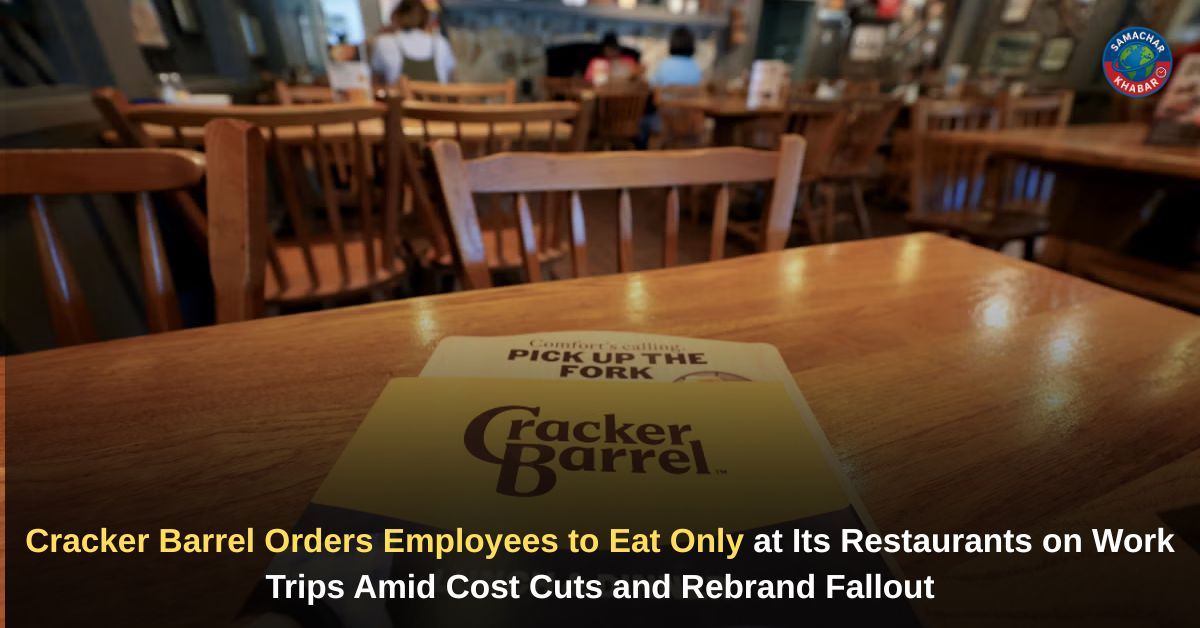
Cracker Barrel Old Country Store has introduced a new internal dining rule requiring employees traveling on company business to eat at Cracker Barrel locations whenever practical. The policy, revealed through a leaked internal memo obtained by the Wall Street Journal, also tightens restrictions on alcohol reimbursement.
The move comes at a turbulent time for the company, which has faced layoffs, declining sales, and widespread backlash over a controversial rebranding effort. While Cracker Barrel says the guidance is a request rather than a mandate, the memo has sparked debate over cost-cutting, corporate culture, and shrinking employee perks.
Key Takeaways on Cracker Barrel’s New Employee Dining Rule and Travel Policy
- Cracker Barrel now expects employees to dine at its own restaurants for most meals during business travel, when practical.
- Alcohol purchases are no longer reimbursable without special approval from senior leadership.
- The policy was disclosed through a leaked internal memo reported by the Wall Street Journal.
- The rule emerges amid layoffs, slowing revenue growth, and fallout from a failed rebranding effort.
- The company says the policy is a request, not a strict mandate, and depends on location and schedule.
What the Leaked Memo Says About Cracker Barrel’s New Dining Rule
According to the internal message obtained by the Wall Street Journal, Cracker Barrel employees traveling for work are “expected to dine at a Cracker Barrel store for all or the majority of meals while traveling, whenever practical based on location and schedule.”
Traditionally, employees on business trips are issued a company card to cover expenses such as meals and transportation. Under the new guidance, that flexibility has narrowed. Employees who choose to eat elsewhere may need to pay out of pocket for their meals.
The directive applies at the corporate level and is not intended for customers or franchise operations. It targets company employees who travel for work, including managers, trainers, and other corporate staff.
Alcohol Reimbursement Tightened Under the New Travel Policy
In addition to meal restrictions, the memo outlines stricter rules on alcohol expenses. Employees will no longer be reimbursed for alcohol purchased during business travel unless they receive special approval from senior leadership.
The guidance states that “exceptions for special occasions must be pre-approved by an E-Team member,” referring to Cracker Barrel’s executive leadership. Employees otherwise must cover alcohol expenses personally.
Cracker Barrel has only recently added alcohol to its restaurant menus, making the restriction particularly notable for a company historically associated with family dining and traditional Southern fare.
Why Cracker Barrel Introduced the Policy Now
The timing of the memo has drawn attention. Cracker Barrel is navigating a difficult period marked by layoffs, shrinking sales, and declining foot traffic. The company has been working to trim expenses as revenue growth slowed in recent years.
Inside the company, employees have interpreted the new travel dining rules as part of a broader push to control costs more tightly. Industry observers note that similar “travel scrimping” measures are becoming common across corporate America as companies reduce discretionary spending.
Rather than enjoying one of the few remaining perks of business travel — choosing where to eat — employees are increasingly being asked to follow strict reimbursement guidelines.
Rebrand Backlash That Put Cracker Barrel Under National Scrutiny
The new dining rule follows months of intense public backlash over Cracker Barrel’s attempted rebrand. Last August, the company unveiled a new logo and removed its longtime mascot, Uncle Herschel — the man leaning on a barrel — as part of a minimalist redesign.
The response was swift and severe. Critics accused the company of abandoning its Southern nostalgia and heritage. MAGA influencers labeled the redesign “woke,” and even Donald Trump publicly urged the chain to return to its classic branding.
Within a single day, Cracker Barrel reportedly lost an estimated $94 million in market value. The company later reversed course, restoring its old-time branding and halting plans to modernize the interiors of more than 650 locations.
CEO Julie Masino and the Fallout From the Branding Crisis
Cracker Barrel CEO Julie Felss Masino acknowledged the depth of the backlash. She later said the reaction made her feel “fired by America.”
Masino told investors that the company had “pivoted quickly” after the controversy, returning to its old-timer logo and leaning back into nostalgia-driven marketing. She also explained that one motivation for the logo change had been to improve visibility from highways.
Despite the reversal, the episode left lasting damage to the brand’s image and finances, intensifying pressure on leadership to demonstrate fiscal discipline.
Menu Changes and Customer Discontent Added to the Pressure
The branding controversy was followed by menu changes that further upset longtime customers. Diners complained that Cracker Barrel had switched to batch-made cookies instead of freshly rolled dough and had begun preparing sides like green beans in ovens rather than on stovetops.
Some customers even brought their own maple syrup to restaurants in protest. Online forums filled with criticism accusing the chain of prioritizing efficiency over tradition.
Facing mounting criticism, Cracker Barrel publicly assured customers that its core identity — rocking chairs, peg games, antique décor, and Southern comfort food — was not going anywhere.
Company Clarification: Request, Not a Mandate
Following media coverage, Cracker Barrel moved to clarify the policy. A spokesperson told The US Sun that employees are requested, not required, to dine at Cracker Barrel locations when practical based on location and schedule.
The company also confirmed that alcohol is not considered a reimbursable corporate expense, aligning the guidance with existing expectations around responsible spending.
Still, the leaked memo’s language has fueled debate over how strictly the policy will be enforced and how it may affect employee morale.
What the Policy Signals About Cracker Barrel’s Direction
Cracker Barrel has announced plans for internal restructuring and a menu revamp in 2026. The new dining rule fits into a broader pattern of tighter controls following reputational and operational pressures.
For employees, the practical impact is clear: fewer choices during business travel and closer oversight of expense accounts. For the company, the policy sends a message that cost discipline is now a priority.
A Defining Moment for Cracker Barrel’s Corporate Culture
Cracker Barrel’s new employee dining rule may seem narrow, but it reflects deeper shifts underway at the company. As the chain works to recover from a bruising rebrand, declining sales, and public criticism, leadership is signaling a renewed focus on efficiency and internal alignment.
While framed as a practical request, the policy underscores how even small corporate perks are being reevaluated. For a brand built on nostalgia and comfort, the challenge now is balancing cost control with the culture that made Cracker Barrel a household name.
FAQs on Cracker Barrel New Dining Rule
1. What is Cracker Barrel’s new dining rule for employees?
Cracker Barrel expects employees traveling for work to eat at its own restaurants for most meals, whenever practical based on location and schedule.
2. Does the new Cracker Barrel policy ban alcohol reimbursement?
Yes. Alcohol is not reimbursable during business travel unless employees receive special pre-approval from senior executives.
3. Why did Cracker Barrel introduce this new dining rule?
The policy aims to cut costs as Cracker Barrel faces slowing sales, layoffs, and financial pressure following backlash over its rebranding efforts.
4. Is the Cracker Barrel dining rule mandatory for employees?
According to the company, it is a request, not a strict mandate, and depends on practicality, location, and employee travel schedules.
5. Does this rule affect Cracker Barrel customers?
No. The policy applies only to employees on business trips and has no impact on regular customers or their dining choices.