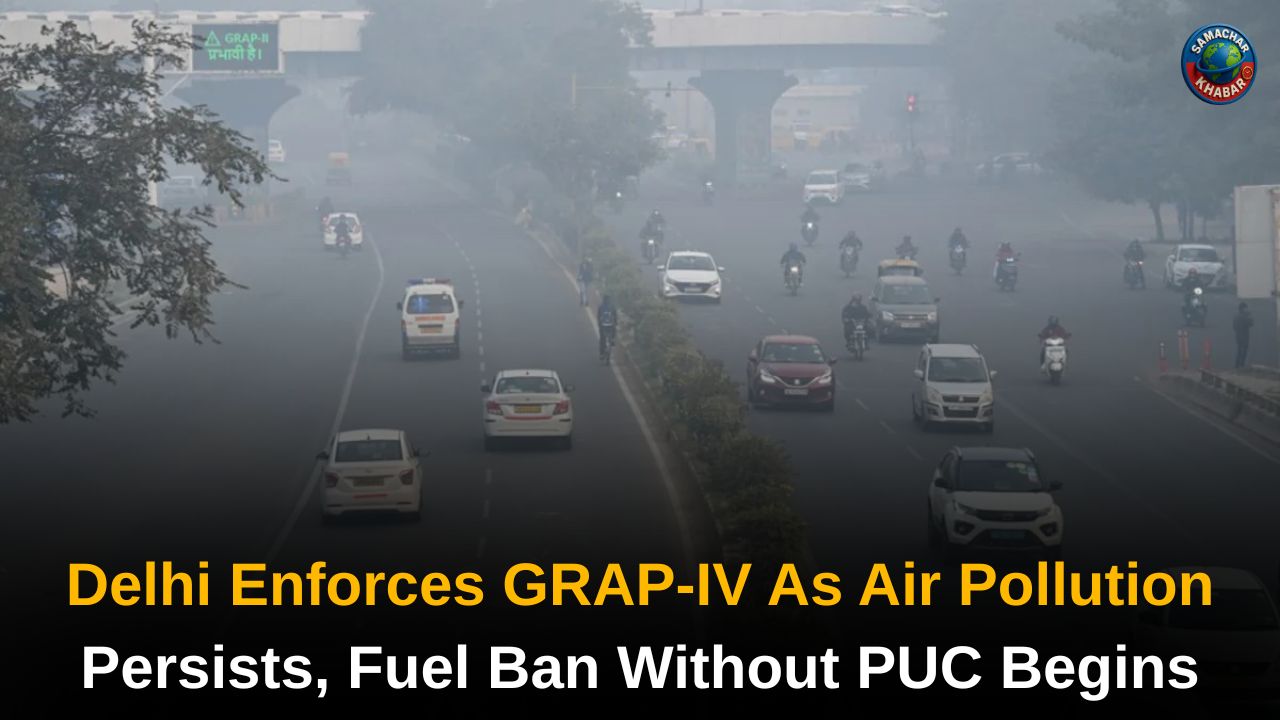
Delhi activated the strictest anti-pollution measures under Stage IV of the Graded Response Action Plan (GRAP) on Thursday, December 18, 2025, as air quality remained a major concern in the national capital. The measures include a ‘No PUC, No Fuel’ rule, restrictions on vehicle entry, suspension of construction activities, and a mandatory 50% work-from-home policy across government and private offices.
Despite pleasant winter weather with moderate temperatures, pollution levels stayed high, accompanied by dense morning fog that disrupted visibility. Authorities intensified enforcement as air quality hovered in the very poor to severe categories.
Key Takeaways on Delhi Air Pollution and GRAP-IV Measures
- GRAP Stage IV came into force on December 18, 2025
- Vehicles without valid PUC certificates are barred from refuelling
- Only BS-VI compliant non-Delhi vehicles are allowed entry
- Construction and demolition activities remain fully suspended
- Offices must operate with 50% staff working from home
- Air Quality Index remained in the very poor range
- Dense fog reduced visibility across Delhi-NCR
- Enforcement tightened with extensive traffic police deployment
- Data on air quality referenced from AQI.in
GRAP Stage IV Comes Into Force Across Delhi-NCR
The Commission for Air Quality Management (CAQM) invoked Stage IV of the Graded Response Action Plan (GRAP) across Delhi-NCR as pollution levels continued to pose health risks. GRAP-IV represents the most stringent set of emergency measures and is implemented in addition to actions already underway under Stages I, II, and III.
On Thursday, December 18, Delhi’s air quality was recorded in the ‘very poor’ category, with an AQI of 358. The move aimed to curb emissions from vehicles, construction activities, and commercial operations contributing to pollution levels.
‘No PUC, No Fuel’ Rule Enforced at Petrol Pumps
One of the key measures under GRAP-IV is the enforcement of the ‘No PUC, No Fuel’ rule. From December 18, vehicles without a valid Pollution Under Control (PUC) certificate are not allowed to refuel at petrol pumps in the national capital.

The Delhi Traffic Police intensified enforcement across the city. Personnel were seen manually checking PUC certificates at fuel stations before permitting refuelling.
According to officials:
- Over 100 teams were deployed across Delhi
- More than 580 police personnel were stationed
- 126 checkpoints, including inter-state borders, were set up
A Delhi Traffic Police officer stated that multiple teams were deployed at key entry points to ensure strict compliance with the new curbs.
Also Read: GRAP 4 Restrictions: STRICTER ANTI POLLUTION MEASURES GRAP-4 IMPOSED IN DELHI NCR
Vehicle Entry Restrictions Tightened Under GRAP-IV
Under the new restrictions:
- Non-Delhi private vehicles below BS-VI standards are barred from entering the city
- Only BS-VI compliant vehicles registered outside Delhi are permitted
- Exceptions apply to vehicles carrying essential items or running on CNG, LNG, BS-VI diesel, or electric power
- Non-essential light commercial vehicles registered outside Delhi are prohibited unless they meet clean fuel norms
- Trucks carrying construction materials are not permitted to enter the city
Emergency services and essential operations, including hospitals, fire services, public transport, electricity departments, pollution control bodies, the Forest Department, and the Delhi Jal Board, remain exempt. BS-VI standard fuel, which authorities describe as the world’s cleanest fuel, remains a key requirement under the vehicle entry norms.
Construction Ban and Work-From-Home Mandate
All construction and demolition activities are suspended under GRAP-IV. The ban includes:
- Private construction projects
- Public infrastructure works
- Linear public projects such as highways, roads, flyovers, pipelines, power transmission lines, and telecom works
Additionally, all government and private establishments are required to function with only 50% staff physically present, as mandated whenever GRAP Stage III or above is invoked.
Professionals and staff involved in emergency and essential services are exempt from the work-from-home requirement.
Schools Shift to Hybrid Mode
Schools in Delhi are required to operate in hybrid mode under GRAP-IV. This applies not only to primary students but also to:
- Classes VI to IX
- Class XI
Students are given the option to attend classes online wherever feasible.
Authorities noted that under Stage IV, governments may also consider further emergency measures such as closing colleges, shutting non-essential commercial activities, or implementing odd-even vehicle rules if pollution worsens.
Compensation Announced for Construction Workers
Labour and Employment Minister Kapil Mishra announced on Wednesday, December 17, a one-time compensation of ₹10,000 for 2,57,244 registered construction workers affected by the suspension of construction and demolition activities under GRAP Stages III and IV.
The compensation aims to support workers who lost income due to the enforcement of pollution control measures.
Weather Remains Pleasant, But Pollution Lingers
On December 18, 2025, New Delhi experienced partly cloudy skies and comfortable temperatures, with:
- Daytime high: 24.8°C
- Night low: 15.6°C
- Humidity: 28%
- Wind speed: Around 12.2 km/h
- No rain predicted
The week ahead is expected to remain stable, with daytime temperatures ranging between 24°C and 28°C and nighttime temperatures between 15°C and 18°C. December 22 and 23 are forecast to be the warmest days. Residents stepping out during sunny afternoon hours were advised to use sunglasses and sunscreen, while the evening was considered suitable for short walks in less congested areas.
However, light winds and dry conditions may not significantly improve air quality.
Fog Disrupts Visibility Across Delhi-NCR
Adding to commuter concerns, dense fog enveloped Delhi-NCR on Thursday morning, reducing visibility to:
- 150 metres at Palam airport
- 200 metres at Safdarjung airport
The fog disrupted road traffic and prompted an orange alert. Weather officials warned that foggy conditions may persist during early mornings as winter intensifies.
Political and Parliamentary Response
Against the backdrop of worsening air quality, the Lok Sabha was scheduled to hold a detailed discussion on air pollution in Delhi and adjoining regions, with Union Environment Minister Bhupendra Yadav expected to respond.
Delhi Minister Parvesh Sahib Singh Verma stated that pollution is not a short-term issue and cited “11 years of neglect” by the previous Aam Aadmi Party government. He listed civic and environmental works that he said remained incomplete, including waste management, Yamuna cleaning, sewage treatment, and road maintenance.
Air Quality Data and Health Advisory
Yesterday’s air quality was recorded as severe, with an AQI of 371, and primary pollutants including:
- PM2.5: 214 µg/m³
- PM10: 286 µg/m³
Both levels exceeded safe limits and posed health risks, particularly for children, the elderly, and those with pre-existing conditions. Authorities advised limiting outdoor exposure and wearing masks in high-traffic areas. Yesterday’s severe air quality, with an AQI of 371, marked the third-worst pollution episode in Delhi this month, underscoring the persistence of the crisis.
Data referenced in this article is taken from AQI.in.
Managing Daily Life Amid Pollution Curbs
Despite the restrictions and lingering haze, authorities advised residents to plan outdoor activities during less congested hours, carry masks, and keep light jackets handy as temperatures drop in the evening. The enforcement measures aim to reduce emissions while allowing essential services to continue uninterrupted.
Spiritual Reflection on Human Responsibility
The continuing environmental challenges highlighted by Delhi’s air pollution situation reflect a deeper issue of human responsibility in the present age. Living in Kalyug, society has gradually moved away from fear of God and collective accountability, focusing increasingly on personal gain and unchecked greed. Sustainable development, which ensures that future generations inherit a healthy environment as earlier generations once did, is often overlooked amid rapid modernisation and industrialisation.
In this context, Tatvdarshi Saint Rampal Ji Maharaj Ji has consistently emphasised the importance of moral living, balanced use of resources, and compassion towards nature. Through His Knowledge, followers are encouraged to adopt environmentally responsible practices such as tree plantation and disciplined living, while also attaining inner peace. Such spiritual awareness promotes happiness, responsible conduct, and devotion, which ultimately align human actions with the well-being of society and the Creator.
- For more information visit our
- Website: www.jagatgururampalji.org
- YouTube: Sant Rampal Ji Maharaj
- Facebook: Spiritual Leader Saint Rampal Ji
- X (Twitter): @SaintRampalJiM
FAQs on Delhi Air Pollution and GRAP-IV Measures
Q1. When did GRAP Stage IV come into force in Delhi?
GRAP Stage IV was implemented on Thursday, December 18, 2025.
Q2. What does the ‘No PUC, No Fuel’ rule mean?
Vehicles without valid PUC certificates are not allowed to refuel at petrol pumps in Delhi.
Q3. Are all vehicles banned from entering Delhi under GRAP-IV?
Only non-Delhi vehicles below BS-VI standards are restricted; clean fuel and essential vehicles are exempt.
Q4. Are offices required to follow work-from-home rules?
Yes, all government and private offices must operate with 50% staff working from home.
Q5. Which source provided the air quality data?
The air quality data cited in the article is sourced from AQI.in.