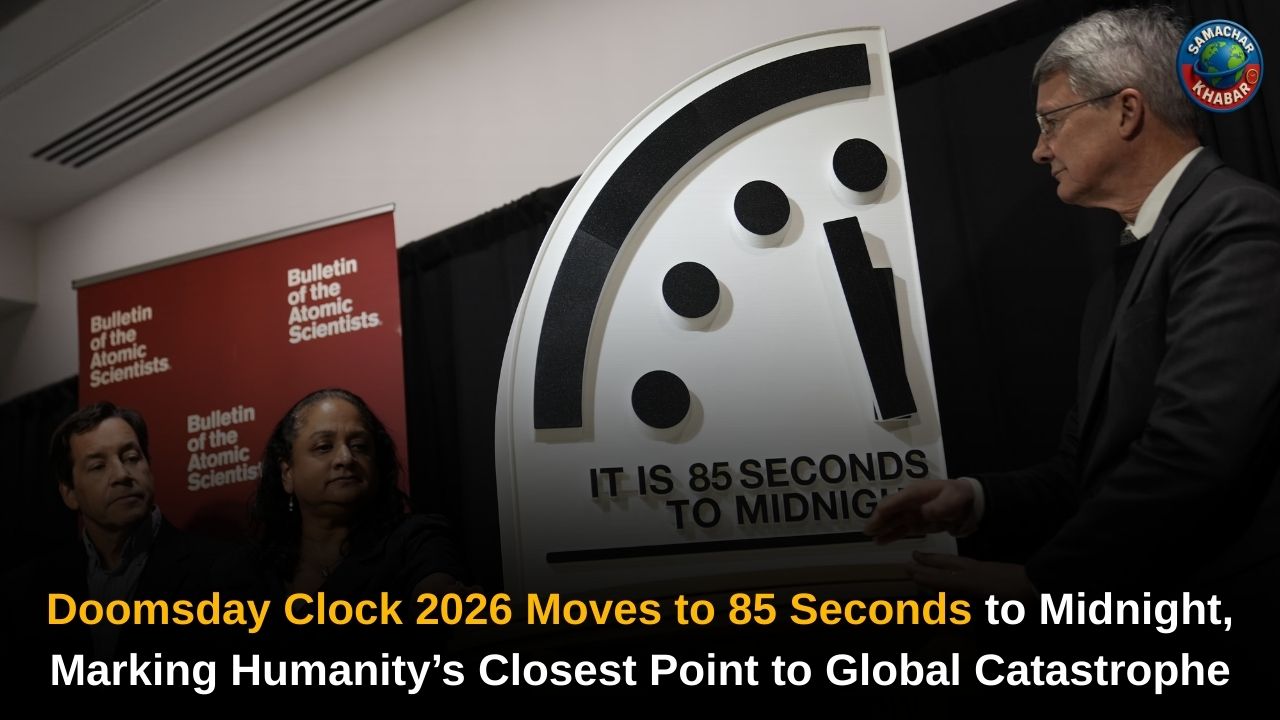
The Doomsday Clock has been moved to 85 seconds to midnight, the closest humanity has ever come to symbolic global catastrophe. Announced on January 27, 2026, by the Bulletin of the Atomic Scientists, the decision reflects escalating nuclear risks, worsening climate impacts, unregulated artificial intelligence, biological threats, and a worldwide failure of leadership.
Scientists warn that aggressive nationalism, weakening arms-control treaties, and the rapid spread of misinformation have sharply increased existential dangers. While the clock is not a prediction of the end, it is a powerful warning that humanity’s survival now depends on urgent global cooperation and decisive action.
Key Takeaways on the Doomsday Clock 2026 and Global Risks
- The Doomsday Clock is now set at 85 seconds to midnight, the closest in its nearly 80-year history.
- Scientists cite nuclear escalation, climate crisis, AI misuse, biosecurity threats, and leadership failure as primary drivers.
- The possible expiry of the New START Treaty raises fears of a renewed nuclear arms race.
- Conflicts involving nuclear-armed states and rising nationalism have increased global instability.
- Experts stress the risks are human-made and reversible through cooperation, regulation, and public engagement.
What Is the Doomsday Clock and Why It Matters
The Doomsday Clock is a symbolic measure created in 1947 by scientists associated with the Manhattan Project to communicate how close humanity is to destroying itself through its own technologies. Originally focused on nuclear weapons, the clock’s scope has expanded over time to include climate change, biotechnology, and emerging technologies such as artificial intelligence.
Midnight represents total global catastrophe. Moving closer to midnight signals rising existential risk, while moving away reflects progress in reducing those dangers. The clock is not a forecast, but a warning meant to drive awareness, debate, and action.
Why Scientists Moved the Clock Closer in 2026
The Bulletin of the Atomic Scientists said the clock was advanced by four seconds because the world has failed to meaningfully reduce major existential threats.
Rising Nuclear Dangers
Scientists highlighted ongoing and potential conflicts involving nuclear-armed states, including the Russia–Ukraine war, tensions in the Middle East, and clashes between India and Pakistan. Particular concern was raised over the possible expiration of the New START Treaty, the last remaining agreement limiting U.S. and Russian nuclear arsenals. Without renewal, experts warn there may be no guardrails left to prevent a renewed arms race.
Climate Crisis Intensifies
Worsening droughts, floods, and heatwaves linked to climate change were cited as growing risks. Scientists warned that governments have failed to implement sufficient policies to reduce emissions, making climate impacts more severe and destabilizing societies worldwide.
Artificial Intelligence and Disinformation
The rapid spread of artificial intelligence, especially without adequate regulation, has emerged as a major concern. Scientists warned that AI is accelerating the spread of misinformation and disinformation, weakening trust, democratic institutions, and international cooperation. There are also fears about AI’s integration into military systems and its potential misuse in biological research.
Also Read: Arijit Singh Calls It Off: Bollywood’s Most Loved Voice Won’t Take New Playback Songs
Nobel Peace Prize laureate Maria Ressa described the situation as an “information armageddon,” where lies spread faster than facts, undermining a shared global reality.
Biological and Biosecurity Threats
Experts also warned about emerging biological risks, including advanced synthetic research and the lack of a coordinated global response to future pandemics or biological threats.
Failure of Leadership and Growing Nationalism
A central theme in the Bulletin’s assessment was a global failure of leadership. Scientists said that major powers — particularly the United States, Russia, and China — have become increasingly aggressive, adversarial, and nationalistic.
According to the Bulletin, hard-won global understandings are collapsing, fueling a “winner-takes-all” competition that undermines cooperation on nuclear arms control, climate action, AI governance, and biosecurity. Experts warned that a world divided into “us versus them” blocs increases the risk that humanity as a whole will suffer.
How the Doomsday Clock Is Determined
The clock is set annually by the Science and Security Board of the Bulletin of the Atomic Scientists, in consultation with its Board of Sponsors, which includes Nobel laureates.
Each year, experts consider two guiding questions:
- Is humanity safer or more at risk than it was last year?
- Is humanity safer or more at risk compared with the entire history of the clock?
Their judgment is based on scientific evidence, geopolitical developments, and emerging technological risks.
Historical Perspective: How Close Have We Been Before?
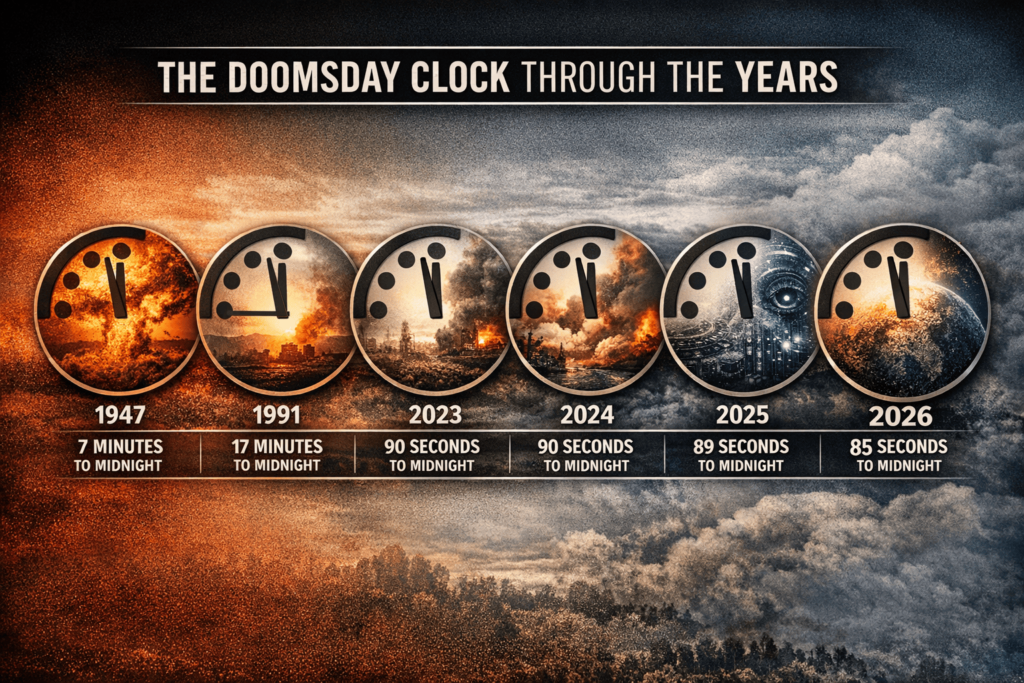
| Year | Doomsday Clock Time | Global Context & Key Reason |
| 1947 | 7 minutes to midnight | Clock introduced amid nuclear fears following World War II and the use of atomic weapons. |
| 1991 | 17 minutes to midnight | Farthest point from catastrophe after the Cold War ended and the Strategic Arms Reduction Treaty was signed. |
| 2023 | 90 seconds to midnight | Heightened nuclear fears linked to the Russia–Ukraine war and global instability. |
| 2024 | 90 seconds to midnight | Continued conflicts, climate-related disasters, and rising concerns over artificial intelligence. |
| 2025 | 89 seconds to midnight | Nuclear risk, climate crisis, biological threats, and disruptive technologies cited by scientists. |
| 2026 | 85 seconds to midnight | Closest ever, driven by nuclear tensions, AI misuse, climate failures, biosecurity risks, and leadership breakdown. |
A Spiritual Perspective on Humanity’s Crisis: Insights from the Unique Knowledge of Saint Rampal Ji Maharaj
While scientists assess humanity’s survival through technology and policy, Saint Rampal Ji Maharaj Ji’s spiritual teachings approach the crisis from a deeper root — the moral and spiritual direction of human life. According to his unique knowledge, widespread unrest, conflict, environmental destruction, and misuse of science arise when humanity disconnects from true spiritual values and ethical living.
His teachings emphasize that peace cannot be sustained only through treaties or technology unless individuals adopt truth, self-restraint, compassion, and righteous conduct. Saint Rampal Ji Maharaj explains that unchecked greed, power struggles, and ignorance of spiritual law lead societies toward destruction, while correct spiritual knowledge guides humanity toward harmony with nature and one another.
From this perspective, the warning symbolized by the Doomsday Clock is not merely scientific but spiritual as well — urging humanity to reform inner values alongside external systems. The message is clear: lasting safety for the world requires not only global cooperation and regulation, but also spiritual awakening and disciplined living, without which no technological progress can secure humanity’s future.
Can the Clock Be Turned Back?
Scientists emphasize that the future is not fixed. Because these dangers are created by human actions, they can also be reduced by human decisions. The Bulletin calls for renewed nuclear arms dialogue, stronger climate policies, global safeguards on artificial intelligence, and coordinated biosecurity measures.
Public engagement also matters. Scientists stress that informed citizens can counter misinformation and pressure leaders to act responsibly.
A Stark Warning, but Not the End of the Story
The Doomsday Clock’s latest setting delivers a sobering message: humanity is closer than ever to the brink. Yet scientists insist this is not a declaration of inevitable doom. History shows that cooperation and diplomacy can reverse dangerous trends. The clock stands as a reminder that while time is short, the responsibility — and the power to change course — still rests in human hands.
Faqs on Doomsday Clock 2026
1. What is the Doomsday Clock and what does 85 seconds to midnight mean?
The Doomsday Clock symbolically measures global existential risk. At 85 seconds to midnight, scientists say humanity is closer than ever to self-destruction.
2. Why was the Doomsday Clock moved closer to midnight in 2026?
Scientists cited rising nuclear threats, climate change impacts, unregulated artificial intelligence, biological risks, and a global failure of political leadership.
3. Who sets the Doomsday Clock time each year?
The Bulletin of the Atomic Scientists’ Science and Security Board sets the time, consulting global experts and Nobel laureates on nuclear, climate, and technological risks.
4. Is the Doomsday Clock a prediction of the end of the world?
No. The Doomsday Clock is a warning tool, not a prediction, designed to highlight risks and push leaders and societies toward corrective action.
5. Can the Doomsday Clock be moved back from midnight?
Yes. Scientists say global cooperation on nuclear arms control, climate action, AI regulation, and biosecurity can reduce risks and move the clock backward.