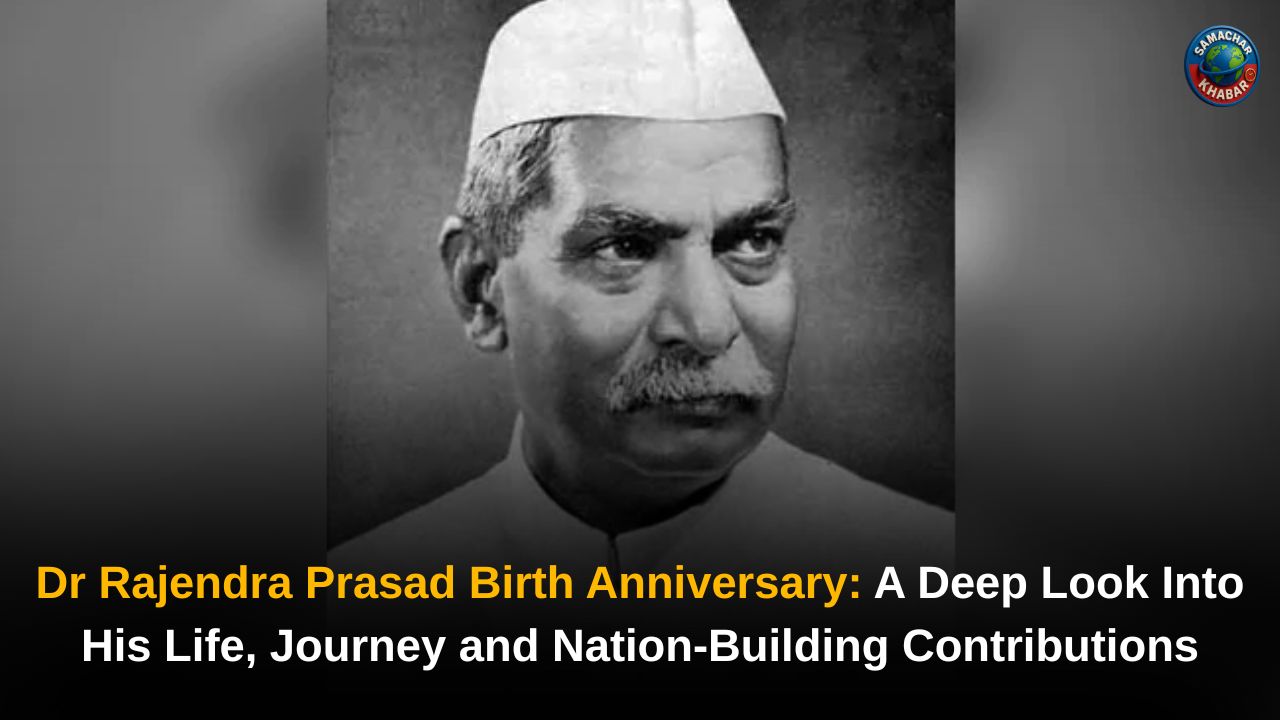
Dr Rajendra Prasad Birth Anniversary: India observes the birth anniversary of Dr Rajendra Prasad on December 3, remembering a statesman whose journey from a brilliant scholar in Bihar to the first President of India remains one of the most inspiring chapters in the nation’s history. Born in 1884 in Ziradei, Siwan, Dr Prasad combined academic excellence, moral courage, administrative discipline and deep humility—qualities that shaped the early decades of independent India.
On this occasion, the country reflects on his life, his contribution to the freedom movement, his role in framing the Constitution and his long tenure as the Head of State.
Key Takeaways: Dr Rajendra Prasad’s Life, Journey and Nation-Building Contributions
- Born on December 3, 1884, in Ziradei, Bihar; known for his humility, intellect and scholarship.
- Excelled academically, topping the University of Calcutta entrance exam; completed M.A. in Economics and a Doctorate in Law.
- Quit a successful legal career to join Gandhi’s freedom movement; jailed during Salt Satyagraha (1931) and Quit India Movement (1942).
- Served as President of the Indian National Congress (1934, 1939, 1947).
- As President of the Constituent Assembly, guided the drafting of the Indian Constitution.
- Became India’s first President in 1950; only President to serve two full terms (1950–1962).
- Awarded the Bharat Ratna in 1962; passed away on February 28, 1963.
- Wrote influential works including Satyagraha at Champaran, India Divided, Atmakatha, and Bapu Ke Kadmon Mein.
Early Life: The Making of a Scholar
Dr Rajendra Prasad was born into a Kayastha family in Ziradei, Bihar. His father, Mahadev Sahai, was well-versed in Sanskrit and Persian, while his mother narrated stories from the Ramayana and Mahabharata, shaping his value system. A gifted child, he stood first in the entrance exam to the University of Calcutta, earning a monthly scholarship. An examiner evaluating his answer sheet famously wrote: “The examinee is better than the examiner.”
He completed his F.A., B.A. and M.A. in Economics with first division and later pursued legal studies—earning a Master of Laws and ultimately a Doctorate. Dr Prasad also taught English in Bihar and Economics in Kolkata before turning to full-time legal practice at the Calcutta and Patna High Courts.
Turning Toward Nation-Building: Influence of Mahatma Gandhi
Dr Prasad’s life changed profoundly after meeting Mahatma Gandhi during the Champaran Satyagraha in 1917. Deeply moved by Gandhi’s ideals, he abandoned his flourishing legal career in 1920 to join the Non-Cooperation Movement. He later played key roles in:
- Champaran Satyagraha (1917)
- Non-Cooperation Movement (1920)
- Salt Satyagraha (1930)
- Quit India Movement (1942)
He was arrested several times and spent nearly three years in jail during the Quit India movement. As part of his commitment, he encouraged his son to leave Western-style education and join the indigenous Bihar Vidyapeeth.
Dr Prasad also contributed to nationalist journalism, writing for the English weekly Searchlight and founding the Hindi weekly Desh.
Leadership in Crisis: Relief Work and Public Welfare
Dr Rajendra Prasad was known not only as a political leader but also as a compassionate relief worker. During the devastating Bihar earthquake of 1934, he was released from jail to lead rescue operations. He set up the Bihar Central Relief Committee and coordinated nationwide aid efforts.
He also organised committees in Sindh and Punjab after the Quetta earthquake of 1935. His hands-on involvement during natural calamities strengthened his bond with the common people.
Rise to National Leadership
Dr Prasad played key organisational roles in the Indian National Congress. He was elected:
- Congress President in 1934 during the Bombay session,
- Again in 1939 after Subhash Chandra Bose resigned,
- And once more in 1947, after J. B. Kripalani stepped down.
His leadership during these crucial years highlighted his administrative balance, moral strength and ability to unify diverse viewpoints.
Framing India’s Constitution: His Defining Role
After the 1946 Constituent Assembly elections, Dr Rajendra Prasad was elected President of the Constituent Assembly. He guided debates with patience, clarity and neutrality, ensuring that diverse ideologies were harmonised into a workable Constitution.
He chaired several pivotal committees, including:
- Committee on the National Flag
- Rules of Procedure Committee
- Finance and Staff Committee
His steady guidance helped the Assembly deliver a Constitution that remains the foundation of India’s democracy.
India’s First President: Twelve Years of Dignified Leadership
When India became a Republic on January 26, 1950, Dr Rajendra Prasad was unanimously elected the nation’s first President. He became the only President in history to be re-elected twice—in 1952 and 1957—serving an unparalleled tenure of nearly 12 years.
During his Presidency, he:
- Upheld strict political neutrality
- Encouraged the development of education and public welfare
- Offered guidance to governments during key decisions
- Reduced his own salary as a gesture of humility
- Welcomed public access to Mughal Gardens, a tradition that still continues
His presidency set standards of dignity, restraint and constitutional clarity.
Dr Rajendra Prasad: A Prolific Writer and Thinker
A multitalented personality, Dr Prasad authored several significant books reflecting his experiences and philosophies.
Major Works
| Book Title | Year |
| Satyagraha at Champaran | 1922 |
| India Divided | 1946 |
| Atmakatha | 1946 |
| Mahatma Gandhi and Bihar: Some Reminiscences | 1949 |
| Bapu Ke Kadmon Mein | 1954 |
| Since Independence | 1960 |
His writings remain essential references for historians, scholars and students.
Final Years and National Honour
Dr Rajendra Prasad stepped away from the Presidency in 1962 due to health concerns. That same year, he received the Bharat Ratna, India’s highest civilian honour.
He spent his later life at Sadaqat Ashram in Patna and passed away on February 28, 1963, at the age of 78.
Spiritual Insight: Understanding Dr Rajendra Prasad’s Legacy Through the Wisdom of Saint Rampal Ji Maharaj
In today’s fast-paced world, the life of Dr Rajendra Prasad continues to inspire discussions on humility, duty and moral discipline. Many spiritual thinkers highlight that true leadership begins with inner transformation.
Saint Rampal Ji Maharaj, through His spiritual discourses based on the scriptures of all major religions, emphasises the importance of simplicity, non-violence and devotion grounded in true knowledge. These values resonate strongly with the life Dr Prasad lived—marked by restraint, service and integrity.
Saint Rampal Ji Maharaj teaches that a stable and just society can be built only when individuals adopt a spiritually disciplined life aligned with the eternal path described in sacred texts. As the nation reflects on Dr Rajendra Prasad’s birth anniversary, this spiritual perspective offers a deeper understanding of how righteousness, humility and truth can guide both personal conduct and public leadership.
A Living Legacy for Modern India
Dr Rajendra Prasad’s life remains a powerful reminder of how humility, education and duty can shape a nation. His contributions—as a scholar, freedom fighter, Constitution-maker and President—continue to guide India’s democratic spirit.
On his birth anniversary, the nation honours not just a historical figure, but a symbol of integrity and service who helped lay the foundation of modern India.
FAQs on Dr Rajendra Prasad Birth Anniversary 2025
1. Why is Dr Rajendra Prasad’s birth anniversary significant?
It commemorates the birth of India’s first President, honouring his scholarship, freedom struggle role, constitutional leadership and contributions to building the early framework of independent India.
2. What were Dr Rajendra Prasad’s major contributions to India’s freedom movement?
He joined Gandhi’s movements, participated in Champaran, Non-Cooperation, Salt Satyagraha and Quit India, and was imprisoned multiple times for resisting British rule.
3. What role did Dr Rajendra Prasad play in drafting the Constitution?
He served as President of the Constituent Assembly, guided debates, and chaired committees on the National Flag, Rules of Procedure, and Finance and Staff.
4. How long did Dr Rajendra Prasad serve as India’s President?
He served nearly 12 years, becoming the first and longest-serving President, and the only one re-elected in both 1952 and 1957.
5. Which key books were authored by Dr Rajendra Prasad?
His notable works include Satyagraha at Champaran, India Divided, Atmakatha, Mahatma Gandhi and Bihar, Bapu Ke Kadmon Mein, and Since Independence.