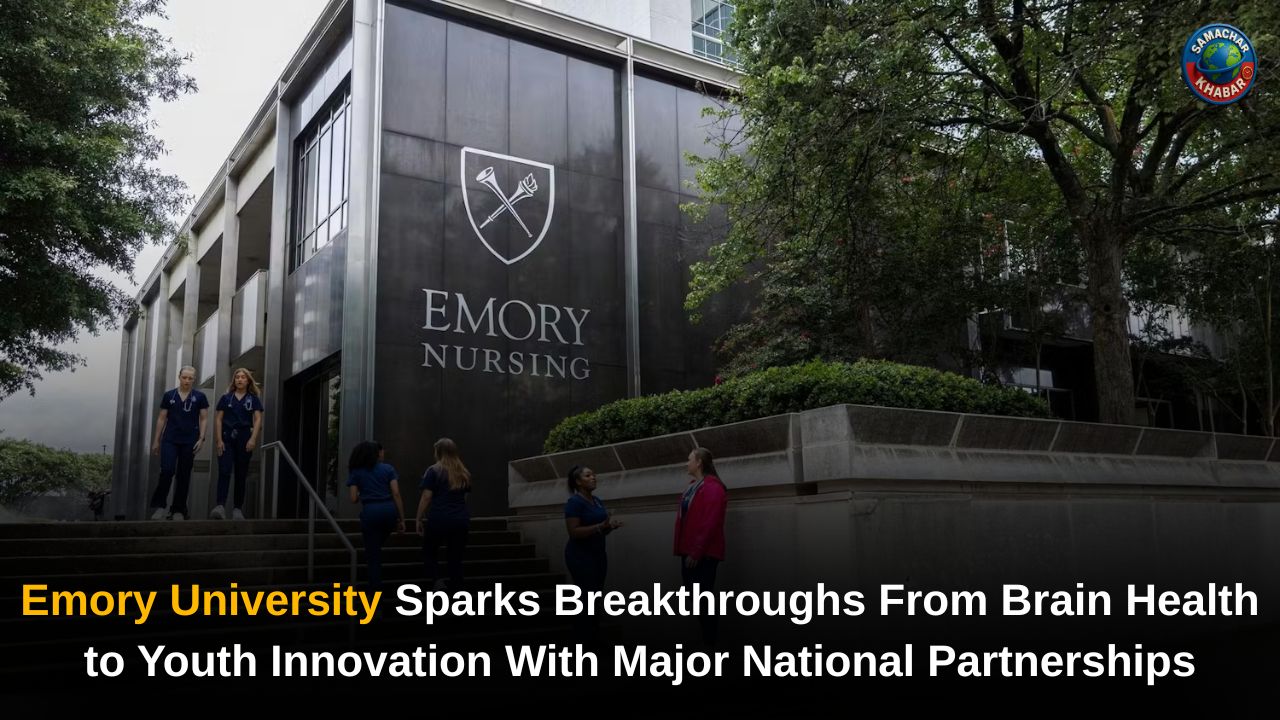
Emory University has emerged at the center of several groundbreaking developments spanning neuroscience, advertising research, alumni excellence, and creative-industry education. From securing a $200,000 Alzheimer’s research grant to reshaping global marketing debates through a joint NYU–Emory study, the university is also celebrating rising alumni leadership while partnering with music icons Usher and Big Sean to invest $1 million in a Detroit-based Entertainment Innovation Incubator.
Together, these initiatives showcase Emory’s expanding role in advancing community well-being, scientific discovery, and next-generation talent development across the United States.
Key Takeaways: Emory University’s Multi-Sector Impact in Health, Research, and Youth Innovation
- Emory receives a $200,000 Alzheimer’s Foundation grant to study how artistic engagement improves emotional well-being and brain health.
- NYU–Emory study finds GenAI-created ads outperform human and hybrid ads, redefining creative strategy and transparency debates.
- Emory honors trademark expert David Jackson in its 2025 “40 Under Forty” class, highlighting alumni leadership in global brand protection.
- Emory partners with Usher and Big Sean for a $1 million Detroit Entertainment Innovation Incubator, offering youth training in film, TV, music, AI, and immersive technologies.
- Michigan Central Boys & Girls Club to host a state-of-the-art 13,000 sq.-ft. youth hub, supporting innovation, production, and workforce development.
Emory Secures Major Alzheimer’s Foundation Grant to Advance NeuroArts Research
Emory University has been awarded a $200,000 grant from the Alzheimer’s Foundation of America to lead a community-driven research project examining how artistic engagement—particularly music—supports brain health and emotional resilience.
The research is headed by Dr. Monica W. Parker of Emory’s Goizueta Alzheimer’s Disease Research Center and is part of the Arts + Health Laboratory: Georgia’s NeuroArts Coalition, an initiative involving the Emory Goizueta Brain Health Institute, the Atlanta Symphony Orchestra, and Performance Hypothesis.
The study seeks to better understand how music and creative arts may help preserve cognitive function across a lifespan. Participants will also attend a live “Christmas with the ASO” performance as part of the program launch.
Allan Levey, Executive Director of the Brain Health Institute, emphasized that artistic engagement may play a meaningful role in slowing cognitive decline and fostering emotional connection — a direction that aligns with Emory’s mission of community-centered innovation.
NYU–Emory Study Reveals GenAI Performs Best Without Human Intervention
A joint academic study conducted by NYU Stern School of Business and Emory’s Goizueta Business School has delivered one of the most influential findings in today’s marketing landscape: ads created entirely by visual generative AI outperform both human-made and AI-modified ads.
Key Findings From the Study
| Creative Type | Result |
| GenAI-Created Ads | Up to 19% higher CTR in field tests |
| Human + AI Hybrid Ads | Reduced purchase intention |
| Human-Made Ads | Outperformed by fully synthetic ads |
| AI Disclosure | Effectiveness dropped up to 31.5% |
Researchers attribute the success of fully AI-originated ads to higher emotional engagement and processing fluency. In contrast, AI edits to human designs often disrupted authenticity, making the final output appear less believable.
The study further notes that when viewers were informed an ad was AI-created, performance decreased sharply — creating a regulatory and ethical tension as governments push for content labeling.
Also Read: Qs World University Rankings 2026: Top 5 Universities in the World
These findings are now prompting global marketers to reconsider their creative workflows, potentially shifting humans from “originators” to strategic editors, while allowing AI to lead first-draft creation.
Emory Recognizes Trademark Leader David Jackson in 2025 “40 Under Forty”
Emory University has honored David Jackson, partner at Womble Bond Dickinson, as part of its distinguished 2025 Class of 40 Under Forty. Jackson manages thousands of trademark filings globally and advises Fortune 500 companies and startups on brand protection and monetization strategies.
Recognized by the World Trademark Review WTR 1000, Jackson is also known for his community leadership. He serves on the board of Big Brothers Big Sisters of Central Arizona and was named Big Brother of the Year in 2019 for his mentorship work.
Emory’s 40 Under Forty program celebrates alumni shaping industries and communities, and Jackson’s inclusion reflects the university’s strong legacy in legal and business leadership.
Emory, Usher, and Big Sean Unite to Build Detroit’s $1 Million Entertainment Innovation Incubator
Emory University’s Goizueta Business School is partnering with global entertainers Usher and Big Sean to launch a $1 million Entertainment Innovation Incubator in Detroit. Opening in February 2026, the incubator is designed to equip youth aged 14–24 with industry-recognized credentials and hands-on training in:
- Film and television production
- Music creation and sound design
- AI and immersive technologies
- 3D design and virtual production
Educational support will be provided through Emory Goizueta Business School and Ilitch Sports + Entertainment.
Facility Features at the Michigan Central Boys & Girls Club
| Space / Equipment | Purpose |
| Virtual Production Studio | Immersive filmmaking |
| Special Effects Lab | Visual effects training |
| Creators Lounge | Collaboration and ideation |
| Autonomous Training Center | Robotics & mobility skills |
| Innovation Lab | AI & advanced manufacturing pathways |
Detroit native Big Sean emphasized that the incubator allows young people to build opportunities without leaving Detroit. The 13,000 sq.-ft. Michigan Central Boys & Girls Club will serve as the creative hub, supported by Michigan Central leadership, Boys & Girls Clubs of Southeastern Michigan, Usher’s New Look, and the Sean Anderson Foundation.
Carolina Pluszczynski, COO of Michigan Central, noted that the initiative aims to equip Detroit youth to innovate across entertainment, technology, and manufacturing—ushering in a new generation of local industry leaders.
How Emory’s Expanding Ecosystem Is Shaping Tomorrow’s Innovators
Emory University’s recent initiatives illustrate a defining shift: academia is no longer confined to laboratories and classrooms—it is actively shaping arts-based health research, transforming global marketing norms, elevating alumni excellence, and building career pipelines for underserved youth.
The Alzheimer’s research collaboration deepens community-based brain-health innovation, the NYU–Emory study challenges long-standing creative assumptions, the 40 Under Forty recognition spotlights leadership grounded in service, and the Detroit incubator opens new pathways for high-potential young creators.
Together, these developments highlight Emory’s evolving role as a national force for discovery, equity, and creative opportunity.
FAQs on Emory University’s Latest Research, Partnerships & Youth Innovation Initiatives
1. What major grant did Emory University receive for brain-health research?
Emory received a $200,000 Alzheimer’s Foundation grant to study how music and arts-based engagement can improve emotional well-being and support brain health in individuals with cognitive changes.
2. What did the NYU–Emory study reveal about AI-created advertisements?
The study found that fully AI-generated ads outperform human or hybrid ads, increasing click-through rates and effectiveness, while disclosure of AI involvement significantly reduces performance.
3. Who is David Jackson, and why was he honored by Emory University?
David Jackson, a leading trademark attorney, was named to Emory’s 2025 40 Under Forty for his global IP work and community leadership with Big Brothers Big Sisters.
4. What is the purpose of the $1 million Entertainment Innovation Incubator in Detroit?
The incubator trains youth ages 14–24 in film, TV, music production, AI, 3D, and immersive technologies, providing industry credentials through Emory and partner organizations.
5. What facilities will the Michigan Central Boys & Girls Club offer to Detroit youth?
The 13,000 sq.-ft. space will include a virtual production studio, special effects lab, innovation lab, autonomous training center, and collaborative areas supporting creative and tech career development.