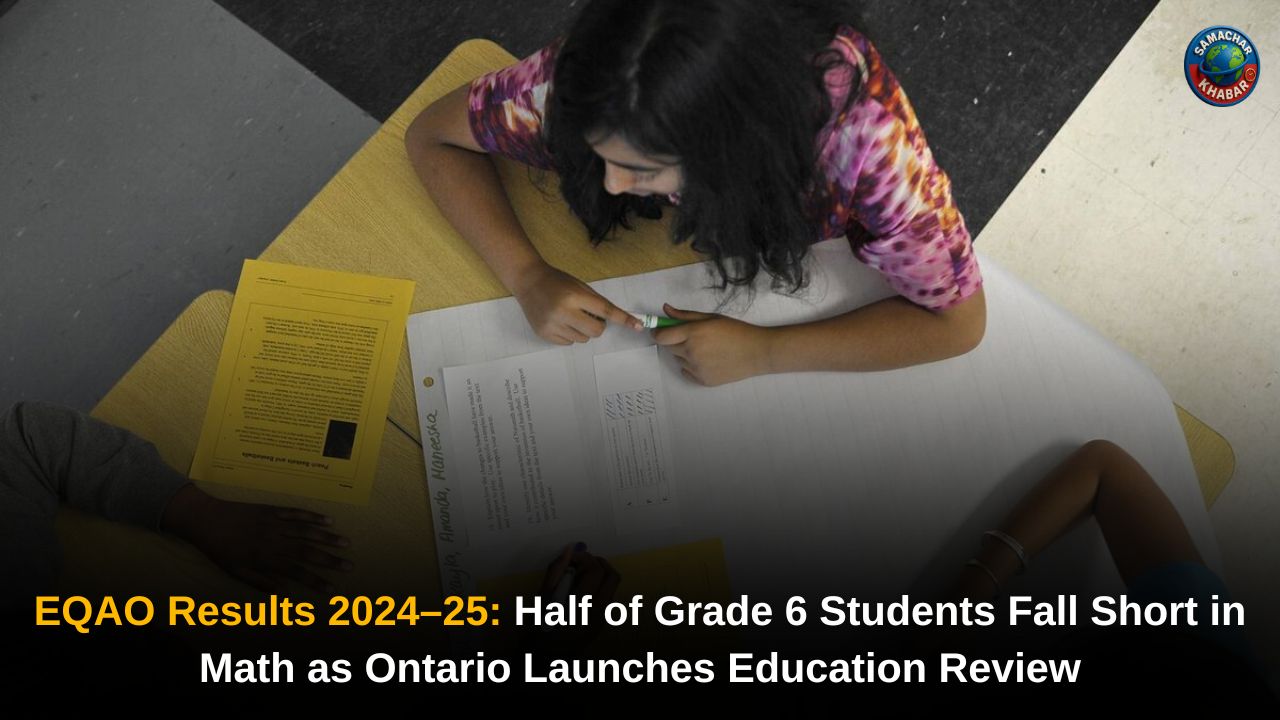
EQAO Results 2024–25: Ontario has released the Education Quality and Accountability Office (EQAO) results for the 2024–2025 school year, revealing slow but noticeable gains in reading, writing, and mathematics across Grade 3, Grade 6, Grade 9 and the Ontario Secondary School Literacy Test (OSSLT). While overall performance has inched upward compared to previous years, mathematics remains a major province-wide concern.
With nearly half of Grade 6 students and a significant share of Grade 9 students not meeting provincial expectations, the Ontario government has ordered a system-wide review aimed at improving curriculum clarity, assessment practices, teacher preparedness and student support.
Key Takeaways: Ontario EQAO Results 2024–25 Show Slow Progress and Deep Gaps in Math Achievement
- Mathematics remains Ontario’s weakest area, with only 51% of Grade 6 and 58% of Grade 9 meeting provincial standards.
- Reading and writing scores continue to outperform math, with Grade 6 reading at 86% and writing at 85%.
- More than 574,000 students took part in EQAO testing across English- and French-language boards.
- Province launches a two-member advisory body to review curriculum, testing alignment, teacher preparation and resources.
- Significant achievement gaps persist between student groups, including those with special education needs.
- Local boards in Essex and Windsor-Essex show mixed performance, with some surpassing provincial standards.
- Cohort tracking data highlights long-term learning trends from Grade 3 to 6 and Grade 6 to 9.
Provincial Overview: EQAO Releases 2024–25 Assessment Data
The EQAO released province-wide, school-level and board-level results, offering a detailed snapshot of how students are meeting curriculum expectations. More than 574,000 students across English- and French-language systems completed the online assessments. EQAO also compiled contextual and attitudinal data through student questionnaires to help interpret achievement patterns.
Officials noted that mathematics results, although slowly improving, continue to present challenges. Several English- and French-language school boards recorded gains, yet the province stresses that the pace of improvement remains inadequate. Disparities between students with special education needs and their peers continue to be significant, underscoring the need for targeted support.
Grade 3: Improvements Across Reading, Writing and Math
Grade 3 students recorded notable gains across all subjects.
- Reading: 74% met the standard (up from 71% in 2023–24).
- Writing: 65% met the standard (similar to previous years).
- Math: 64% met the standard (up from 61%).
Learner attitudes showed:
- 71% like reading, 74% believe they are good readers.
- 56% like writing, 59% feel confident as writers.
- 67% like math, and 64% consider themselves good at math.
Grade 6: Literacy Strong, Math Still a Challenge
Grade 6 students demonstrated strong literacy outcomes but continued struggles in mathematics:
- Reading: 86%
- Writing: 85%
- Math: 51%
Attitudinal data indicates declining interest in core skills, especially math:
- 61% like reading, 70% feel confident reading.
- 52% like writing, 50% feel confident writing.
- Only 48% like math, with 50% believing they are good at it.
Grade 9: Math Results Improve Slightly but Remain Concerning
The Grade 9 computer-adaptive math assessment showed a modest improvement:
- 58% met the provincial standard (up from 54% in the previous two years).
Learners’ perception:
- 50% like math,
- 51% believe they are good at math,
- 64% believe they understand most lessons.
OSSLT: Literacy Outcomes Stable for Grade 10 Students
EQAO’s literacy test results remained steady:
- 85% of first-time eligible students were successful in 2024–25.
- 50% of previously eligible students passed, indicating ongoing challenges for repeat writers.
Achievement gaps persist between academic and applied streams, though the gap has narrowed over the past three years.
Also Read: Holly Willoughby Fined After Guilty Plea in Crash That Broke Scooter Rider’s Neck Near London Home
French-Language School Performance: Mixed Trends in Reading and Writing, Gains in Math
French-language schools recorded mixed outcomes:
- Grade 3: Reading decreased to 75%, writing remained 67%, math rose to 75%.
- Grade 6: Reading dropped to 89%, writing stayed at 79%, math climbed to 63%.
- Grade 9 math: 66% met the provincial standard.
- TPCL literacy test: 93% of first-time eligible students passed.
Learner attitudes mirrored English boards, with declining interest in writing and modest confidence in math.
Cohort Tracking: Long-Term Learning Trends
EQAO also analyzed learning progression from Grade 3 to Grade 6 and from Grade 6 to Grade 9.
Grade 3 (2021–22) → Grade 6 (2024–25): Reading
- 70% maintained standard
- 17% rose
- 4% dropped
- 9% never met
Writing
- 62% maintained
- 24% rose
- 4% dropped
- 11% never met
Math
- 45% maintained
- 8% rose
- 15% dropped
- 33% never met
Grade 6 (2021–22) → Grade 9 (2024–25): Math
- 45% maintained
- 16% rose
- 5% dropped
- 34% never met
These trends highlight persistent gaps and the need for early, sustained intervention.
Local Board Analysis: Performance Across Essex and Windsor-Essex
Greater Essex County DSB
- Grade 3: Reading 73%, Writing 64%, Math 62%
- Grade 6: Reading 86%, Writing 85%, Math 51%
- Grade 9 Math: 57%
- OSSLT: 81% first-time success; 48% repeat success
Windsor-Essex Catholic DSB
- Grade 3: Reading 79%, Writing 71%, Math 72%
- Grade 6: Reading 92%, Writing 93%, Math 60%
- Grade 9 Math: 57%
- OSSLT: 94% first-time success
Local board data shows both strengths—particularly in literacy—and ongoing concerns in math.
Government Response: System-Wide Review Announced
Education Minister Paul Calandra said the results reflect “insufficient progress,” noting that trustee infighting and inconsistent support continue to hinder student achievement. The province has launched a two-member advisory body to conduct a comprehensive review early next year.
The review will examine:
- Why student outcomes remain slow to improve
- Curriculum clarity
- Teacher preparation and support
- Resource availability
- Alignment between EQAO tests and classroom teaching
- Effectiveness of student supports, including special education
- Use of data for policy and funding
The panel’s final report will be made public.
Opposition leaders raised concerns, arguing that underfunding, large class sizes and lack of support staff contribute to stagnant scores. The Elementary Teachers’ Federation of Ontario repeated its call to scrap EQAO entirely, stating that standardized testing diverts resources from classrooms.
Moving Forward: What Ontario’s Education System Needs Next
With literacy remaining strong but math falling short across several grades and regions, Ontario now stands at a defining crossroads. The advisory review aims to identify the structural, curricular and resource-based barriers preventing stronger progress.
Evidence from year-over-year trends, cohort tracking and board-level data signals that early intervention, consistent instructional support and stable learning environments are critical.
As the province prepares for policy changes, the 2024–25 results serve as a clear reminder that student success hinges on sustained, system-wide reforms grounded in real classroom needs.
FAQs on Ontario EQAO Results 2024–2025
1. What are the key highlights of the Ontario EQAO Results 2024–2025?
The results show improved literacy scores but slow progress in math, with major achievement gaps and a province-wide review launched to address declining performance.
2. How did students perform in Grade 6 and Grade 9 math in 2024–2025?
Only 51% of Grade 6 and 58% of Grade 9 students met provincial math standards, indicating persistent challenges despite slight improvements.
3. Why is the Ontario government launching a system-wide education review?
The review aims to address slow academic progress, math weaknesses, curriculum clarity issues, and achievement gaps highlighted by EQAO data.
4. What does EQAO cohort tracking reveal about student learning?
Cohort data shows many students maintain or rise to standards, but a significant portion consistently struggles, especially in mathematics.
5. How did local boards in Essex and Windsor-Essex perform in EQAO tests?
Local boards showed strong literacy outcomes and mixed math results, with several areas surpassing provincial averages.