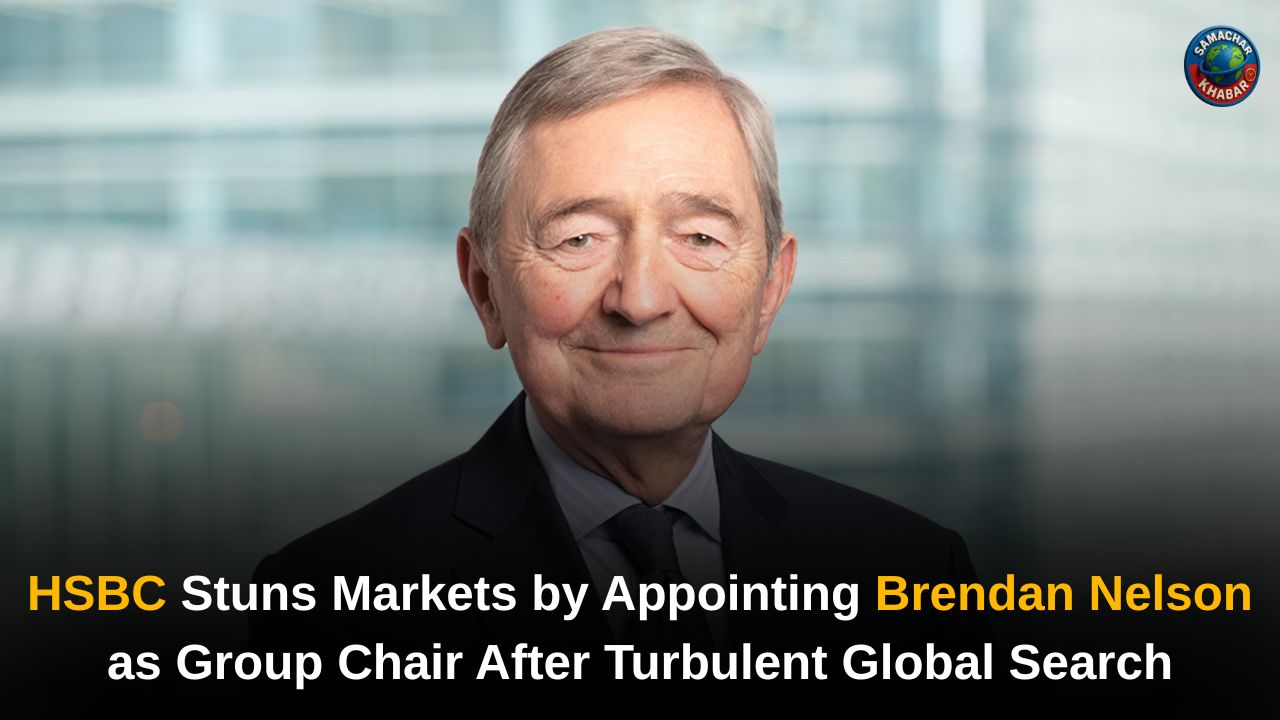
HSBC has finalized its months-long leadership search by appointing Brendan Nelson as its new Group Chair, ending a confusing and highly scrutinized succession process that unfolded across London, Hong Kong and global financial circles. Nelson, who has served as interim chair since October 1, now steps permanently into one of the most influential roles in international banking.
His appointment comes amid intense geopolitical pressures, strategic restructuring, shareholder tension and the departure of former chair Mark Tucker, whose exit—which led him back to AIA Group—left HSBC navigating uncertainty at a critical moment for the bank’s Asia-first strategy and long-term global positioning.
Key Takeaways on HSBC’s Appointment of Brendan Nelson as Group Chair
- HSBC appoints Brendan Nelson as permanent Group Chair, ending months of speculation and a prolonged search that involved multiple high-profile external candidates.
- Mark Tucker’s departure after eight years pushed HSBC into a complex transition, with the former chair rejoining AIA Group as its leader.
- The search process appeared chaotic, despite HSBC calling it a “robust” internal–external evaluation. Criticism arose over perceived lack of succession planning.
- Nelson’s background at KPMG, BP and RBS/NatWest positions him as a strong governance figure, though he lacks deep Asia experience.
- HSBC intensifies its Asia-first strategy, scaling back Western operations and focusing on growth in China and Hong Kong despite rising geopolitical risks.
- The bank faces earnings and regulatory challenges, including falling interest income, US–China tensions and trade tariffs threatening profitability targets.
Investors express concern about leadership stability, as Nelson has indicated he is not seeking a full six-to-nine-year term.
A Leadership Shift After Months of Uncertainty
HSBC’s announcement ends a protracted period filled with rumours, internal debates and disrupted timelines. Brendan Nelson had been considered a long-shot candidate, particularly after CEO Georges Elhedery stated publicly at a London banking conference that Nelson did not wish to commit to a lengthy chairmanship given the stage of his career. Yet, the board ultimately selected him, signalling internal preference amid limited external consensus.
Mark Tucker’s early departure intensified pressure. Although he had originally announced a plan to step down by the end of 2025, he exited in September to assume the non-executive chair role at Hong Kong-based AIA Group. His exit left HSBC without a permanent successor for months, prompting criticism from analysts who argued the bank should have managed its transition more smoothly.
A Search Process That Drew Global Attention
Despite HSBC’s official statement describing a “robust process,” the leadership search was widely seen as disordered. The board conducted several rounds of interviews this week alone, meeting both internal and external contenders. Among the most talked-about names were:
- Former UK Chancellor George Osborne, who would have brought political expertise
- Goldman Sachs Vice Chair Richard Gnodde
- Goldman Sachs Asia-Pacific executive Kevin Sneader
All three ultimately failed to secure the role. Analysts later commented that the bank’s inability to land an external candidate suggested limited consensus and heightened risk sensitivity during a politically charged moment for HSBC’s global operations.
Also Read: HSBC Stuns Markets by Appointing Brendan Nelson as Group Chair After Turbulent Global Search
Independent analyst John Cronin sharply criticised the process, calling it “utterly haphazard” and reflective of weak succession planning. Others echoed that sentiment, arguing the board should have anticipated the complexity of replacing a chair in an institution as globally entangled as HSBC.
Brendan Nelson: An Experienced Governance Voice, Though Not the Expected Choice
Nelson, 76, brings extensive governance and audit experience built over decades:
- More than 25 years at KPMG, including roles as global chair of banking and global chair of financial services
- Board positions at BP, RBS and NatWest
- Non-executive directorship at HSBC since 2023
His audit background and familiarity with complex financial structures make him a steadying figure for HSBC’s balance sheet oversight. However, some analysts have pointed out gaps—most notably his lack of deep Asia exposure, critical at a time when HSBC is refocusing sharply on its Asian footprint.
Nonetheless, HSBC’s senior independent director, Ann Godbehere, praised Nelson’s leadership, saying he had demonstrated strong governance credentials since assuming the interim role.
Nelson will also continue as chair of the Group Audit Committee until HSBC publishes its 2025 financial results in February 2026.
Mark Tucker’s Exit and the Legacy He Leaves Behind
Mark Tucker, the bank’s first-ever external chair, played a pivotal role during his eight-year tenure. His leadership spanned a period marked by:
- The COVID-19 pandemic
- Persistent pressure from Ping An to spin off HSBC’s Asian business
- Rising geopolitical tensions involving China, the US and the UK
- Internal restructuring debates and cost challenges
Tucker’s strategic focus and Asia experience helped shape HSBC’s direction through some of its most difficult years. His return to AIA—where he previously served as CEO and president—was widely seen as a natural homecoming.
HSBC Deepens Asia-Focused Strategy Amid Global Tensions
Nelson assumes leadership at a pivotal moment as HSBC sharpens its Asia-first strategy. Under CEO Georges Elhedery, the bank has undertaken a sweeping restructuring that includes:
- Scaling back US and European operations
- Strengthening Hong Kong and mainland China divisions
- Aligning the bank under four operational pillars
- Achieving record profit of $32.3 billion in 2024
- Offering $13.6 billion to buy out minority investors in Hang Seng Bank
Yet challenges remain. The bank warned that US President Donald Trump’s trade tariffs could threaten its long-term return-on-equity targets. Political scrutiny in the UK and US continues to intensify as HSBC navigates accusations of favouring mainland China.
Investor Reaction Reflects Concerns About Stability
The market responded cautiously, with HSBC shares dropping about 1% after Nelson’s appointment was confirmed.
Analysts pointed to two growing concerns:
- Nelson’s publicly stated reluctance for a long-term commitment
- The unclear succession pipeline for one of global finance’s most influential roles
Still, many welcomed the decision to finally close a drawn-out process. As one analyst noted, Nelson’s appointment “resolves a governance issue” and provides short-term certainty as the bank moves forward with restructuring and Asia-focused expansion.
What Lies Ahead for HSBC Under Nelson’s Leadership
Nelson now steps into a high-stakes chairmanship during one of HSBC’s most sensitive eras. He must balance:
- Falling interest income amid global rate cuts
- A push to grow fee-based revenue
- Investor pressure regarding strategic clarity
- Heightened geopolitical volatility
- Shareholder concerns about long-term leadership continuity
Working alongside CEO Georges Elhedery, Nelson will guide the next phase of the bank’s restructuring, oversee cost-cutting, and help steer Asia-driven growth while managing regulatory demands in the UK and US.
A Defining Period Begins for HSBC’s Global Future
Brendan Nelson’s appointment marks both the end of an uncertain search and the beginning of one of HSBC’s most consequential leadership chapters. With restructuring underway, geopolitical tensions rising, and earnings pressure intensifying, Nelson must stabilize the board, support a complex Asia-first strategy and rebuild confidence after a widely criticized selection process.
His extensive governance experience positions him as a steadying force, but the coming years will test HSBC’s ability to navigate competing global expectations while delivering the strategic and financial results demanded by shareholders.
FAQs on HSBC Appointing Brendan Nelson as Group Chair
1. Who is Brendan Nelson, the newly appointed HSBC Group Chair?
Brendan Nelson is a former KPMG global banking leader and HSBC board member since 2023, appointed permanent Group Chair after serving as interim chair from October 1.
2. Why did HSBC choose Brendan Nelson as its new Group Chair?
HSBC selected Nelson after a robust internal–external search. His governance, audit expertise, and board experience at BP and RBS made him a strong continuity candidate.
3. Why did Mark Tucker step down as HSBC’s Group Chair?
Mark Tucker stepped down after eight years to become non-executive chairman of AIA Group, returning to a company he previously led as CEO and president.
4. What challenges will Brendan Nelson face as HSBC’s new chair?
Nelson must oversee HSBC’s Asia-focused strategy, restructuring, cost-cutting, declining interest income, and rising geopolitical tensions involving China, the US and the UK.
5. How have investors reacted to Brendan Nelson’s appointment?
Investors expressed mixed views, citing leadership stability concerns. HSBC shares fell about 1% after the announcement, reflecting uncertainty over the long-term succession plan.