[ad_1]
In this year’s Union Budget, the government sanctioned the establishment of two new telescopes to study the sun and the origins of the universe, besides the upgradation of an existing telescope, in Ladakh.
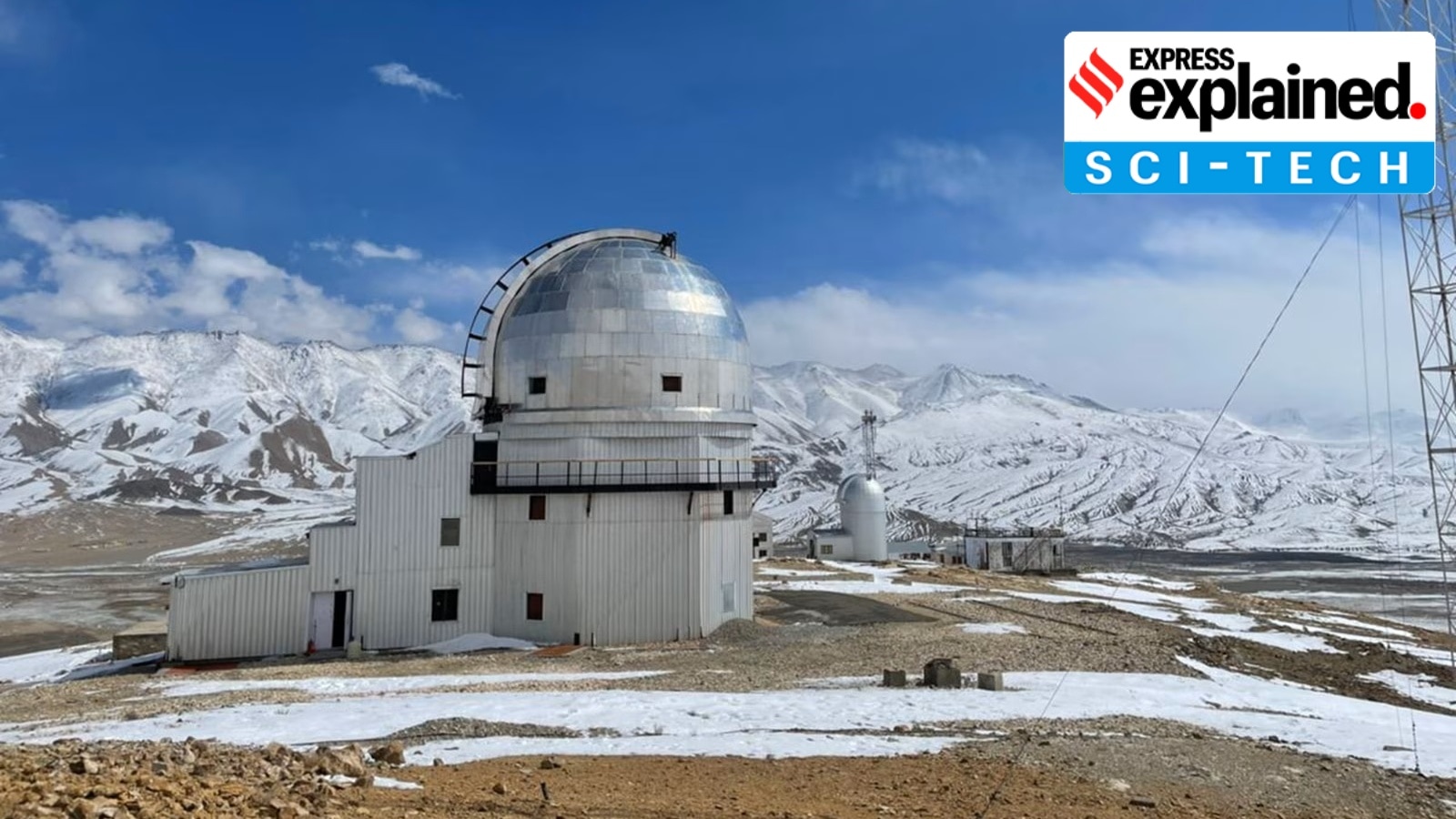
Ladakh is already a major centre of astronomy in the country, being home to several big and small telescopes. There, the village of Hanle also has been identified as India’s first and only Dark Sky Reserve, a protected area meant to preserve the natural darkness of the night sky.
The decision to set up these new telescopes is seen as a big boost to observational astronomy in India and the Global South. But how do these telescopes work, and what kind of findings will emerge from them? We explain.
National Large Solar Telescope
One of the new telescopes meant to study the sun, the National Large Solar Telescope (NLST) is a 2-metre aperture solar telescope, coming up in the Merak region near the Pangong Tso lake. The NLST will operate in the visible and near-infrared wavelengths of the electromagnetic spectrum. Even though all astronomers study the same light, the electromagnetic spectrum (range of radiation including gamma, X-ray, radio, optical, infra-red, etc.) they are looking at may differ. Also, not all light penetrates the Earth’s atmosphere, so scientists have to carefully design observational facilities based on their sensitivities, either from the ground or in space.
NLST will help solar physicists to study the fundamental solar dynamics and magnetism, energetic solar events, and map various space-weather processes having a direct bearing on the Earth and national space assets, like satellites and space launches.
Once built and operational, which is estimated to happen over the next 5-6 years, NLST will serve as India’s third ground-based solar observatory. Currently, the Kodaikanal Solar Observatory (in Tamil Nadu, established 1899) and the Udaipur Solar Observatory (in Rajasthan, established 1975) are operational.
In 2023, ISRO had launched Aditya-L1, India’s first space-based solar observatory. Along with Aditya-L1, data from NLST will help reinforce India’s leadership in heliophysics.
National Large Optical-Near Infrared Telescope
Story continues below this ad
The second telescope is the National Large Optical–Near Infrared Telescope (NLOT), a 13.7-metre aperture segmented-mirror telescope which will be built in Hanle. In a segmented-mirror telescope, a larger primary mirror comprises highly complex, smaller hexagonal mirror segments. In NLOT’s case, the 13.7-metre primary mirror will have 90 smaller segmented mirrors arranged in a fashion that they all collect light but act as one, large mirror.
Projected to be ready over the next decade, NLOT will be one of the world’s largest telescopes operating in the electromagnetic spectrum’s optical-infrared wavelengths.
Due to the high altitude, cold and dry atmospheric conditions, and mostly clear skies in Ladakh, data from NLOT will not suffer diffraction, which is common in other locations. Frontier research on exoplanets, stellar and galactic evolution, and supernovae will be possible, besides looking for clues to trace the origins of the universe.
In building NLOT, India can count on its experience of its participation in the ongoing construction of the Thirty Meter Telescope (TMT), a major international collaborative project involving India, the US, Canada, China, and Japan that aims to significantly advance our understanding of the universe.
Story continues below this ad
TMT has 494 hexagonal mirror segments across the 30-metre primary mirror. India is playing a major role by designing TMT’s Segment Support Assembly, a critical component which controls the mirror assembly and alignment. In addition, Indian will provide 80 hexagonal mirror segments to be placed along TMT’s primary mirror. Armed with the technical know-how and industry expertise, building NLOT’s major components will be easier.
Upgraded Himalayan Chandra Telescope
Besides the two new telescopes, the government also approved the upgradation of the 2-metre Himalayan Chandra Telescope (HCT), which was one of the first facilities to come up in Ladakh. Having completed 25 years of operations and provided continuous and critical data on transient astronomy (study of short-lived cosmic events that dramatically change brightness, such as supernovae), HCT is gearing up for its first major upgrade.
The upgraded HCT will have a 3.7-metre segmented primary mirror. It will operate in the optical-infrared wavelength. HCT’s operations will complement operations of international facilities like LIGO-India and the Square Kilometre Array.
An Indo-US collaboration, LIGO-India stands for Laser Interferometer Gravitational-Wave Observatory, which will comprise an advanced gravitational-wave observatory in Maharashtra’s Hingoli district. The Square Kilometre Array is an international project to build the world’s largest and most sensitive radio telescope across two sites (in Australia and South Africa).
Story continues below this ad
Why are the two new telescopes important?
Both NLST and NLOT will be one-of-their-kind telescopes in their respective wavelengths to operate at this longitude in this region of the world. Both will offer Indian scientists a major advantage over existing global telescopes by generating data that was never possible before.
Another advantage would be with respect to the telescope observation time, which is preferentially slotted to proposals made by collaborating member countries. Together, the two are pitted to be game-changers as far as astronomy and its observations are concerned, both for India and the world.
[ad_2]
Source link