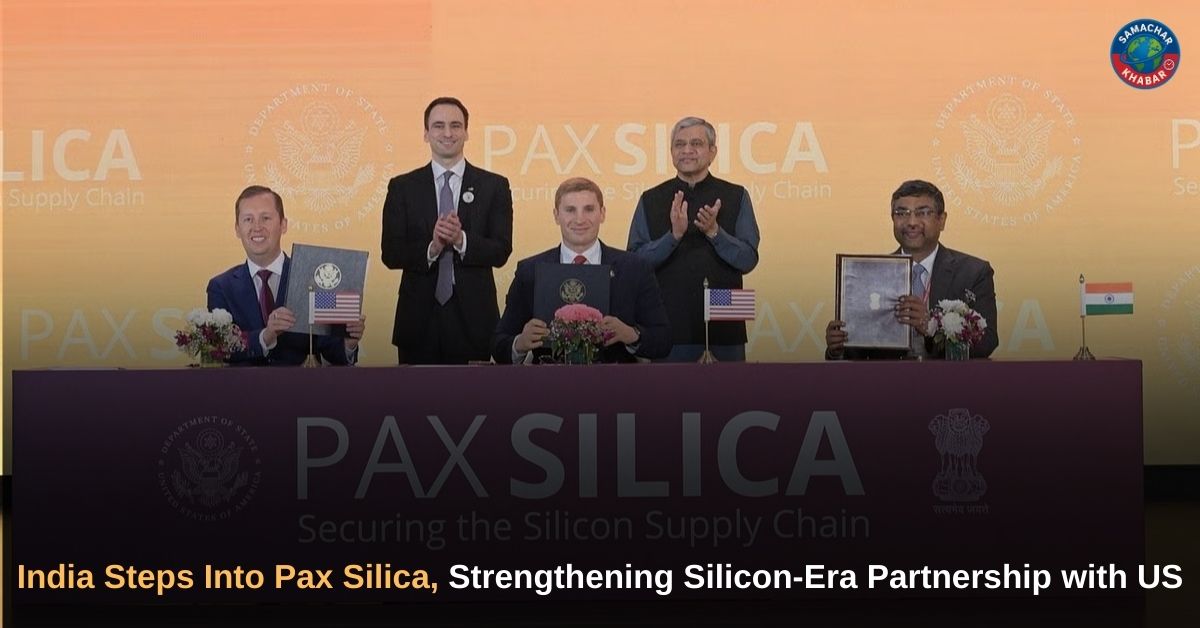
On February 20, 2026, amid the buzz of the India AI Impact Summit in New Delhi, India formally signed the Pax Silica Declaration, marking its entry into a US-led strategic technology alliance. While the ceremony itself was measured and diplomatic, the implications stretch far beyond the conference venue.
The agreement was signed in the presence of Union Minister for Electronics and Information Technology Ashwini Vaishnaw, US Under Secretary of State for Economic Affairs Jacob Helberg, US Ambassador to India Sergio Gor, and S. Krishnan, Secretary of the Ministry of Electronics and Information Technology. Their joint appearance signaled more than protocol; it reflected a calibrated alignment of priorities between two major democracies navigating a rapidly shifting tech landscape.
What Pax Silica Really Represents
Launched by the United States in December 2025, Pax Silica is not just another multilateral framework. It is positioned as a strategic alliance of trusted partner nations designed to secure resilient supply chains in critical minerals, semiconductors, artificial intelligence infrastructure, and related advanced technologies.
At its core lies the idea of building a secure, innovation-driven “silicon stack.” This stack spans the entire chain: extraction and refining of critical minerals, semiconductor fabrication, AI model development, data centers, and final deployment. The initiative emphasizes mutual prosperity, economic security, and pro-innovation regulatory ecosystems built around trusted AI.
The name itself carries symbolism. “Pax,” Latin for peace and stability, combined with “silica,” a nod to the silicon foundation of chips and AI systems, reflects a world transitioning from oil and steel dominance to silicon-powered economies.
India Becomes the Tenth Partner
With this signing, India became the tenth signatory to the Pax Silica Declaration. The existing members include Australia, Greece, Israel, Japan, Qatar, the Republic of Korea, Singapore, the United Arab Emirates, and the United Kingdom.
According to the US Department of State, India brings a substantial talent pool, expanding critical mineral processing and refining capacity, investments in AI infrastructure, and a policy commitment to trusted technologies.
The declaration affirms shared commitments to advancing technological progress, reducing vulnerabilities in global supply chains, and countering potential disruptions or weaponization of resources. This aspect gains added weight in light of China’s dominance in rare earth elements processing. India currently imports 93% of its rare earth requirements, a figure that underscores the strategic urgency behind diversification efforts.
Domestic Industry at a Turning Point
Union Minister Ashwini Vaishnaw described India’s entry into Pax Silica as a significant boost for the country’s electronics and semiconductor industry. He noted that ten semiconductor plants are either established or in advanced stages of development, with the first facility nearing commercial production. A broader ecosystem, he indicated, is steadily taking shape.
Vaishnaw linked the move to the National Critical Mineral Mission and the India Semiconductor Mission, positioning it as part of a coordinated national push. He also highlighted its potential benefits for India’s youth, framing it within the context of long-term industrial capacity and technological capability.
Washington’s Perspective
US Ambassador Sergio Gor characterized India’s participation as “strategic and essential.” He pointed to India’s engineering depth, progress in mineral processing, and its expanding role in strengthening US-India technology cooperation.
His remark that “peace comes through strength” captured the strategic underpinning of the initiative. In an era where supply chains and advanced technologies are intertwined with national security, Pax Silica is presented as both an economic and geopolitical safeguard.
Gor also indicated that an interim US-India trade deal has been completed, with formal signing expected soon, adding another layer to the broader bilateral engagement.
Invitation, Alignment and Official Confirmation
The development followed an invitation extended to India by Ambassador Gor last month. The February 20 ceremony formalized India’s acceptance.
Official confirmations from the US Department of State, India’s Ministry of External Affairs, and the Press Information Bureau described the signing as a milestone in deepening bilateral strategic technology cooperation. As of February 20, 2026, no additional signings or related incidents have been reported.
The initiative aligns closely with the Transforming the Relationship Utilizing Strategic Technology (TRUST) vision articulated by President Donald Trump and Prime Minister Narendra Modi. That framework underscores emerging technologies, secure supply chains, and strategic collaboration as pillars of the modern partnership.
A Broader Shift in the Global Order
India’s decision to join Pax Silica reflects a wider recalibration underway in global geopolitics. Control over critical minerals, semiconductor manufacturing capacity, and AI infrastructure increasingly shapes economic strength and national resilience.
The signing in New Delhi may have been a single event on a crowded summit calendar, but it marks a deeper transition toward silicon-centered diplomacy. As nations rethink dependencies and vulnerabilities, alliances like Pax Silica signal an attempt to anchor stability in shared technological trust rather than resource concentration.