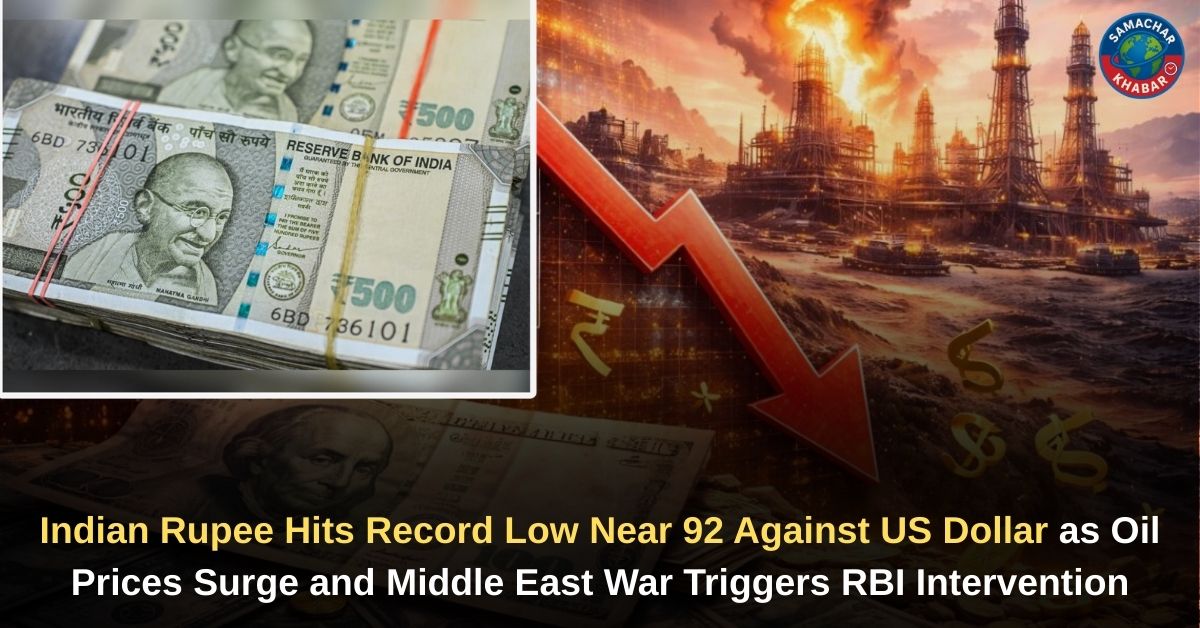
The Indian rupee has come under sharp pressure in global currency markets, weakening significantly against the US dollar as surging crude oil prices, escalating tensions in the Middle East, and a stronger greenback weigh on emerging market currencies. The local currency recently breached the crucial 91-per-dollar mark and moved close to the 92 level, one of its weakest points on record.
The slide in the rupee has coincided with a surge in oil prices following military developments involving Iran, Israel, and the United States, which have unsettled financial markets worldwide. As investors shifted toward safe-haven assets and oil-importing countries faced rising energy costs, the Reserve Bank of India (RBI) stepped in to smooth volatility in the foreign exchange market.
Key Developments Behind the Indian Rupee’s Fall Against the US Dollar
- The Indian rupee weakened sharply and moved close to 92 per US dollar, marking one of its weakest levels on record.
- The currency breached the psychologically important 91-per-dollar mark, triggering stop-loss orders in forex markets.
- Brent crude prices surged above $76 per barrel and later crossed $85, intensifying pressure on India’s import bill.
- The Reserve Bank of India intervened through state-run banks in both spot and forward currency markets to stabilise the rupee.
- Foreign portfolio investors sold equities worth about ₹7,536 crore, adding pressure on domestic markets and the currency.
- Rising geopolitical tensions involving Iran, Israel and the United States heightened global financial uncertainty.
- India’s heavy dependence on imported oil, which accounts for about 85 percent of its fuel needs, amplified the impact on the rupee.
- Analysts warn that if crude prices remain elevated, the rupee could weaken further toward 93–94 per dollar levels.
Rupee Breaches 91 as Global Dollar Demand Strengthens
The rupee’s weakness became evident early in trading when the currency opened near 90.97 against the US dollar before quickly sliding past the 91-per-dollar threshold, a level closely watched by traders and policymakers.
During the session, the rupee touched intraday lows near 91.32, with dealers reporting strong demand for dollars from importers, particularly oil marketing companies hedging their rising energy costs. Foreign banks were also seen buying dollars amid heightened geopolitical uncertainty.
At one stage, the rupee weakened further to around 91.47 per dollar, before stabilising slightly toward the end of the session. Market participants said the breach of the 91 level carried psychological significance, triggering stop-loss orders and reinforcing bearish sentiment in currency markets.
Later developments pushed the rupee even closer to record territory, touching about 92.0550 per dollar, surpassing its previous record low of 91.9875 recorded earlier this year.
Oil Price Surge Becomes the Main Driver of Currency Pressure
The sharp rise in global oil prices has emerged as the most significant factor behind the rupee’s recent weakness.
Brent crude futures jumped around 3.9 percent to approximately $76.78 per barrel after military strikes targeted Iranian facilities. As geopolitical tensions escalated and fears grew about potential supply disruptions, oil prices climbed further, moving above $85 per barrel.
For India, which imports roughly 85 percent of its crude oil requirements, rising oil prices translate directly into higher import bills and greater demand for US dollars from energy companies.
Currency analysts say this dynamic is now dominating short-term movements in the rupee.
Anindya Banerjee, head of commodity and currency research at Kotak Securities, noted that crude oil has become the primary driver of the rupee’s direction in the near term. According to him, if oil prices remain elevated, the rupee could move toward 93–94 levels against the dollar.
Middle East Conflict Sends Shockwaves Through Global Markets
The rupee’s decline is also closely linked to geopolitical developments in the Middle East. Reports of US and Israeli strikes on Iranian targets, including missile sites and naval assets, have intensified tensions across the region and unsettled financial markets.
The conflict has triggered a broader risk-off sentiment among global investors, prompting a shift toward safe-haven assets such as the US dollar and gold. Stock markets across Asia and Europe have also retreated amid fears of a wider regional escalation.
A key concern for global energy markets is the Strait of Hormuz, a strategic shipping route through which around 20 percent of the world’s oil supply passes. Any disruption in this corridor could cause crude prices to spike further and intensify economic pressures on oil-importing nations.
For India, such developments pose significant risks in terms of rising inflation, higher import costs, and potential pressure on the country’s external balance.
RBI Intervenes to Stabilise the Currency Market
Amid the rupee’s sharp decline, the Reserve Bank of India stepped into the foreign exchange market to limit excessive volatility.
According to traders, the central bank sold US dollars through state-run banks, providing liquidity to the market and preventing disorderly currency movements. The RBI was also reportedly active in the forward currency market and the offshore non-deliverable forwards (NDF) market.
Market participants described the intervention as measured and moderate, aimed primarily at smoothing volatility rather than defending a particular exchange rate level.
India’s substantial foreign exchange reserves have provided the central bank with a strong buffer to manage fluctuations in the currency market during periods of global uncertainty.
India’s Forex Reserves Offer a Buffer Amid Market Turbulence
Recent data from the Reserve Bank of India shows that the country’s foreign exchange reserves remain strong despite currency volatility.
India’s forex reserves declined by $2.119 billion to $723.608 billion during the week ended February 20. In the previous reporting week, reserves had increased by $8.663 billion to a record high of $725.727 billion.
Although the recent decline is modest, analysts say it may reflect the RBI’s efforts to manage currency volatility during periods of market stress. India’s large reserve buffer continues to provide stability and allows the central bank to intervene when necessary.
Equity Markets and Capital Flows Reflect Investor Caution
The rupee’s weakness has been accompanied by declines in domestic financial markets as investors reacted to global uncertainty.
- The BSE Sensex dropped about 691 points, or roughly 0.85 percent, in early trading.
- The Nifty 50 index fell around 241 points, representing a decline of nearly 0.96 percent.
Foreign institutional investors also reduced their exposure to Indian equities, selling shares worth approximately ₹7,536 crore.
At the same time, the yield on India’s 10-year government bond rose to about 6.6955 percent, reflecting concerns that sustained high oil prices could complicate the inflation outlook and limit the scope for interest rate cuts.
Structural Economic Factors Continue to Influence the Rupee
Beyond immediate market volatility, broader economic factors are also shaping the rupee’s trajectory.
India’s trade deficit widened to $34.7 billion in January, driven by a sharp rise in imports of commodities such as gold and silver. While exports grew slightly by about 0.6 percent year-on-year, imports surged by 19.2 percent, increasing pressure on the country’s external balance.
Domestic liquidity conditions have also tightened, with three-month bank certificate of deposit yields rising above 7 percent to around 7.23 percent, indicating funding stress in financial markets.
Despite these challenges, positive foreign portfolio investment inflows during parts of the month have provided some support to the balance of payments.
Currency Contrast: Israeli Shekel Holds Firm While Iranian Rial Collapses
The economic impact of Middle East tensions has affected regional currencies differently.
The Israeli shekel has remained relatively resilient, trading around 3.14 per US dollar. Israel’s strong technology sector, diversified economy, and foreign exchange reserves of approximately $212.93 billion have helped support the currency even during periods of regional conflict.
In contrast, the Iranian rial has experienced a dramatic collapse, falling to around 1.75 million rials per US dollar in the open market. Decades of economic sanctions, high inflation exceeding 48 percent, and limited access to global financial systems have severely weakened Iran’s currency.
Currency comparisons highlight the stark disparity:
| Currency | Approximate Exchange Rate |
| 1 USD | ~3.14 Israeli Shekels |
| 1 USD | ~1,749,500 Iranian Rials |
| 1 Israeli Shekel | ~₹29.04 |
These figures illustrate the severe depreciation of the Iranian currency compared with other regional currencies.
Recent Performance of the Rupee Against the Dollar
Currency data shows that the rupee has faced sustained pressure over the past year.
- Over the past four weeks, the USD-INR pair has moved roughly 1.06 percent.
- Over the last 12 months, the US dollar has strengthened about 4.13 percent against the rupee.
- Recent market data placed the USD-INR rate around 92.24, close to record territory.
These trends reflect a broader depreciation of the Indian currency amid global economic uncertainty, rising energy costs, and persistent demand for the US dollar.
Oil Prices and Geopolitical Risks Will Shape the Rupee’s Path Ahead
The near-term outlook for the Indian rupee remains closely tied to global crude oil prices and geopolitical developments.
If oil prices remain elevated or supply disruptions intensify in the Middle East, pressure on the rupee may persist. Conversely, any easing in geopolitical tensions or a decline in crude prices could help stabilise the currency.
Market participants expect the Reserve Bank of India to continue closely monitoring forex markets and intervene when necessary to prevent disorderly movements.
For now, the rupee’s trajectory remains highly sensitive to developments in global energy markets and international politics, underscoring how external shocks can quickly influence currency stability in an interconnected global economy.
Spiritual Insight: True Spiritual Knowledge Offers the Path Beyond Material Uncertainty
Economic fluctuations, currency instability, rising oil prices, and geopolitical conflicts remind humanity that the material world is constantly changing and uncertain. Financial systems, markets, and global economies can shift rapidly due to forces beyond human control. Such instability highlights a deeper truth that worldly prosperity alone cannot guarantee lasting peace or security.
According to the unique spiritual knowledge explained by Saint Rampal Ji Maharaj, true stability and happiness come from understanding the purpose of human life and connecting with the Supreme God through the correct method of worship described in holy scriptures. This knowledge teaches that while material systems may rise and fall, spiritual wisdom provides a permanent path toward peace, security, and ultimate salvation.
Saint Rampal Ji Maharaj explains that by following the true spiritual path and engaging in the correct form of devotion, a person can rise above the temporary struggles of the physical world and attain lasting happiness and liberation.
FAQs on Indian Rupee Hits Record Low Near 92 Against US Dollar
1. Why did the Indian rupee fall close to 92 against the US dollar?
The rupee weakened mainly due to rising global crude oil prices, a stronger US dollar, foreign investor outflows, and geopolitical tensions in the Middle East affecting global financial markets.
2. Did the Reserve Bank of India intervene to stabilise the rupee?
Yes. The RBI reportedly sold US dollars through state-run banks and intervened in spot and forward markets to reduce volatility and prevent disorderly movements in the currency market.
3. How do rising crude oil prices affect the Indian rupee?
India imports about 85% of its oil. When crude prices rise, the import bill increases, boosting dollar demand and putting downward pressure on the rupee.
4. What is the record low level of the Indian rupee against the US dollar?
The rupee recently touched around 92.0550 per US dollar, surpassing its previous record low of 91.9875 amid global market volatility and rising oil prices.
5. Could the rupee weaken further against the US dollar?
Analysts say the rupee may test levels around 93–94 per dollar if crude oil prices remain high and geopolitical tensions continue affecting global markets.