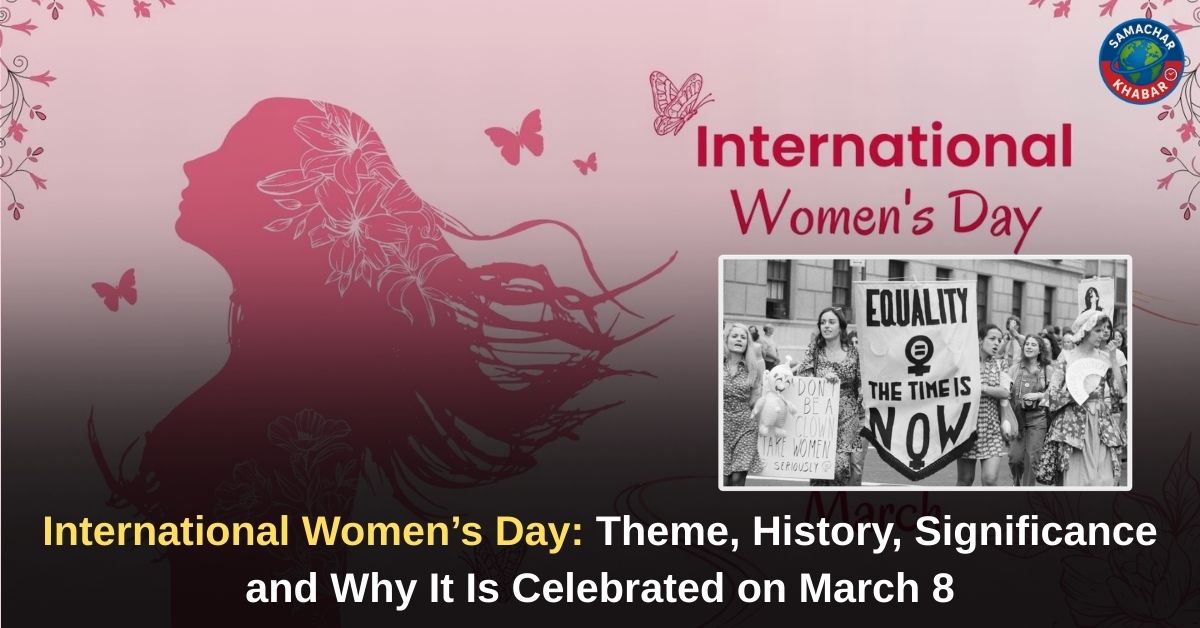
International Women’s Day (IWD) 2026 will be celebrated worldwide on March 8, recognising the social, economic, cultural and political achievements of women. The global observance also serves as a call to accelerate gender equality and ensure equal rights for women and girls. Over the years, the day has evolved into a powerful international movement supported by governments, organisations and communities.
The International Women’s Day 2026 theme “Give To Gain” highlights the value of generosity and collaboration in empowering women, while the United Nations emphasises “Rights. Justice. Action. For ALL Women and Girls,” urging stronger legal protections and equal access to justice.
Key Highlights of International Women’s Day 2026: Theme, Rights and Global Impact
- International Women’s Day 2026 will be observed on March 8, which falls on a Sunday.
- The campaign theme “Give To Gain” promotes generosity, collaboration and mutual support to advance women’s empowerment.
- The United Nations theme “Rights. Justice. Action. For ALL Women and Girls” calls for stronger legal protections and equal justice worldwide.
- Globally, women currently have only about 64 percent of the legal rights that men possess.
- In nearly 70 percent of countries, women face more barriers than men in accessing justice systems.
- Around 676 million women and girls live within 50 kilometres of active conflict zones, where legal protection is limited.
- The day also celebrates women’s achievements in education, politics, business, culture and social leadership.
International Women’s Day 2026 Theme: Meaning of the “Give To Gain” Campaign
The International Women’s Day 2026 theme “Give To Gain” encourages individuals, organisations and communities to support women through generosity and collaboration. The idea behind the campaign is that when people contribute knowledge, opportunities and resources, women’s advancement increases and societies benefit collectively.
The campaign highlights that giving should not be seen as a loss. Instead, it represents a form of intentional multiplication, where support leads to broader opportunities and growth for women.
Support can take many forms, including:
- Giving respect and recognition
- Providing mentorship and training
- Promoting equal pay and workplace equality
- Supporting women-led initiatives and funding
- Amplifying women’s voices and leadership
- Offering education, workshops and opportunities
Through such contributions, the campaign aims to build a more inclusive and supportive global community.
United Nations Theme 2026: “Rights, Justice and Action for All Women and Girls”
Alongside the global campaign, the United Nations has announced the theme “Rights. Justice. Action. For ALL Women and Girls.”
The theme emphasises the need to address structural barriers that prevent women from accessing justice and equal rights. Despite progress in many areas, major challenges remain across the world.
Key issues highlighted include:
- Discriminatory laws and weak legal protections
- Gender-based violence and lack of justice for victims
- Limited representation in leadership and decision-making
- Barriers to economic and educational opportunities
Women worldwide still experience inequality in important areas such as employment, financial access, safety, mobility, property ownership and retirement benefits. Strengthening legal systems and ensuring accessible justice remain central goals of the 2026 observance.
History of International Women’s Day: How the Global Movement Began
The origins of International Women’s Day can be traced back to the early twentieth century, when women began demanding better working conditions, fair wages and voting rights.
Early Milestones in the Women’s Rights Movement
| Year | Event |
| 1909 | First Women’s Day organised in New York by the Socialist Party of America |
| 1910 | Clara Zetkin proposed an international celebration during the Socialist Women’s Conference in Copenhagen |
| 1911 | First International Women’s Day demonstrations held across Austria-Hungary, Denmark, Germany and Switzerland |
| 1917 | Women workers in Petrograd protested for “Bread and Peace,” contributing to the Russian Revolution |
| 1975 | United Nations officially began celebrating International Women’s Day |
| 1977 | March 8 was adopted globally to promote women’s rights and international peace |
The 1917 protests by women textile workers in Russia played a pivotal role in history. Their demonstrations demanding food, peace and better working conditions helped trigger political changes that eventually led to women gaining voting rights.
Today, more than a century later, International Women’s Day continues to symbolize activism, equality and collective progress.
Why International Women’s Day Is Celebrated on March 8
International Women’s Day is observed on March 8 each year due to the historical significance of women-led protests during the Russian Revolution in 1917. On this date, women workers in Petrograd organised demonstrations demanding an end to war, food shortages and oppressive rule.
These protests marked the beginning of revolutionary changes that ultimately resulted in the abdication of Tsar Nicholas II and the extension of voting rights to women in Russia.
Also Read: Top Government Schemes for Women Empowerment in India: Benefits, Eligibility & How to Apply
Over time, the socialist movement and later international organisations adopted March 8 as the official date for recognising women’s rights and achievements.
Significance of International Women’s Day in the Modern World
International Women’s Day plays a vital role in raising awareness about gender equality and social justice. The day highlights ongoing issues affecting women while celebrating progress made in various fields.
Key themes associated with the observance include:
- Equal pay and economic empowerment
- Access to education and career opportunities
- Ending violence against women and girls
- Reproductive rights and healthcare access
- Representation in political and corporate leadership
The day also recognises women who have contributed significantly to society, inspiring future generations to pursue leadership, innovation and social change.
Global Celebrations of International Women’s Day
International Women’s Day is observed in many countries through events, discussions and cultural celebrations.
United States
In the United States, March is celebrated as Women’s History Month, highlighting the achievements of women throughout history. Many cities organise discussions, rallies and leadership events on March 8.
Romania
In Romania, the day is similar to Mother’s Day, where people present flowers and gifts to mothers, grandmothers and women as a gesture of appreciation.
Italy
Italian celebrations traditionally involve giving yellow mimosa flowers, symbolising solidarity and strength among women.
United Kingdom
The Women of the World (WOW) Festival in London gathers activists, artists and leaders to discuss women’s issues and share experiences from around the globe.
China
China has recognised International Women’s Day since 1949. In many workplaces, women may receive a half-day off from work.
Spain
Large public demonstrations and marches highlight issues such as gender equality and women’s safety.
Australia
Conferences, panel discussions and leadership events address women’s representation and workplace equality.
India
In India, International Women’s Day is marked by seminars, conferences and awareness campaigns celebrating women’s achievements.
Government initiatives such as Beti Bachao Beti Padhao and Pradhan Mantri Mudra Yojana are often discussed, focusing on education, entrepreneurship and financial independence for women.
International Women’s Day 2026 Campaign Activities and Women Entrepreneurship Initiatives
International Women’s Day also encourages programmes that promote women’s participation in business and economic development.
For example, Big Ideas Wales is organising a workshop titled “Women Into Business” on March 10, 2026, encouraging women to explore entrepreneurship opportunities. The programme will be conducted in Bangor, Newtown and Blaenau Gwent, with a live stream connecting participants across locations.
The Welsh Government recognises the role of women entrepreneurs in strengthening the economy and continues to support initiatives that provide resources, guidance and training for women-led businesses.
Such programmes reflect the broader purpose of International Women’s Day—supporting women’s leadership and economic independence.
The Symbolic “Give To Gain” Pose and Global Social Media Movement
An important element of the IWD 2026 campaign is the symbolic “Give To Gain” pose, which represents generosity and shared progress.
Participants can demonstrate the gesture in two ways:
- Cupped hands extended forward, symbolising the act of giving and receiving.
- One hand placed on the heart with the other extended outward, representing compassion and support.
Historically, the open palm gesture has symbolised truth, honesty and openness. People around the world are encouraged to share photos of the pose on social media using the hashtag #GiveToGain, spreading awareness and encouraging others to contribute to gender equality initiatives.
Spiritual Perspective on Equality: Teachings of Saint Rampal Ji Maharaj
The unique spiritual knowledge of Saint Rampal Ji Maharaj teaches that all human beings are equal creations of the Supreme God. According to the sacred scriptures explained by him, both men and women deserve equal respect, dignity and rights in society.
His teachings guide people to move away from discrimination, injustice and harmful social practices. Saint Rampal Ji Maharaj emphasises that true spiritual knowledge helps individuals develop values such as compassion, respect and fairness. When people follow the path of true devotion described in the scriptures, it can help create a more balanced, peaceful and harmonious society for both women and men.
A Global Movement Driving Progress Toward Gender Equality
International Women’s Day 2026 reinforces the message that achieving gender equality requires collective action from individuals, communities, governments and organisations.
Through the “Give To Gain” campaign and the United Nations emphasis on rights, justice and action, the global community is encouraged to support women and girls in every sphere of life. By providing opportunities, resources and recognition, societies can build a future where women enjoy equal rights, equal representation and equal opportunities worldwide.
FAQs on International Women’s Day 2026
1. When is International Women’s Day 2026 celebrated?
International Women’s Day 2026 will be celebrated worldwide on March 8, 2026. The day honours women’s achievements and highlights global efforts toward gender equality and women’s rights.
2. What is the theme of International Women’s Day 2026?
The campaign theme for International Women’s Day 2026 is “Give To Gain,” promoting generosity, collaboration and support to empower women and expand opportunities for equality.
3. What is the United Nations theme for International Women’s Day 2026?
The UN theme is “Rights. Justice. Action. For ALL Women and Girls,” focusing on strengthening legal protections, ensuring equal access to justice and removing barriers to women’s rights worldwide.
4. Why is International Women’s Day celebrated on March 8?
International Women’s Day is celebrated on March 8 to commemorate the 1917 protests by women workers in Petrograd, which helped trigger political change and advanced women’s rights.
5. Why is International Women’s Day important today?
International Women’s Day raises awareness about gender equality, equal pay, education access, women’s safety and leadership opportunities while celebrating women’s achievements worldwide.