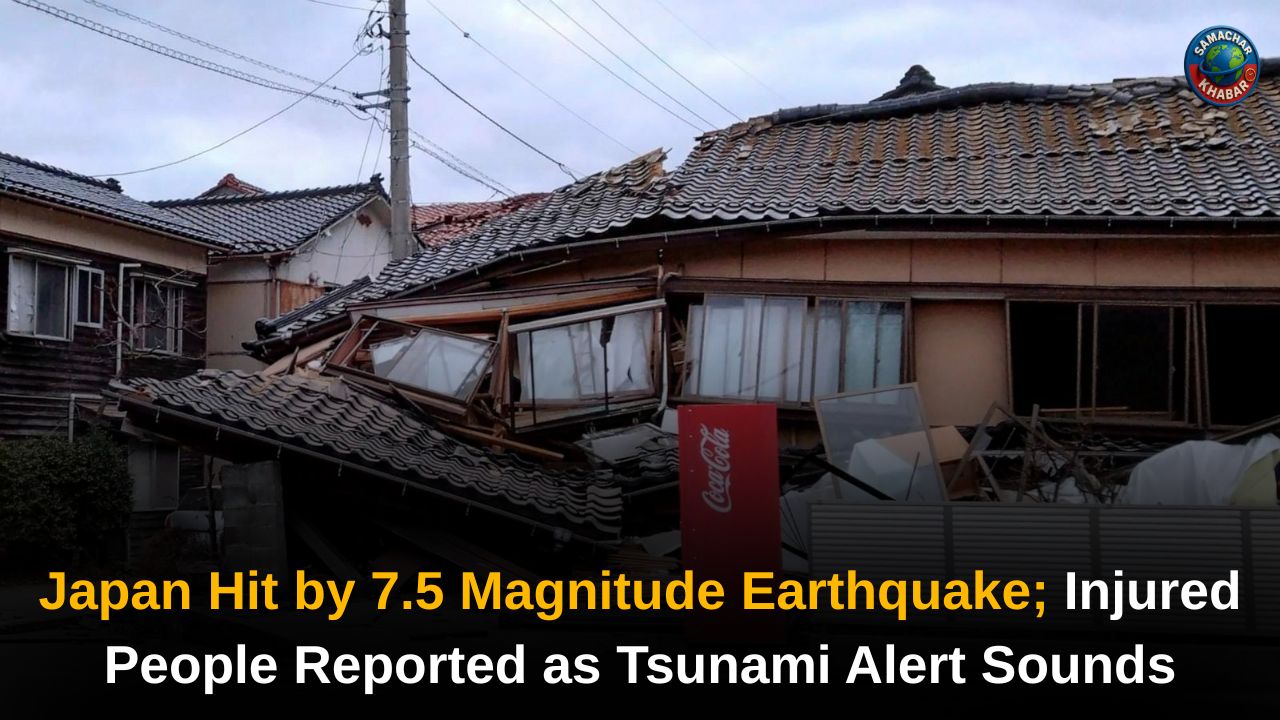
A powerful 7.5-magnitude earthquake struck northeastern Japan late Monday night, shaking cities hundreds of miles away, injuring dozens and forcing more than 100,000 people to evacuate coastal areas under urgent tsunami alerts.
The quake, one of the strongest to hit the region in years, triggered widespread warnings, power outages, transport disruptions and safety checks at nuclear facilities, while authorities urged residents to remain on high alert for an entire week due to the risk of stronger aftershocks or even a potential megaquake.
Key Takeaways on the Japan Earthquake, Injured People and Tsunami Alerts
- 7.5–7.6 magnitude earthquake struck at 11:15 p.m., with the epicenter 80 km off Aomori at a depth of 50 km.
- At least 23–33 people were injured, mostly from falling objects; several incidents reported in homes and hotels.
- Tsunami waves of 20–70 cm were recorded across multiple ports before warnings were lifted.
- 90,000 to 114,000 residents were ordered or advised to evacuate coastal regions.
- Train services suspended, air passengers stranded and thousands left without power.
- No nuclear abnormalities detected after urgent checks at regional plants.
- Japan issued its first-ever megaquake warning, indicating a slight risk of a magnitude 8 or greater quake within a week.
- Aftershocks of 6.6 and 5.1 magnitude followed, with more expected.
Intense Late-Night Tremor Shakes Japan’s Northeast
The quake struck suddenly just before midnight, registering an upper six on Japan’s seismic intensity scale in Aomori—a level so strong it makes standing nearly impossible and can topple heavy furniture. Residents across northern prefectures reported violent shaking, while those in Tokyo, more than 400 miles away, felt tremors that lasted over 30 seconds.
Videos on social media showed swaying lights, cracked ceilings, falling objects and public loudspeakers repeatedly urging residents to “evacuate to higher ground immediately.”
According to the U.S. Geological Survey, the quake measured 7.6 magnitude, slightly higher than the JMA’s reading of 7.5.
Tsunami Alerts Sounded as Waves Hit Coastal Communities
Minutes after the quake, the Japan Meteorological Agency issued tsunami warnings for Hokkaido, Aomori and Iwate, predicting waves up to three metres (10 feet).
Observed tsunami activity included:
- 70 cm at Kuji port in Iwate
- 50 cm in several northern coastal towns
- 20–30 cm at multiple ports
Evacuation orders and public alerts were issued across coastal municipalities, urging residents to drop everything and flee to designated shelters or higher ground.
By early Tuesday, tsunami warnings were downgraded to advisories and later lifted entirely.
Injuries Reported Across Quake-Hit Areas
Authorities confirmed at least 23–33 injured people, with most hurt by falling furniture, shattered glass and collapsing fixtures.
Notable incidents include:
- A hotel in Hachinohe, where several guests were injured and taken to hospital.
- A man in Tohoku was injured after his car plunged into a crack formed by the quake.
- Local reports of fires in Aomori, triggered by structural damage.
Emergency medical teams and firefighters were dispatched across multiple prefectures.
Evacuations and Overnight Disruptions
The earthquake and tsunami alerts forced large-scale evacuations:
- 90,000 residents were ordered to evacuate according to Reuters.
- More than 114,000 people under evacuation advisories in early updates.
- 480 residents sheltered at the Hachinohe Air Base.
Cars jammed highways, evacuation routes overflowed and people described chaotic scenes as they attempted to escape low-lying coastal zones.
Transport Suspended, Power Outages Reported
The quake disrupted major transportation networks:
- Shinkansen bullet trains were halted across parts of northern Japan.
- Several local rail lines suspended operations due to damaged infrastructure.
- 200 passengers were stranded overnight at New Chitose Airport, where ceiling tiles had collapsed.
In Aomori alone, 2,700 homes lost power initially. Tohoku Electric Power later reduced this number to the “hundreds” as restoration efforts progressed.
Nuclear Plants Under Safety Checks, No Threat Detected
Japan immediately initiated safety protocols at nuclear facilities across the region.
Findings included:
- No irregularities at Higashidori and Onagawa plants.
- At the Rokkasho reprocessing plant, 450 litres of water spilled from a spent fuel cooling area, but levels remained normal and no safety risk was reported.
- The International Atomic Energy Agency confirmed no issues at Fukushima Daiichi.
Despite the reassuring reports, inspections remain ongoing.
Government Activates Emergency Task Force
Prime Minister Sanae Takaichi convened an emergency task force, stating that the government was “putting people’s lives first.”
Chief Cabinet Secretary Minoru Kihara warned residents to remain alert until all seismic advisories are lifted and emphasized the need for rapid evacuations when ordered.
Defence Minister Shinjiro Koizumi deployed 18 helicopters to assess damage from the air.
Japan Issues Its First Megaquake Warning
In an unprecedented move, the JMA issued its highest-level megaquake alert, warning of a small but real possibility of a magnitude 8 or greater earthquake within the next week.
This top-tier warning has never been issued before since the system was created in 2022.
Authorities stressed the caution is not a prediction but a preparedness measure rooted in lessons from the 2011 magnitude 9.0 disaster, where a foreshock struck two days before the catastrophic tsunami.
The advisory covers 182 municipalities from Hokkaido to Chiba.
Critical Week Ahead as Japan Monitors Aftershocks
Though immediate tsunami threats have subsided, Japan now faces a week of heightened vigilance. Aftershocks—including magnitude 6.6 and 5.1 quakes—continue to shake the region, leaving communities anxious and alert.
Residents are being urged to secure furniture, keep emergency supplies ready and remain prepared to evacuate instantly if strong shaking returns.
Spiritual Insight: Understanding Calamities Through the Teachings of Saint Rampal Ji Maharaj
Natural disasters often remind society of human vulnerability and the need for deeper reflection. According to the spiritual knowledge shared by Saint Rampal Ji Maharaj, such events encourage humanity to adopt a righteous path, remain humble, and understand the supreme power governing creation.
His teachings emphasise compassion, non-violence, and devotion, guiding individuals to stay prepared—physically and spiritually—while cultivating inner peace during uncertain times.
A Defining Moment of Preparedness for a Quake-Prone Nation
Japan, which experiences nearly 1,500 earthquakes a year and accounts for 20% of the world’s magnitude 6 or greater quakes, now stands at a critical moment. As coastal communities recover from Monday’s violent tremors, the nation braces for potential seismic escalation.
With transport networks disrupted, injured civilians receiving care and nuclear plants under strict monitoring, authorities call for patience, vigilance and cooperation as Japan navigates the tense days ahead.
FAQs on Japan 7.5 Magnitude Earthquake and Tsunami Alert
1. What caused the 7.5 magnitude earthquake in Japan?
The 7.5 magnitude offshore quake originated about 80 km off Aomori at a depth of 50 km, triggering widespread shaking and tsunami alerts across northern Japan.
2. How many people were injured in the Japan earthquake?
Authorities reported 23–33 injured people, mostly from falling objects and structural damage, with incidents in homes, hotels and public areas across the affected northern prefectures.
3. Were tsunami waves recorded after the Japan earthquake?
Yes. Tsunami waves between 20 and 70 cm were recorded at several ports, including a 70 cm surge at Kuji in Iwate, before warnings were lifted.
4. Did Japan issue a megaquake warning after the tremor?
Yes. Japan issued its first-ever megaquake warning, citing a slight risk of a magnitude 8 or greater earthquake within a week along the Pacific coast.
5. Were nuclear power plants affected by the Japan earthquake?
No major issues were reported. Safety checks found no abnormalities at Higashidori, Onagawa or Fukushima, though a water spill occurred at the Rokkasho facility without safety impact.