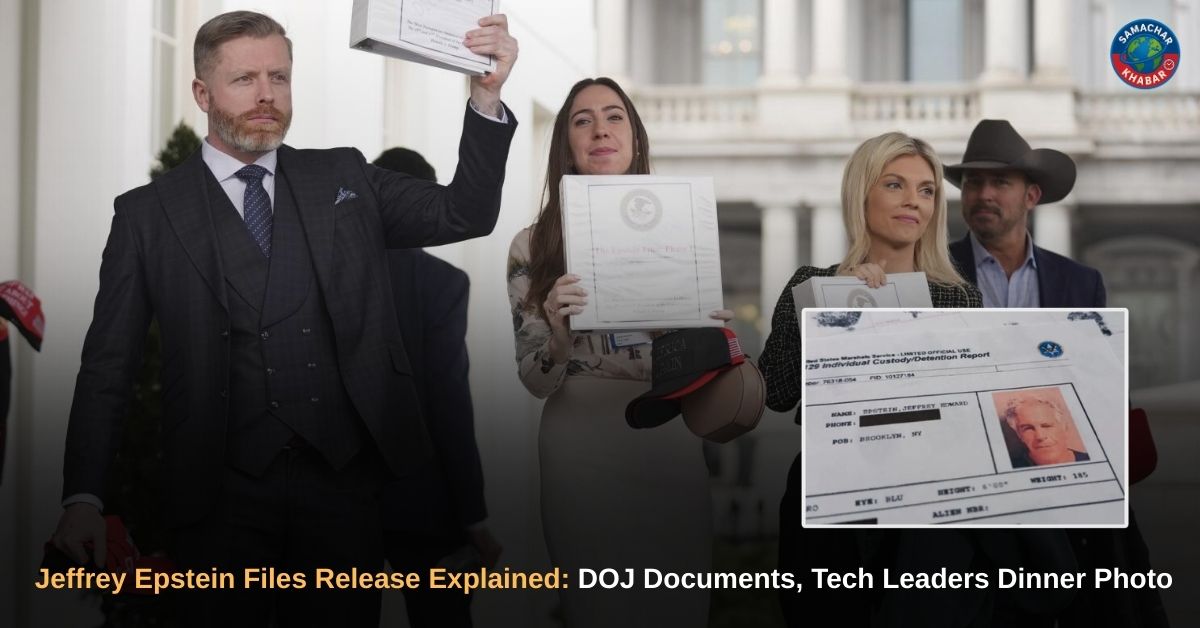
The release of millions of documents linked to Jeffrey Epstein by the United States Department of Justice has once again brought the late financier’s criminal case into global focus. The newly disclosed material includes emails, FBI interview summaries, photographs, financial records, and internal communications that collectively provide an unprecedented view into Epstein’s network and the systems that surrounded him.
While the files expand public understanding of the investigation, they have also triggered political fallout, survivor concerns about privacy, and renewed scrutiny of powerful individuals mentioned in the records. Authorities continue to emphasize that appearance in the documents or photographs does not constitute evidence of criminal wrongdoing.
Key Developments in the Jeffrey Epstein Files Release and What the Records Show
- Nearly three million pages of Epstein-related documents were released under the Epstein Files Transparency Act.
- The archive includes more than 2,000 videos and approximately 180,000 images.
- Millions of additional pages remain withheld to protect victims and sensitive information.
- FBI interview records describe allegations and operational details shared by witnesses.
- The files reveal Epstein’s continued contact with influential figures across politics, business, and technology after his 2008 conviction.
- Survivor advocates raised concerns after unredacted names reportedly appeared in released documents.
- Political consequences have emerged in parts of Europe, while reactions in the United States remain more limited.
- Officials repeatedly state that inclusion in the files does not imply criminal involvement.
DOJ Release of Epstein Files and the Transparency Process
The Justice Department’s latest release followed the passage of the Epstein Files Transparency Act, which required disclosure of unclassified records connected to investigations and prosecutions involving Epstein and Ghislaine Maxwell. Deputy Attorney General Todd Blanche stated that the department reviewed approximately six million pages of material, with nearly half released publicly.
Documents withheld from release include material containing child sexual abuse imagery, victims’ medical records, personally identifying information, ongoing investigative material, and documents protected by legal privilege. A team of hundreds of attorneys reportedly reviewed the files before publication.
The release drew criticism after attorneys representing survivors reported that some victims’ names appeared unredacted. The Department of Justice responded by establishing a reporting mechanism to correct redaction errors and remove affected documents.
What the Epstein Files Library Contains and How Researchers Navigate It
The Epstein Files Library refers to the large public archive created through government releases and indexed repositories. The materials include:
| Document Type | Description |
| FBI FD-302 Reports | Interview summaries from alleged victims and witnesses |
| Emails & Correspondence | Communications between Epstein and associates |
| Flight Logs & Travel Records | Documentation of travel arrangements |
| Financial Records | Transactions and internal documentation |
| Internal Memoranda | Agency communications and investigative notes |
| Photos & Videos | Images and recordings collected during investigations |
Researchers commonly use searchable databases, indexed media summaries, and PDF search tools to navigate the archive, as many documents remain partially redacted and require cross-referencing with court records.
FBI Interview Records and Allegations Described by Witnesses
FBI records included in the release contain detailed statements from alleged victims describing recruitment methods and travel arrangements connected to Epstein and Maxwell. Witnesses described being approached through professional opportunities such as massages, modeling work, or dance-related activities.
Documents describe allegations that travel logistics, passports, and accommodation arrangements were organized to facilitate movement between residences in New York, Florida, London, and private island locations. Some witnesses reported feeling pressured or intimidated after leaving Epstein’s circle.
Internal FBI documents also include charts mapping Epstein’s associates and timelines of contacts following his arrest. Several individuals were listed as suspected co-conspirators in internal documents, though only Maxwell has been criminally convicted in connection with Epstein’s crimes.
Full List of Names Appearing in Epstein Files
The following individuals are among those whose names appear in various documents, emails, or records released. Authorities and investigators stress that appearance in the files does not imply wrongdoing.
| Names Mentioned in Documents |
| Bill Clinton |
| Donald Trump |
| Prince Andrew |
| Ghislaine Maxwell |
| Les Wexner |
| Michael Jackson |
| Alan Dershowitz |
| Sarah Ferguson |
| Elon Musk |
| Richard Branson |
| Steven Tisch |
| Casey Wasserman |
| Ehud Barak |
| Howard Lutnick |
| Larry Summers |
| Sergey Brin |
| Miroslav Lajčák |
| Bill Gates |
| Steve Bannon |
| Peter Mandelson |
Elon Musk, Mark Zuckerberg and the 2015 Dinner Photograph
A photograph included in the newly released documents shows Elon Musk and Mark Zuckerberg attending a 2015 dinner linked to Epstein alongside several technology leaders, including Peter Thiel and others. Emails show Epstein describing the gathering as “wild.”

The dinner, reportedly organised in connection with MIT neuroscientist Ed Boyden, was first reported publicly in 2019. Musk has stated that he had limited interaction with Epstein, never attended Epstein parties, and declined invitations to visit his island. Meta previously said Zuckerberg met Epstein briefly and did not maintain contact afterward.
Released material does not provide evidence of criminal involvement by individuals appearing in the photograph.
Political Fallout in Europe Compared With the United States
The release of the files has triggered investigations, resignations, and public apologies in several European countries. Political figures faced scrutiny, and some government roles were affected following revelations of past associations.
In contrast, reactions within the United States have largely centered on public debate and media scrutiny, with fewer immediate professional consequences for individuals mentioned in the documents. The differing responses have prompted discussions about accountability standards among political and corporate elites.
Power Networks, Gender Dynamics and Social Influence in the Documents
Emails and correspondence contained in the files illustrate how Epstein cultivated relationships through introductions, favors, and social gatherings involving influential figures. The documents also reveal how women frequently appeared in supporting roles as assistants, organizers, or companions, highlighting broader discussions about power structures and gender dynamics within elite social networks.
Journalists reviewing the archive note that beyond individual names, the files offer insight into how influence, reputation management, and institutional failures intersected in Epstein’s world.
A Continuing Archive That Keeps Questions About Accountability Open
The Epstein files have transformed the case into an evolving public archive rather than a closed investigation. The documents provide insight into investigative processes, institutional responses, and the enduring challenges of balancing transparency with survivor protection. As lawmakers review additional material and researchers continue examining the records, the files underscore the complexity of accountability when wealth, influence, and legal systems intersect.
While the disclosures deepen public understanding of Epstein’s network and activities, officials continue to stress that the documents must be interpreted carefully and within proper legal context.
FAQs on Jeffrey Epstein Files Release and DOJ Documents
1. What are the Jeffrey Epstein files released by the DOJ?
The Jeffrey Epstein files are millions of documents, emails, FBI records, photos, and investigative materials released under transparency laws to provide public access to Epstein-related investigations.
2. Does appearing in the Epstein files mean someone committed a crime?
No. Authorities have clarified that appearance in the Epstein files or photographs does not imply criminal wrongdoing and must not be treated as proof of illegal activity.
3. Why were some Epstein files withheld or redacted?
Certain documents were withheld or redacted to protect victims’ identities, ongoing investigations, legal privileges, and sensitive material including child sexual abuse content.
4. What is the Epstein Files Transparency Act (EFTA)?
The Epstein Files Transparency Act required the Justice Department to release unclassified Epstein-related records while allowing exceptions for privacy protection, legal restrictions, and victim safety.
5. Why did the Epstein files release create global political controversy?
The files revealed past associations between Epstein and influential figures, leading to political scrutiny, resignations in some countries, and debates about accountability and institutional failures.