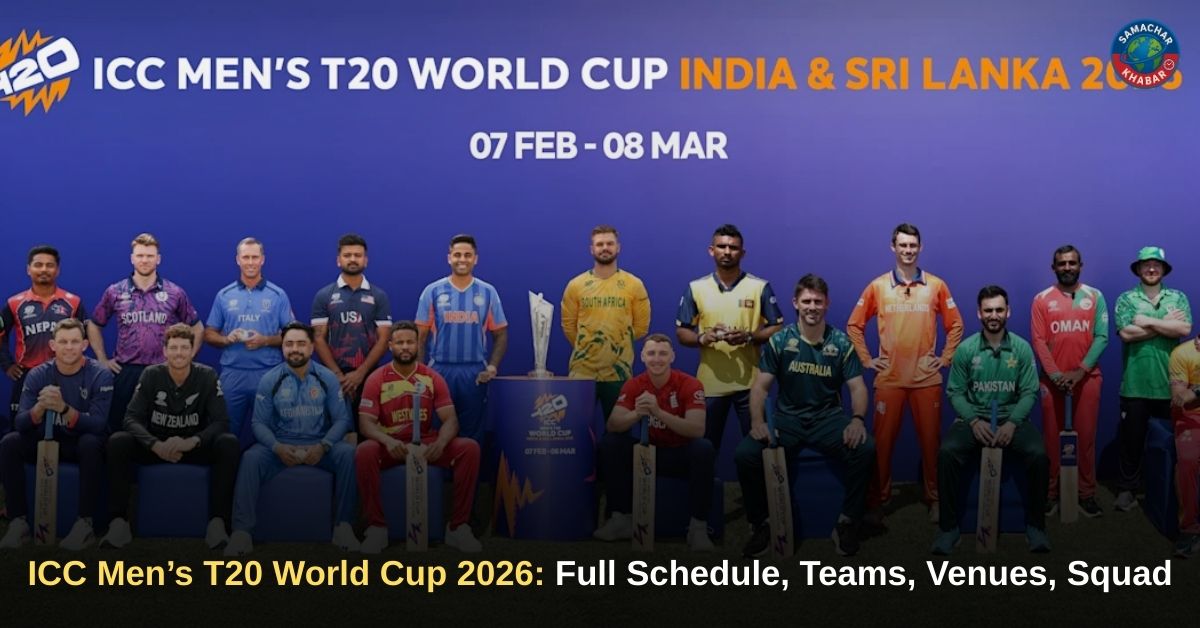
The ICC Men’s T20 World Cup 2026 has officially begun, marking the start of the 10th edition of cricket’s premier T20 tournament. Co-hosted by India and Sri Lanka, the competition runs from February 7 to March 8 and features 20 international teams competing across 55 matches at eight venues. India enter the tournament as defending champions after their victory in 2024, while emerging nations and established cricketing powers prepare for a month of high-intensity competition.
With expanded participation, global broadcast coverage, technological innovations and evolving team combinations, the tournament represents one of the most significant events in modern international cricket.
ICC Men’s T20 World Cup 2026: Key Highlights, Tournament Format and Essential Details
- The tournament is being played from February 7 to March 8, 2026.
- India and Sri Lanka are co-hosting the event across eight venues.
- A total of 20 teams are participating in 55 matches.
- Teams are divided into four groups of five teams each.
- The top two teams from each group advance to the Super 8 stage.
- Semi-finals are scheduled for March 4 and March 5, with the final on March 8.
- India are defending champions after winning the 2024 edition.
- Mohammed Siraj replaced injured Harshit Rana in India’s squad following ICC approval.
- Matches are broadcast globally through television, digital platforms, radio and mobile applications.
Tournament Overview: Hosts, Dates and Global Context
The ICC Men’s T20 World Cup 2026 is jointly hosted by India and Sri Lanka, continuing the expanded 20-team format introduced in the previous edition. The tournament began on February 7 in Colombo with Pakistan facing the Netherlands, while India opened their campaign later the same day against the United States in Mumbai.
The final is scheduled for March 8, with Ahmedabad’s Narendra Modi Stadium designated as the primary venue, while Colombo remains an alternate venue depending on tournament circumstances. India begin their title defence after defeating South Africa in the 2024 final, where Virat Kohli scored 76 and Jasprit Bumrah finished as Player of the Tournament.
Teams and Groups: Full Tournament Structure
The 20 teams are divided into four groups. Each team plays four matches in the group stage.
| Group A | Group B | Group C | Group D |
| India | Australia | England | New Zealand |
| Pakistan | Sri Lanka | West Indies | South Africa |
| USA | Ireland | Scotland | Afghanistan |
| Netherlands | Zimbabwe | Nepal | Canada |
| Namibia | Oman | Italy | UAE |
The top two teams from each group advance to the Super 8 stage, followed by semi-finals and the final.
Tournament Venues Across India and Sri Lanka
| Country | Venue | City |
| India | Narendra Modi Stadium | Ahmedabad |
| India | Eden Gardens | Kolkata |
| India | Arun Jaitley Stadium | New Delhi |
| India | Wankhede Stadium | Mumbai |
| India | M.A. Chidambaram Stadium | Chennai |
| Sri Lanka | R. Premadasa Stadium | Colombo |
| Sri Lanka | Sinhalese Sports Club Ground | Colombo |
| Sri Lanka | Pallekele International Cricket Stadium | Kandy |
Match Format, Playing Conditions and Complete T20 Rules Explained
The ICC Men’s T20 World Cup follows the Twenty20 format, where each team faces a maximum of 20 overs per innings. Matches typically last just over three hours, emphasizing aggressive batting, strategic bowling and rapid momentum shifts.
Key rules include:
- Six-over powerplay with fielding restrictions.
- Two unsuccessful Decision Review System (DRS) reviews per innings.
- A Super Over decides tied matches; additional Super Overs are played if required.
- Minimum five overs per side required for a result in group and Super 8 matches.
- Minimum ten overs per side required in semi-finals and final.
- Duckworth-Lewis-Stern method used in rain-affected matches.
- Stop-clock rule requiring bowling teams to begin the next over within 60 seconds.
Opening Ceremony and Tournament Launch
The tournament began with an opening ceremony at Mumbai’s Wankhede Stadium ahead of India’s opening match. Performances by Rishab Sharma, Shivamani, Badshah and Nora Fatehi formed part of the ceremony, while the ICC T20 World Cup trophy made a ceremonial arrival. ICC Chairman Jay Shah and former India captain Rohit Sharma officially launched the tournament alongside young ambassadors representing all competing nations.
Match Timings and Global Viewing Schedule
Daily match timings are scheduled as follows (IST):
| Match Slot | Time (IST) |
| First Match | 10:30 AM |
| Second Match | 2:30 PM |
| Third Match | 6:30 PM |
These timings correspond to viewing windows across major cricket markets including the United States, United Kingdom, Australia, New Zealand, Pakistan and the Middle East.
Global Broadcast and Streaming Details
In India, matches are broadcast on Star Sports and streamed live on JioHotstar in multiple languages including English, Hindi, Tamil, Telugu and Kannada, along with regional feeds such as Bengali, Bhojpuri and Haryanvi. Coverage in Marathi and Indian Sign Language is available for selected matches.
International broadcast partners include Sky Sports (UK), Willow TV (USA and Canada), Prime Video (Australia), SKY Sport (New Zealand), ESPN (Caribbean) and various regional platforms. ICC.tv provides live streaming in multiple territories with multilingual commentary. Audio commentary is available globally via the ICC mobile application, while radio coverage is provided by international broadcasters.
ICC Men’s T20 World Cup 2026 Full Team Squads
Group A
India: Suryakumar Yadav (c), Abhishek Sharma, Tilak Varma, Sanju Samson, Shivam Dube, Ishan Kishan, Hardik Pandya, Arshdeep Singh, Jasprit Bumrah, Mohammed Siraj, Varun Chakaravarthy, Kuldeep Yadav, Axar Patel, Washington Sundar, Rinku Singh
Pakistan: Salman Ali Agha (c), Abrar Ahmed, Babar Azam, Faheem Ashraf, Fakhar Zaman, Khawaja Nafay, Mohammad Nawaz, Mohammad Salman Mirza, Naseem Shah, Sahibzada Farhan, Saim Ayub, Shaheen Shah Afridi, Shadab Khan, Usman Khan, Usman Tariq
USA: Monank Patel (c), Jessy Singh, Andries Gous, Shehan Jayasuriya, Milind Kumar, Shayan Jahangir, Saiteja Mukkamala, Sanjay Krishnamurthi, Harmeet Singh, Nosthush Kenjige, Shadley Van Schalkwyk, Saurabh Netravalkar, Ali Khan, Mohammad Mohsin, Shubham Ranjane
Netherlands: Scott Edwards (c), Colin Ackermann, Noah Croes, Bas de Leede, Aryan Dutt, Fred Klaassen, Kyle Klein, Michael Levitt, Zach Lion-Cachet, Max O’Dowd, Logan van Beek, Timm van der Gugten, Roelof van der Merwe, Paul van Meekeren, Saqib Zulfiqar
Namibia: Gerhard Erasmus (c), Zane Green, Bernard Scholtz, Ruben Trumpelmann, JJ Smit, Jan Frylinck, Louren Steenkamp, Malan Kruger, Nicol Loftie-Eaton, Jack Brassell, Ben Shikongo, JC Balt, Dylan Leicher, WP Myburgh, Max Heingo
Group B
Australia: Mitchell Marsh (c), Xavier Bartlett, Cooper Connolly, Tim David, Ben Dwarshuis, Cameron Green, Nathan Ellis, Josh Hazlewood, Travis Head, Josh Inglis, Matthew Kuhnemann, Glenn Maxwell, Matthew Renshaw, Marcus Stoinis, Adam Zampa
Sri Lanka: Dasun Shanaka (c), Pathum Nissanka, Kamil Mishara, Kusal Mendis, Kamindu Mendis, Kusal Janith Perera, Charith Asalanka, Janith Liyanage, Pavan Rathnayake, Wanindu Hasaranga, Dunith Wellalage, Maheesh Theekshana, Dushmantha Chameera, Matheesha Pathirana, Eshan Malinga
Zimbabwe: Sikandar Raza (c), Brian Bennett, Ryan Burl, Graeme Cremer, Bradley Evans, Clive Madande, Tinotenda Maposa, Tadiwanashe Marumani, Wellington Masakadza, Tony Munyonga, Tashinga Musekiwa, Blessing Muzarabani, Dion Myers, Richard Ngarava, Brendan Taylor
Ireland: Paul Stirling (c), Mark Adair, Ross Adair, Ben Calitz, Curtis Campher, Gareth Delany, George Dockrell, Matthew Humphreys, Josh Little, Barry McCarthy, Harry Tector, Tim Tector, Lorcan Tucker, Ben White, Craig Young
Oman: Jatinder Singh (c), Vinayak Shukla, Mohammad Nadeem, Shakeel Ahmad, Hammad Mirza, Wasim Ali, Karan Sonavale, Shah Faisal, Nadeem Khan, Sufyan Mehmood, Jay Odedra, Shafiq Jan, Ashish Odedara, Jiten Ramanandi, Aamir Kaleem
Group C
England: Harry Brook (c), Rehan Ahmed, Jofra Archer, Tom Banton, Jacob Bethell, Jos Buttler, Sam Curran, Liam Dawson, Ben Duckett, Will Jacks, Jamie Overton, Adil Rashid, Phil Salt, Josh Tongue, Luke Wood
West Indies: Shai Hope (c), Shimron Hetmyer, Johnson Charles, Roston Chase, Matthew Forde, Jason Holder, Akeal Hosein, Shamar Joseph, Brandon King, Gudakesh Motie, Rovman Powell, Sherfane Rutherford, Quentin Sampson, Jayden Seales, Romario Shepherd
Italy: Wayne Madsen (c), Marcus Campopiano, Gian Piero Meade, Zain Ali, Ali Hasan, Crishan Jorge Kalugamage, Harry Manenti, Anthony Mosca, Justin Mosca, Syed Naqvi, Benjamin Manenti, Jaspreet Singh, JJ Smuts, Grant Stewart, Thomas Draca
Nepal: Rohit Paudel (c), Dipendra Singh Airee, Sandeep Lamichhane, Kushal Bhurtel, Aasif Sheikh, Sundeep Jora, Aarif Sheikh, Basir Ahamad, Sompal Kami, Karan KC, Nandan Yadav, Gulshan Jha, Lalit Rajbanshi, Sher Malla, Lokesh Bam
Scotland: Richie Berrington (c), Tom Bruce, Matthew Cross, Bradley Currie, Oliver Davidson, Chris Greaves, Zainullah Ihsan, Michael Jones, Michael Leask, Finlay McCreath, Brandon McMullen, George Munsey, Safyaan Sharif, Mark Watt, Bradley Wheal
Group D
South Africa: Aiden Markram (c), Corbin Bosch, Dewald Brevis, Quinton de Kock, Marco Jansen, George Linde, Keshav Maharaj, Kwena Maphaka, David Miller, Lungi Ngidi, Anrich Nortje, Kagiso Rabada, Ryan Rickelton, Jason Smith, Tristan Stubbs
New Zealand: Mitchell Santner (c), Finn Allen, Michael Bracewell, Mark Chapman, Devon Conway, Jacob Duffy, Lockie Ferguson, Matt Henry, Kyle Jamieson, Daryl Mitchell, James Neesham, Glenn Phillips, Rachin Ravindra, Tim Seifert, Ish Sodhi
Afghanistan: Rashid Khan (c), Noor Ahmad, Abdullah Ahmadzai, Sediqullah Atal, Fazalhaq Farooqi, Rahmanullah Gurbaz, Mohammad Ishaq Rahimi, Shahidullah Kamal, Mohammad Nabi, Gulbadin Naib, Azmatullah Omarzai, Mujeeb Ur Rahman, Darwish Rasooli, Ibrahim Zadran, Zia Ur Rahman Sharifi
Canada: Dilpreet Bajwa (c), Ajayveer Hundal, Ansh Patel, Dilon Heyliger, Harsh Thaker, Jaskarandeep Singh, Kaleem Sana, Kanwarpal Tathgur, Navneet Dhaliwal, Nicholas Kirton, Ravinderpal Singh, Saad Bin Zafar, Shivam Sharma, Shreyas Movva, Yuvraj Samra
UAE: Muhammad Waseem (c), Alishan Sharafu, Aryansh Sharma, Dhruv Parashar, Haider Ali, Harshit Kaushik, Junaid Siddique, Mayank Kumar, Muhammad Arfan, Muhammad Farooq, Muhammad Jawadullah, Muhammad Zohaib, Rohid Khan, Sohaib Khan, Simranjeet Singh
Spiritual Perspective: Understanding Life’s Purpose Through the Unique Knowledge of Saint Rampal Ji Maharaj Ji
Beyond the excitement of global sporting events like the ICC Men’s T20 World Cup 2026, spiritual teachings remind individuals about balance, discipline and the deeper purpose of human life. The unique spiritual knowledge given by Saint Rampal Ji Maharaj emphasizes true devotion, moral living and understanding of sacred scriptures in their original context.
His teachings focus on attaining inner peace, freedom from stress and living a life guided by truth and righteousness. In a world driven by competition and achievement, such spiritual awareness encourages harmony, self-control and a meaningful direction for human life beyond material success.
A Tournament Shaping the Future of Global T20 Cricket
The ICC Men’s T20 World Cup 2026 represents a defining moment for international cricket, combining established champions, emerging teams and debutants within an expanded global format. With matches spread across iconic venues, extensive broadcast reach and evolving competitive balance, the tournament highlights the continued growth of the T20 format.
As teams progress through the group stage and into the knockout rounds, performances over the coming weeks will determine whether a new champion emerges or history is made through a successful title defence, reinforcing the tournament’s place as one of cricket’s most influential global events.
FAQs on ICC Men’s T20 World Cup 2026
1. When does the ICC Men’s T20 World Cup 2026 start and end?
The ICC Men’s T20 World Cup 2026 started on February 7 and will conclude with the final on March 8, 2026, across venues in India and Sri Lanka.
2. How many teams are playing in the ICC Men’s T20 World Cup 2026?
A total of 20 teams are participating, divided into four groups of five teams each, competing across 55 matches in the tournament.
3. Where can fans watch ICC Men’s T20 World Cup 2026 live?
In India, matches are broadcast on Star Sports and streamed on JioHotstar, while global viewers can watch through regional broadcasters and ICC.tv streaming platforms.
4. What is the format of the ICC Men’s T20 World Cup 2026?
Teams play a group stage first, followed by the Super 8 stage. The top teams advance to semi-finals and then the final to decide the champion.
5. Who are the defending champions of the ICC Men’s T20 World Cup 2026?
India are the defending champions, having won the 2024 ICC Men’s T20 World Cup after defeating South Africa in the final.