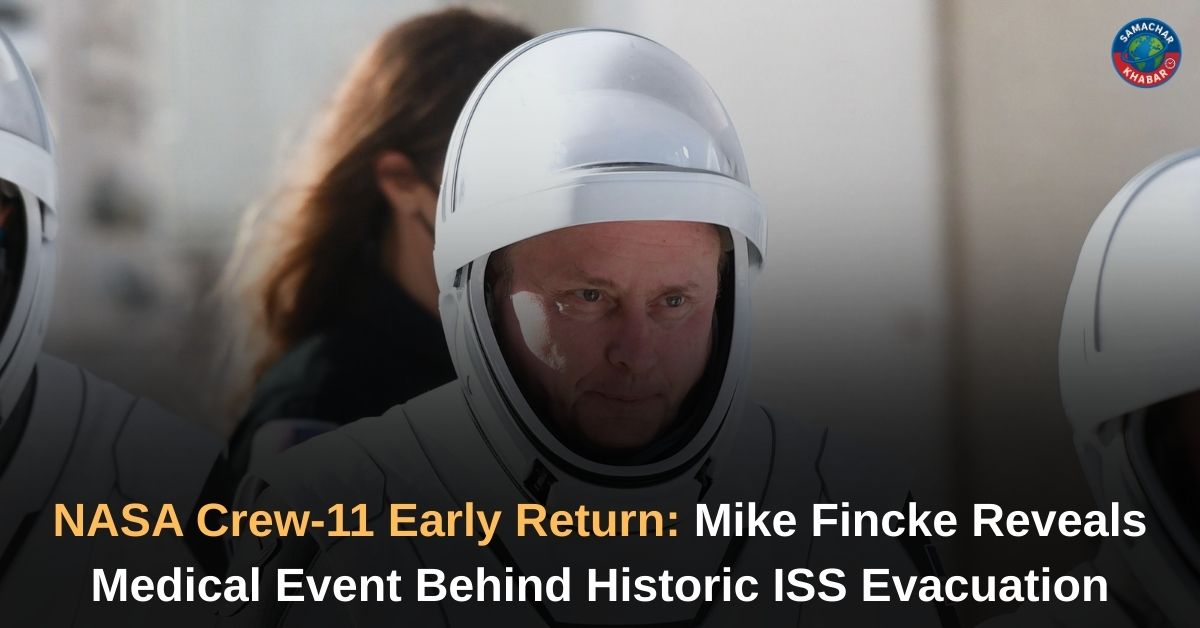
NASA’s Crew-11 mission was supposed to conclude in February 2026 after roughly six months aboard the International Space Station (ISS). Instead, the mission ended nearly a month early after veteran astronaut Mike Fincke experienced a medical event on January 7 that required immediate attention in orbit.
Weeks after NASA confirmed the early return, Fincke identified himself as the astronaut at the center of the incident. While he described the situation as serious, he emphasized it was “not an emergency, but a carefully coordinated plan” to return to Earth for advanced medical imaging unavailable aboard the station. The decision marked the first dedicated medical evacuation in the ISS’s 25-year history — and the first such evacuation in 65 years of human spaceflight.
NASA Crew-11 Early Return: Key Facts About the ISS Medical Event
- Medical event occurred January 7, 2026
- Planned January 8 spacewalk (EVA) was canceled
- NASA announced early return on January 8
- Undocking took place January 14
- Splashdown occurred January 15 off San Diego
- First dedicated medical evacuation in ISS history
- First NASA medical evacuation in 65 years of human spaceflight
- Situation described as serious but stable
- Advanced diagnostic imaging required on Earth
- Fincke now undergoing post-flight reconditioning in Houston
What Happened Aboard the International Space Station?
The incident unfolded as preparations were underway for what would have been the first spacewalk of 2026. NASA abruptly postponed the extravehicular activity that Fincke and fellow NASA astronaut Zena Cardman were scheduled to conduct on January 8.
At the time, NASA issued a statement saying it was monitoring a medical concern involving a crew member but declined to identify the astronaut due to privacy policies. The agency stated that the situation was stable.
In his later statement, Fincke explained:
“On Jan. 7, while aboard the International Space Station, I experienced a medical event that required immediate attention from my incredible crewmates. Thanks to their quick response and the guidance of our NASA flight surgeons, my status quickly stabilized.”
The crew utilized onboard medical resources, including the station’s ultrasound system, which Fincke later said proved especially helpful.
Why NASA Ended the Crew-11 Mission Early
After further evaluation, NASA leadership and medical teams determined that returning Fincke to Earth was the safest course of action to access advanced medical imaging technology not available in orbit.
“After further evaluation, NASA determined the safest course was an early return for Crew-11 — not an emergency, but a carefully coordinated plan,” Fincke said.
NASA Administrator Jared Isaacman later described the event as a “serious situation” in orbit but confirmed the astronaut had remained safe and stable.
NASA’s chief health and medical officer, James Polk, clarified that the issue was not the result of an operational injury. He noted that diagnosing certain medical conditions in microgravity presents unique challenges given the limitations of onboard equipment.
Crew-11 Mission Details and Timeline
Crew-11 launched in August 2025 aboard Crew Dragon Endeavour as part of SpaceX Crew-11. The four-person crew included:
- Mike Fincke (NASA)
- Zena Cardman (NASA)
- Kimiya Yui
- Oleg Platonov
Fincke served as Expedition 73/74 flight engineer and commander during the mission. The spacecraft undocked from the ISS on January 14 and splashed down safely in the Pacific Ocean near San Diego on January 15 after an approximately 11-hour return journey.
Following splashdown, the astronauts were transported for medical evaluation, including care at Scripps Memorial Hospital La Jolla near San Diego.
Medical Capabilities in Orbit — Strengths and Limits
The International Space Station maintains a robust medical kit, a pharmacy, and diagnostic tools such as ultrasound equipment. Astronauts receive medical training prior to flight, and each crew designates a crew medical officer. NASA flight surgeons remain in continuous communication with astronauts during medical situations.
However, certain advanced imaging technologies used for comprehensive diagnosis on Earth are not available in microgravity. That limitation ultimately shaped NASA’s decision.
Also Read: Artemis II Moon Mission: NASA Clears Major Hydrogen Hurdle, March 6 Launch Window Opens
A 2015 study published in the Federation of American Societies for Experimental Biology journal found that medication use aboard the ISS is relatively low, averaging about 10 doses of non-prescription medication per astronaut per week. Still, long-duration spaceflight can involve health challenges such as headaches, congestion, skin irritation, and musculoskeletal strain.
Operational Impact on the ISS
Crew-11’s early departure temporarily reduced the ISS population to three astronauts:
- Chris Williams
- Sergey Kud-Sverchkov
- Sergei Mikayev
NASA paused spacewalks and trimmed research output while awaiting replacement personnel. The next mission, SpaceX Crew-12, launched in February aboard Crew Dragon “Freedom,” restoring the ISS to its standard seven-person staffing level.
Public Reaction and Privacy Considerations
When the early return was first announced, NASA did not identify the affected astronaut. Weeks later, Fincke requested that the agency release his statement publicly.
The disclosure prompted mixed reactions. Many offered well wishes and expressed relief at his recovery. Others questioned why the specific medical condition was not revealed. NASA has consistently maintained that astronauts retain their right to medical privacy, and that broader health findings from spaceflight are typically shared through scientific research rather than individual disclosures.
Human Limits in Space and the Eternal Wisdom of Saint Rampal Ji Maharaj Ji
The NASA Crew-11 early return serves as a powerful reminder that even the most highly trained astronauts remain human in the face of physical limitations. Despite advanced technology, medical expertise, and years of preparation, spaceflight continues to expose the fragility of the human body.
Saint Rampal Ji Maharaj explains through His spiritual discourses that the human body is temporary and subject to suffering, whether on Earth or in space. According to His teachings based on holy scriptures, true safety and freedom from physical distress are not found in technological advancement alone, but in attaining correct spiritual knowledge and devotion to the Supreme God.
While science explores outer space, His spiritual knowledge focuses on inner awakening — guiding humanity toward permanent peace beyond material limitations.
A Historic Yet Human Chapter in Spaceflight
Mike Fincke, selected by NASA in 1996, has now logged 549 days in space across four missions, including previous ISS expeditions and Soyuz flights. His experience and leadership were central to Crew-11’s operations during Expedition 73/74.
In reflecting on the experience, Fincke said:
“I’m doing very well and continuing standard post-flight reconditioning at NASA’s Johnson Space Center in Houston. Spaceflight is an incredible privilege, and sometimes it reminds us just how human we are.”
The NASA Crew-11 early return will be remembered not as a crisis, but as a demonstration of preparedness and caution. It underscored both the resilience of astronauts and the realities of human space exploration — where safety decisions, even when not emergencies, can redefine history.
FAQs on NASA Crew-11 Early Return and Mike Fincke ISS Medical Event
1. Why did NASA Crew-11 return early from the International Space Station?
NASA Crew-11 returned early after astronaut Mike Fincke experienced a medical event on January 7, 2026, requiring advanced medical imaging unavailable aboard the ISS.
2. What medical issue did Mike Fincke experience on the ISS?
Mike Fincke described it as a medical event needing immediate attention, but NASA did not disclose the specific condition due to medical privacy policies.
3. Was the NASA Crew-11 early return considered an emergency?
No. NASA and Mike Fincke stated the return was not an emergency but a carefully coordinated decision to ensure proper medical evaluation on Earth.
4. When did NASA Crew-11 splash down after leaving the ISS?
Crew-11 undocked on January 14, 2026, and safely splashed down on January 15 in the Pacific Ocean off the coast of San Diego.
5. Was this the first medical evacuation in ISS history?
Yes. The Crew-11 early return marked the first dedicated medical evacuation in the International Space Station’s 25-year history and NASA’s first in 65 years of human spaceflight.