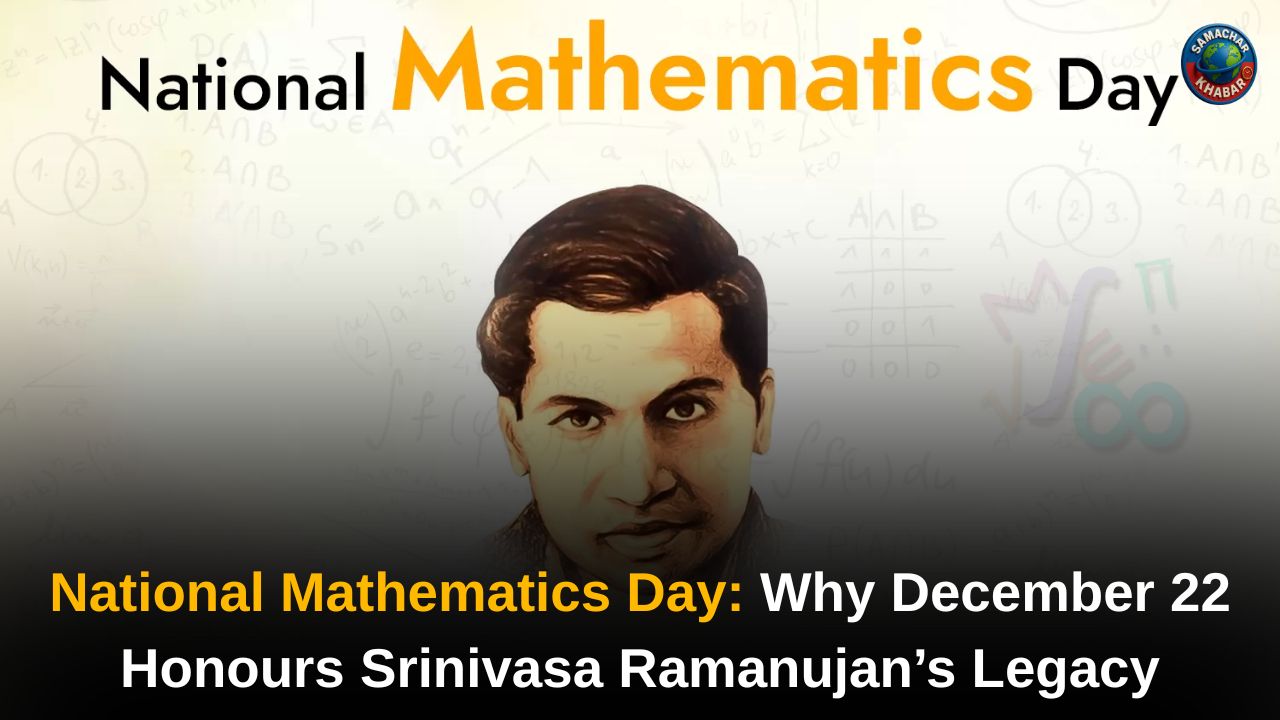
National Mathematics Day is being observed across India on December 22 to commemorate the birth anniversary of Srinivasa Ramanujan, one of the country’s most influential and globally recognised mathematicians.
Instituted by the Government of India in December 2011, the observance aims to recognise Ramanujan’s extraordinary contributions to mathematics while highlighting the subject’s importance in scientific progress and everyday life. Educational institutions, research bodies, and academic forums are marking the day through various programmes, reinforcing the role of mathematics in innovation, technology, and logical thinking.
Key Takeaways on National Mathematics Day 2025
- National Mathematics Day is observed every year on December 22
- The date marks the birth anniversary of Srinivasa Ramanujan
- The observance was instituted in December 2011 by the Government of India
- 2012 was observed as the National Mathematics Year nationwide
- The day highlights India’s mathematical heritage and modern relevance of mathematics
Why National Mathematics Day Is Observed on December 22
December 22 holds national significance as it marks the birth anniversary of Srinivasa Ramanujan, whose work continues to influence modern mathematics more than a century after his lifetime. National Mathematics Day is observed to recognise his original thinking and solutions to problems that were considered intractable during his era.
According to official accounts, the observance serves not only as a tribute to Ramanujan but also as a platform to encourage students and researchers to engage deeply with mathematics as a discipline central to scientific inquiry, technological development, and innovation.
Institution of National Mathematics Day
The observance of National Mathematics Day was formally instituted by the Government of India in December 2011. December 22 was designated as the annual date to recognise Ramanujan’s extraordinary contributions to the field of mathematics.
Also Read: National Science Day: जानिए इतिहास, महत्व, थीम और उद्देश्य
The initiative was followed by the nationwide observance of 2012 as the National Mathematics Year, providing an institutional push to mathematical education, research, and awareness across India. Educational institutions and academic forums continue to play a central role in marking the day.
India’s Long and Enduring Mathematical Tradition
India’s association with mathematics extends back several centuries. According to a statement cited by the Press Information Bureau, India’s contributions to mathematics can be traced as early as 1200 BCE to 1800 BCE.
Foundational concepts such as:
- The decimal number system
- The concept of zero
- The use of negative numbers
originated in the Indian subcontinent. Significant developments in arithmetic, algebra, and trigonometry also emerged during this period.
Classical and Golden Periods of Indian Mathematics
The classical and golden periods of Indian mathematics, spanning roughly from the fourth to the sixteenth century, witnessed seminal contributions from scholars including:
- Aryabhatta
- Varahamihira
- Brahmagupta
- Bhaskara II
National Mathematics Day is also viewed as an occasion to place Srinivasa Ramanujan within this longer intellectual and scholarly tradition, highlighting continuity between ancient mathematical thought and modern discoveries.
Srinivasa Ramanujan: Life and Mathematical Contributions
Born in 1887 in Erode, Tamil Nadu, Srinivasa Ramanujan is widely regarded as one of the most original mathematical minds in history. Despite limited formal higher education, he independently compiled nearly 3,900 mathematical results, many of which were later recognised as both original and profound.
His pioneering work covered areas such as:
- Mathematical analysis
- Number theory
- Infinite series
- Continued fractions
Ramanujan’s intuitive methods and unconventional approaches reshaped key areas of twentieth-century mathematics and continue to influence research in the twenty-first century.
Global Impact and Enduring Influence
According to official references cited by the PIB, Ramanujan’s ideas opened new directions in mathematical thought and inspired generations of mathematicians worldwide. His work remains central to ongoing research and continues to find relevance in modern scientific and technological studies.
His legacy forms the core significance of National Mathematics Day, reinforcing the global recognition of India’s contribution to mathematical knowledge.
Mathematics Beyond Classrooms
On National Mathematics Day, schools, colleges, and academic institutions across the country organise programmes to highlight that mathematics extends beyond textbooks and examinations. Experts emphasise that mathematics plays an essential role in daily life, from basic calculations and measurements to strategic thinking and problem-solving.
The observance seeks to address the perception of mathematics as a difficult subject and encourages its understanding through practical applications, logical reasoning, and real-world relevance.
Mathematics in the Modern Scientific Era
In the contemporary era, mathematics has become increasingly significant due to its role in emerging fields such as artificial intelligence, data science, and coding. Ramanujan’s formulas continue to be applied in advanced scientific research, including studies related to black holes and quantum mechanics.
National Mathematics Day underscores how foundational mathematical thinking supports modern innovation and scientific progress.
Reinforcing the Purpose of National Mathematics Day
National Mathematics Day reinforces the idea that dedication and intellectual curiosity can overcome limitations of resources or formal training. By commemorating Ramanujan’s life and work, the observance highlights the importance of nurturing mathematical talent and encouraging analytical thinking among students and researchers.
The day serves as a reminder of mathematics as a tool for understanding the world and advancing knowledge across disciplines.
Beyond Infinity and Higher Truth
While mathematics has enabled humanity to understand concepts such as infinity and the vastness of the universe, it also reflects a broader philosophical question about realities that extend beyond measurable knowledge. It states that despite advanced mathematical understanding, humanity still lacks awareness of realms believed to exist far beyond the material universe, accessible only after death through true devotion.
According to spiritual descriptions referenced in sacred texts such as the Gita, this supreme realm is referred to as Satlok. The knowledge of Satlok, as described, cannot be explained by even the greatest mathematicians, scientists, astrologers, or geographers. It is imparted only by a Tatvdarshi Saint, identified in the present context as Sant Rampal Ji Maharaj, whose Satsang, Knowledge, and books Gyan Ganga and Jeene Ki Rah are cited as sources guiding individuals towards understanding the purpose of human life and attaining salvation through true devotion.
For more information visit our
- Website: www.jagatgururampalji.org
- YouTube: Sant Rampal Ji Maharaj
- Facebook: Spiritual Leader Saint Rampal Ji
- X (Twitter): @SaintRampalJiM
FAQs on National Mathematics Day 2025
Q1. When is National Mathematics Day observed?
National Mathematics Day is observed every year on December 22.
Q2. Why is December 22 significant?
December 22 marks the birth anniversary of Srinivasa Ramanujan.
Q3. When was National Mathematics Day instituted?
It was instituted by the Government of India in December 2011.
Q4. What was the National Mathematics Year?
The year 2012 was observed nationwide as the National Mathematics Year.
Q5. What is the purpose of National Mathematics Day?
It recognises Ramanujan’s contributions and promotes mathematics in education, research, and everyday life.