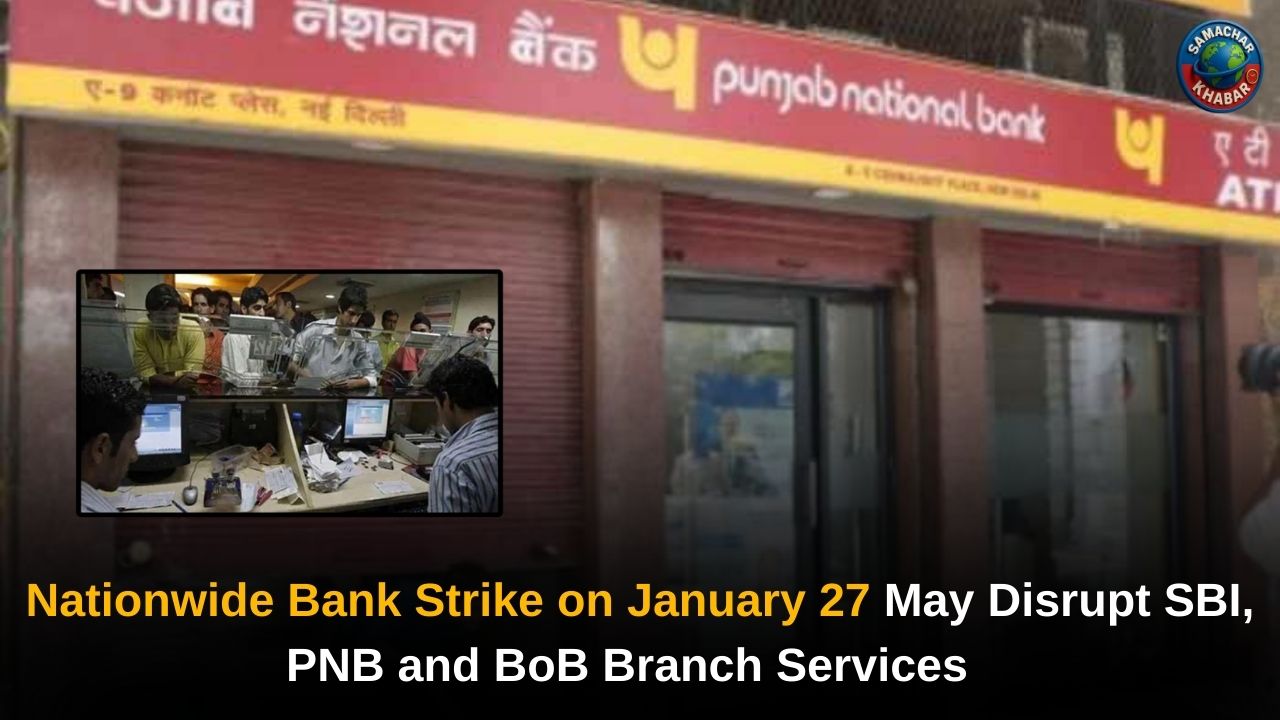
Public sector banking services across India faced disruption on Tuesday, January 27, as bank employee unions went ahead with a nationwide strike demanding the immediate implementation of a five-day work week. The strike, called by the United Forum of Bank Unions (UFBU), followed failed conciliation meetings with the Chief Labour Commissioner. With banks already closed on preceding holidays, customers encountered an extended period of limited branch access.
While public sector banks such as SBI, PNB and Bank of Baroda were impacted, private banks continued normal operations. Digital banking services remained available, though customers were advised to plan branch-related transactions in advance.
Key Highlights on the Nationwide Bank Strike and Customer Impact
- Nationwide bank strike held on January 27 across India
- Strike called by United Forum of Bank Unions (UFBU) representing nine unions
- Core demand is the implementation of a five-day work week
- Public sector banks face branch-level service disruption
- SBI, PNB, Bank of Baroda and other PSU banks affected
- Private sector banks continue normal operations
- Digital banking services remain functional
- ATM cash availability may face localised issues
- Government and banks take steps to limit disruption
Why the Nationwide Bank Strike Is Happening
The nationwide bank strike was announced by the United Forum of Bank Unions (UFBU) after conciliation meetings with the Chief Labour Commissioner on January 22 and 23 failed to produce any assurance on their long-standing demand.
UFBU is a joint platform of nine major unions representing officers and employees of public sector banks. The unions are demanding the immediate implementation of a five-day work week, which would make all Saturdays bank holidays.
According to union leaders, this proposal was already agreed upon during the 12th Bipartite Settlement signed with the Indian Banks’ Association (IBA) in March 2024. However, the absence of a formal government notification has delayed its implementation, prompting unions to proceed with strike action.
Public Sector Banks Affected by the Strike
Branch-level operations at public sector banks were significantly impacted due to employee participation in the strike. Customers reported limited or suspended services at major lenders, including:
- State Bank of India
- Punjab National Bank
- Bank of Baroda
- Union Bank of India
- Canara Bank
- Bank of India
Services requiring physical presence at branches were the most affected during the strike.
Services That Were Disrupted at Bank Branches
Customers visiting public sector bank branches on January 27 faced difficulties accessing several routine services, including:
- Cash deposits and withdrawals
- Cheque clearing and settlement
- Passbook updates and draft issuance
- Loan documentation and processing
- Routine administrative and customer service work
Due to the strike coinciding with earlier holidays, some branches effectively remained non-operational for multiple consecutive days.
Which Banks Continued Normal Operations
Private sector banks were largely unaffected by the strike, as their employees are not members of the unions participating in the protest. Banks that continued operations as usual include:
- HDFC Bank
- ICICI Bank
- Axis Bank
- IDFC First Bank
- Kotak Mahindra Bank
Some older private banks and cooperative banks, however, experienced partial disruption in select locations.
Status of Digital Banking and ATM Services
Despite the strike, digital banking services continued to function normally across platforms. Customers were able to use:
- UPI services
- Mobile banking applications
- Internet banking portals
- Card-based payment systems
ATM services remained operational in most areas, although localised cash shortages were reported due to logistical delays in cash replenishment linked to reduced branch activity.
Government and Banks’ Response to the Strike
Ahead of the strike, an urgent meeting was convened under the chairmanship of the Secretary, Department of Financial Services. The meeting was attended by senior officials, including the Chairman of SBI, Managing Directors and CEOs of nationalised banks, and the Chief Executive of the Indian Banks’ Association.
Banks were instructed to ensure the smooth functioning of essential services, including digital channels, clearing and settlement systems, government transactions, and services delivered through business correspondents.
Several public sector banks also informed stock exchanges about the possible impact of the strike. In a regulatory filing, SBI stated that while arrangements were made to ensure normal functioning, operations could still be affected due to employee participation in the strike.
Union Stand on Work Hours and Customer Convenience
Union leaders clarified that the strike was not intended to inconvenience customers. They reiterated that the five-day work week would not result in any loss of productivity.
To compensate for reduced working days, bank employees have agreed to work an additional 40 minutes daily from Monday to Friday. According to the unions, a rested and balanced workforce is essential for maintaining service quality, operational efficiency, and financial stability.
What This Bank Strike Signals for Customers and the Banking System
The nationwide bank strike on January 27 highlights ongoing challenges in aligning workforce reforms with policy implementation in India’s public sector banking system. While digital banking has helped minimise immediate inconvenience, repeated disruptions underline the importance of timely decision-making. With the five-day work week already acknowledged in formal agreements, the delay in notification remains the central issue.
For customers, the episode reinforces the need to plan branch-dependent transactions in advance, while for policymakers, it signals the urgency of resolving long-pending operational and workforce concerns.
FAQs on Nationwide Bank Strike on January 27
1. Why is there a nationwide bank strike on January 27?
Bank unions are protesting to demand immediate implementation of a five-day work week and the declaration of all Saturdays as bank holidays.
2. Which banks are affected by the January 27 bank strike?
Public sector banks across India are affected, while most private sector banks continue normal operations.
3. What banking services are disrupted due to the strike?
Branch services like cash deposits, withdrawals, cheque clearing, passbook updates and administrative work are impacted at public sector banks.
4. Will digital banking services work during the bank strike?
Yes, UPI, mobile banking, internet banking and card payments continue to function, though ATM cash availability may face localised issues.
5. What should customers do during the nationwide bank strike?
Customers should plan branch-related transactions in advance and rely on digital banking channels for routine financial needs.