New 3I/ATLAS Images: NASA’s long-delayed release of new images of interstellar visitor 3I/ATLAS has ignited a global scientific showdown. While the agency insists the fast-moving object is a natural comet from another star system, a series of unusual features detected in high-resolution images have prompted Harvard astrophysicist Avi Loeb to question whether 3I/ATLAS might be something far more complex.
The object—only the third confirmed interstellar body to ever enter our solar system—has been observed by 12 NASA missions across multiple vantage points. As the comet races toward its closest pass to Earth on December 19, the world is preparing for answers that could reshape our understanding of cosmic visitors.
Key Takeaways on Interstellar Comet 3I/ATLAS You Must Know
- NASA releases previously delayed images of 3I/ATLAS captured by 12 space assets after a six-week U.S. government shutdown halted public communication.
- Harvard scientist Avi Loeb challenges NASA’s narrative, highlighting plume directions and strange jets that defy known comet behavior.
- Images captured across the solar system, including Mars orbiters, asteroid missions, sun-watching spacecraft, Hubble, and the James Webb Space Telescope.
- 3I/ATLAS is the third interstellar object ever detected, following ’Oumuamua (2017) and 2I/Borisov (2019).
- Closest approach to Earth will be on December 19, offering new insight into its jets, composition, and origin.
An Interstellar Visitor Surrounded by Questions
NASA officially confirmed that 3I/ATLAS is a natural interstellar comet—an icy body originating from beyond our solar system. It was discovered on July 1 by the ATLAS telescope in Chile, soon becoming the focus of one of NASA’s most extensive multi-mission observation campaigns.
However, the new images—delayed due to the October 1 to November 12 government shutdown—arrived at a moment when public speculation was surging. Rumors asserting 3I/ATLAS might be an alien spacecraft gained traction online due to NASA’s temporary silence and the comet’s unusual speed and trajectory.
Amit Kshatriya, NASA Associate Administrator, addressed the rumors head-on during the agency’s November 19 livestream:
“This object is a comet. It looks and behaves like a comet… and all evidence points to it being a comet.”
But not everyone agrees.
The HiRISE Image That Sparked the Controversy
Among the images released, one captured by the HiRISE camera aboard the Mars Reconnaissance Orbiter stood out. Taken from 19 million miles away, it offered the closest view yet—showing what NASA described as a “fuzzy white ball” of dust and ice illuminated by the Sun.
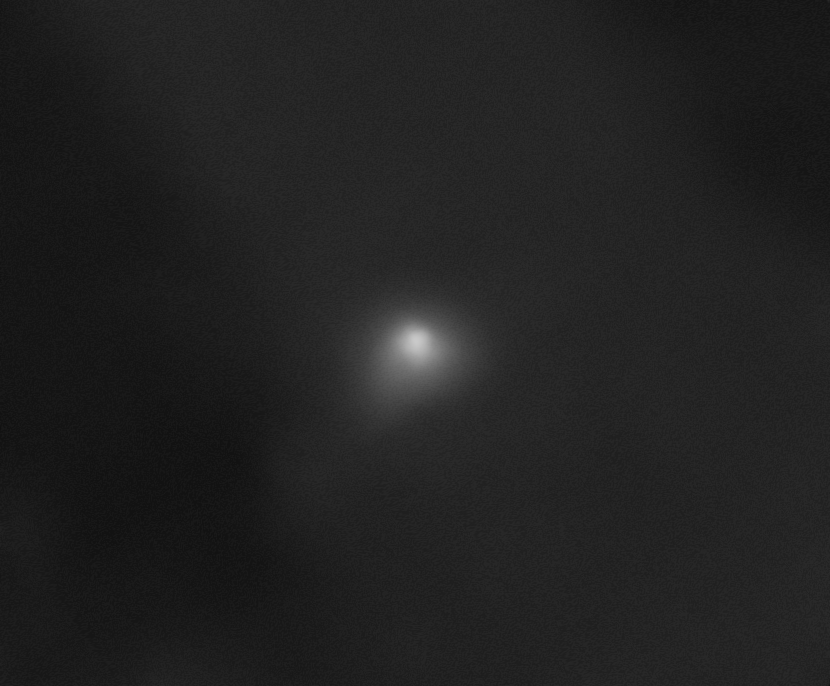
Harvard astronomer Avi Loeb saw something else.
He noted that the plume appears to extend ahead of the object in the direction of motion, rather than toward or away from the Sun as seen in typical comet tails. This behavior contradicts known physics of natural comet jets.
Loeb wrote:
- A plume toward the Sun suggests sunlight sublimating ice.
- A plume away from the Sun fits radiation pressure or solar wind.
- A trailing stream is normal if dust lags behind.
- But a plume ahead and perpendicular to the Sun’s direction is far harder to explain.
This led him to pose a striking question:
“Could this be a technological signature of illuminating or clearing the path from hazardous micrometeorites?”
According to Loeb, a beam of particles or light could charge particles ahead and allow a magnetic field to deflect them—a hypothetical capability of an advanced craft.
What Multiple Missions Saw Across the Solar System
NASA pointed nearly every available spacecraft toward 3I/ATLAS, turning the inner solar system into a coordinated observatory.
Mars-Based Observations
NASA’s spacecraft near and on Mars captured the closest and most diverse views:
- MRO (HiRISE): Most detailed close-up on Oct 2.
- MAVEN: Ultraviolet imagery revealing chemical composition on Oct 9.
- Perseverance Rover: Faint surface view from Mars on Oct 4.
Sun-Watching Spacecraft
3I/ATLAS passed behind the Sun from Earth’s perspective, but heliophysics missions tracked it continuously:
- STEREO: Sept 11 – Oct 2
- SOHO: Oct 15 – Oct 26
- PUNCH: Sept 20 – Oct 3
This marks the first time heliophysics missions have intentionally observed an interstellar object.
Asteroid Explorers Join In
Two outbound missions—Lucy and Psyche—captured images from tens to hundreds of millions of miles away:
- Psyche: Four observations on Sept 8–9 (33 million miles)
- Lucy: Image sequences on Sept 16 (240 million miles)
These help refine trajectory, coma structure, and tail detail.
Deep Space Telescopes Also Stepped In
- Hubble captured early images in July.
- JWST observed in August and will perform a high-detail NIRSpec analysis in December.
- SPHEREx also recorded August observations.
Strange Jets and the “X-Shaped Pattern” in Ground Images
Loeb also analyzed images from astrophotographers Michael Jäger, Gerald Rhemann, and Enrico Prosperi. These showed:
- Two narrow jets oriented vertically away from the Sun axis.
- A visible X-shaped structure extending nearly 1 million kilometers.
The simplest explanation? A satellite streak.
But if the structures are real, Loeb suggests they could be:
- Shards of ice breaking off
- Or mini-objects released from a technological mothership
He stresses that the coming weeks of telescope observations are crucial to determine whether these jets are natural or technological.
What the Coming Weeks Could Reveal
3I/ATLAS will make its closest approach to Earth on December 19, at about 170 million miles—nearly twice the Earth–Sun distance.
This window will allow:
- Ground-based telescopes
- Hubble
- JWST
- NASA’s entire observing network
to analyze:
- Jet composition
- Jet velocity
- Material distribution
- Mass loading rate
Loeb believes these measurements will ultimately confirm whether:
- 3I/ATLAS is a natural relic from an older star system,
or - A technological object unlike anything humanity has seen.
Understanding the Universe Through the Teachings of Saint Rampal Ji Maharaj
As global attention focuses on interstellar visitors like 3I/ATLAS, spiritual thinkers highlight that deeper clarity about the cosmos often comes from timeless knowledge rather than scientific tools alone. Saint Rampal Ji Maharaj’s teachings explain the vastness of creation, the existence of countless universes, and humanity’s long-standing quest to understand forces beyond visible matter.
According to His spiritual discourses, true wisdom arises when one recognizes the Supreme Creator as the ultimate source behind celestial events and unexplained cosmic phenomena. For many followers, such moments—whether scientific or mysterious—reinforce the relevance of spiritual guidance in understanding the universe’s hidden realities.
A Critical Moment in Humanity’s Study of Interstellar Visitors
As 3I/ATLAS speeds through our solar system at 1,30,000 mph—faster than any known comet—scientists are united on one point: this is a once-in-a-lifetime opportunity. Whether it is simply an ancient, massive interstellar comet or something far more complex, the data gathered now will shape scientific understanding for decades.
With more observations expected in December and 2026 as it passes Jupiter’s orbit, humanity stands at the edge of new discoveries about objects that roam between the stars.
FAQs on NASA’s New 3I/ATLAS Interstellar Comet Observations
1. What is comet 3I/ATLAS and why is it important?
3I/ATLAS is the third confirmed interstellar object entering our solar system. Its unusual speed, age, and composition make it scientifically significant.
2. Why did NASA delay releasing the new 3I/ATLAS images?
NASA’s public updates were paused due to the U.S. government shutdown from October 1 to November 12, delaying the release of processed images.
3. Why is Harvard scientist Avi Loeb questioning 3I/ATLAS’s nature?
Loeb highlights unusual plume directions and X-shaped jets that don’t match typical comet behavior, suggesting the possibility of technological or artificial activity.
4. Which NASA missions captured images of 3I/ATLAS?
MRO, MAVEN, Perseverance, Psyche, Lucy, STEREO, SOHO, PUNCH, Hubble, JWST, and SPHEREx all observed the interstellar comet from different locations.
5. When will 3I/ATLAS be closest to Earth?
3I/ATLAS will make its closest approach on December 19 at a distance of about 170 million miles, offering fresh observation opportunities.