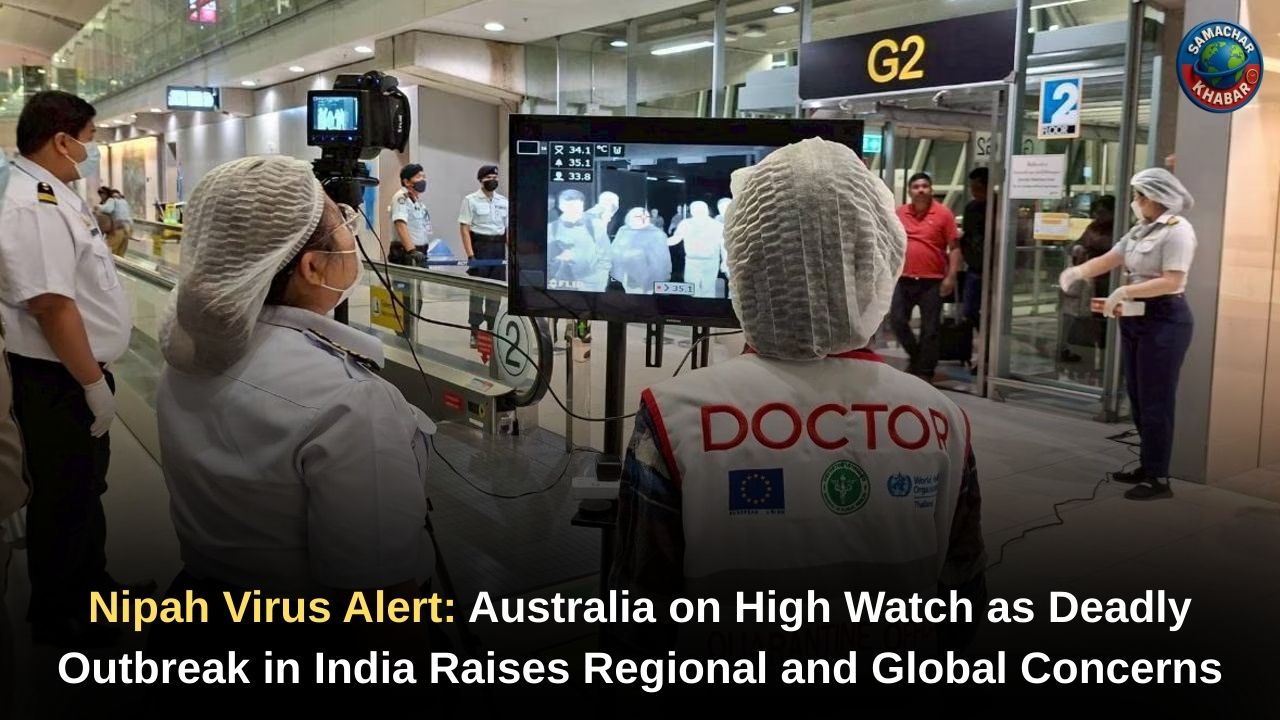
Australia is closely monitoring the outbreak of the Nipah virus in India’s West Bengal after confirmed cases among healthcare workers triggered heightened alerts across Asia. While the virus has never been detected in Australia, health authorities have acknowledged its exceptionally high fatality rate and are watching developments “very, very closely.”
Several Asian countries have tightened airport screening, particularly during the busy Lunar New Year travel period. However, Australian officials say there is currently no medical advice to tighten border controls, stressing that Nipah spreads differently from COVID-19 and requires close personal contact. Experts urge vigilance, preparedness, and calm.
Key Developments in the Nipah Virus Outbreak and Australia’s Response
- Australia is monitoring the Nipah virus outbreak in India but has not changed border health protocols
- Two confirmed Nipah cases were reported in West Bengal, India, both healthcare workers
- The virus has a fatality rate between 40% and 75%, but low human-to-human transmissibility
- WHO has stated the risk of international spread remains low
- Several Asian nations have introduced airport screening measures
- Experts stress preparedness over panic, citing Nipah’s history of containment
What Triggered the Latest Nipah Virus Alert
The current concern stems from confirmed Nipah virus cases reported in India’s eastern state of West Bengal. Indian authorities officially reported two epidemiologically linked cases in Barasat, on the outskirts of Kolkata. Both individuals were nurses working at the same hospital and had close contact with each other during their duties.
Symptoms first appeared in late December 2025. Preliminary testing on January 11 indicated Nipah virus infection, with RT-PCR confirmation received on January 13, 2026. As of late January, the male nurse was recovering, while the female nurse remained in critical condition. No additional cases have been detected so far.
India’s central government deployed a National Joint Outbreak Response Team, identifying and tracing nearly 200 close contacts. All contacts tested negative and remained asymptomatic, with authorities confirming that the situation is under constant monitoring.
Australia’s Position: High Vigilance, No Border Changes
Australia’s Health Minister Mark Butler has repeatedly stated that while the virus is extremely serious, there is currently no advice to tighten border controls. Speaking to ABC Radio and other broadcasters, he emphasized that Australia already has established protocols for managing ill travellers arriving from overseas.
According to Butler, Nipah virus spreads very differently from respiratory illnesses such as COVID-19 or influenza. Transmission requires very close personal contact and the exchange of bodily fluids, making widespread community transmission far less likely.
Australian health authorities confirmed that the virus has never been detected in people or animals in Australia. Existing airport screening and ill-traveller assessment procedures remain in place, with no additional measures introduced at this stage.
WHO Assessment and Global Risk Level
The World Health Organization has assessed the risk of international spread from the current cases as low. WHO officials have stated there is no evidence of increased human-to-human transmission and that India has the capacity to contain such outbreaks.
WHO has not recommended travel restrictions, noting that Nipah outbreaks in the past have remained localized. Despite this, the virus remains classified as a priority pathogen due to its epidemic potential and severe clinical outcomes.
Why Other Asian Countries Have Tightened Airport Screening
While Australia has not altered border measures, several Asian nations have moved to strengthen health surveillance. Thailand introduced screening at major airports, including Phuket, Suvarnabhumi, and Don Mueang, transferring symptomatic travellers to quarantine facilities. Indonesia stepped up monitoring at Bali’s I Gusti Ngurah Rai International Airport, a major destination for Australian tourists.
Singapore, Nepal, Malaysia, Taiwan, and Hong Kong have also enhanced precautions, including temperature checks, health advisories, and monitoring of travellers and migrant workers from affected regions. These steps reflect caution during the Lunar New Year travel period, which historically contributed to the early spread of COVID-19.
Expert Warnings: Preparedness Without Panic
Zoonotic disease expert Wang Linfa has urged Australian authorities to be prepared, particularly by ensuring accurate contact details for travellers arriving from affected areas. He cautioned against blanket PCR testing, calling it excessive, but stressed the importance of rapid tracing if a case is suspected.
Wang emphasized that while panic is unnecessary, preparedness is critical given the virus’s severity. He noted that Australia has the testing capacity to quickly isolate and restrict movement if a positive case were detected.
In contrast, infectious diseases expert Sanjaya Senanayake urged calm, pointing out that Nipah virus has been known since the late 1990s and that outbreaks occur regularly in parts of South Asia without escalating into global crises.
Understanding Nipah Virus: Transmission and Symptoms
Nipah virus is a zoonotic disease belonging to the henipavirus family, similar to Hendra virus. It is naturally carried by fruit bats and can spread to humans in three main ways: direct contact with infected bats or animals such as pigs, consumption of food contaminated by bat saliva or urine, and limited human-to-human transmission through close contact and bodily fluids.
The incubation period typically ranges from four days to two weeks, though rare cases have extended beyond a month. Early symptoms can be mild, including fever, headache, vomiting, and sore throat, making outbreaks difficult to detect. Severe cases may progress rapidly to pneumonia, acute respiratory distress, encephalitis, seizures, coma, and death.
Some survivors have experienced relapsed encephalitis years after recovery, highlighting the virus’s long-term risks.
Why Nipah Is Not the Next COVID-19
Despite its high fatality rate, experts stress that Nipah virus lacks the characteristics needed to trigger a global pandemic. Unlike COVID-19, which spreads easily through airborne droplets and aerosols, Nipah requires prolonged close contact for transmission. Its basic reproduction number remains well below the level needed for sustained global spread.
Only around 750 cases have been documented over nearly three decades, underscoring its rarity despite repeated outbreaks in India and Bangladesh. Scientists agree that Nipah would need significant mutation to become highly transmissible before posing a pandemic-level threat.
Treatment, Vaccines, and Medical Preparedness
There is currently no approved vaccine or specific antiviral treatment for Nipah virus. Medical care focuses on intensive supportive treatment, including respiratory support and management of neurological complications.
In Australia, a monoclonal antibody treatment known as m102.4 is under development. A phase-one trial published in 2020 found a single dose to be well tolerated, though it remains far from widespread clinical use. WHO has indicated that several vaccine candidates are in early development stages, but progress is slow due to the small size of outbreaks.
Travel Advice and Public Health Guidance
The Australian Centre for Disease Control has advised travellers to affected regions to avoid contact with bats and sick animals, refrain from consuming raw date palm sap or fallen fruit, practice good hygiene, and avoid close contact with unwell individuals.
Clinicians have been advised to consider Nipah virus only in patients presenting with encephalitis or severe respiratory illness combined with recent travel to affected areas. Any suspected cases must be managed in strict isolation with appropriate infection-control measures.
Why Authorities Say Vigilance Matters More Than Panic
While Nipah virus is among the deadliest known pathogens, health authorities consistently stress that context matters. For people living outside affected regions, the risk remains very low. Even within outbreak areas, swift surveillance, contact tracing, and isolation have proven effective.
Public health experts agree that continued vigilance, surveillance, and preparedness — rather than fear — are the most effective responses. Australia’s approach reflects this balance, maintaining readiness while avoiding unnecessary disruption.
Spiritual Perspective: Life, Health and Awareness in the Light of the Unique Knowledge of Saint Rampal Ji Maharaj
According to the unique spiritual knowledge imparted by Saint Rampal Ji Maharaj, human life is precious and health is not merely a physical condition but deeply connected with right conduct, awareness, and disciplined living. He emphasizes that fear, panic, and misinformation weaken society, while true knowledge brings balance and clarity. In times of health crises like the Nipah virus alert, his teachings highlight the importance of calmness, ethical living, cleanliness, and compassion rather than chaos.
Saint Rampal Ji Maharaj Ji teaches that when individuals follow righteous knowledge and awareness, society becomes stronger, more united, and better equipped to face challenges without fear or confusion.
A Virus to Watch Closely, Not Fear Blindly
Australia’s response to the Nipah virus outbreak reflects a careful balance between caution and evidence-based decision-making. With no cases detected locally, strong monitoring systems in place, and global health authorities assessing the risk as low, officials see no justification for immediate border changes. At the same time, the virus’s severity ensures it remains under constant scrutiny.
Experts agree that while Nipah demands respect and preparedness, its limited transmissibility means it is unlikely to pose a threat on the scale of COVID-19. For now, vigilance, transparency, and calm remain the guiding principles.
FAQs on Nipah Virus Alert in Australia
1. What is the Nipah virus and why is it dangerous?
Nipah virus is a zoonotic disease with a fatality rate of 40–75%, causing severe respiratory illness and brain inflammation, and is classified as a priority pathogen by WHO.
2. Are there any Nipah virus cases in Australia right now?
No. Australian health authorities have confirmed that Nipah virus has never been detected in Australia in humans or animals.
3. Why is Australia monitoring the Nipah virus outbreak in India?
Australia is monitoring the outbreak due to the virus’s high fatality rate and international travel links, despite the current risk of spread being assessed as very low.
4. How does Nipah virus spread between people?
Nipah virus spreads through close, prolonged contact and exchange of bodily fluids, not through airborne transmission like COVID-19 or influenza.
5. Has Australia tightened border controls because of Nipah virus?
No. Australian authorities say existing protocols for sick travellers are sufficient, and there is currently no medical advice to tighten border controls.