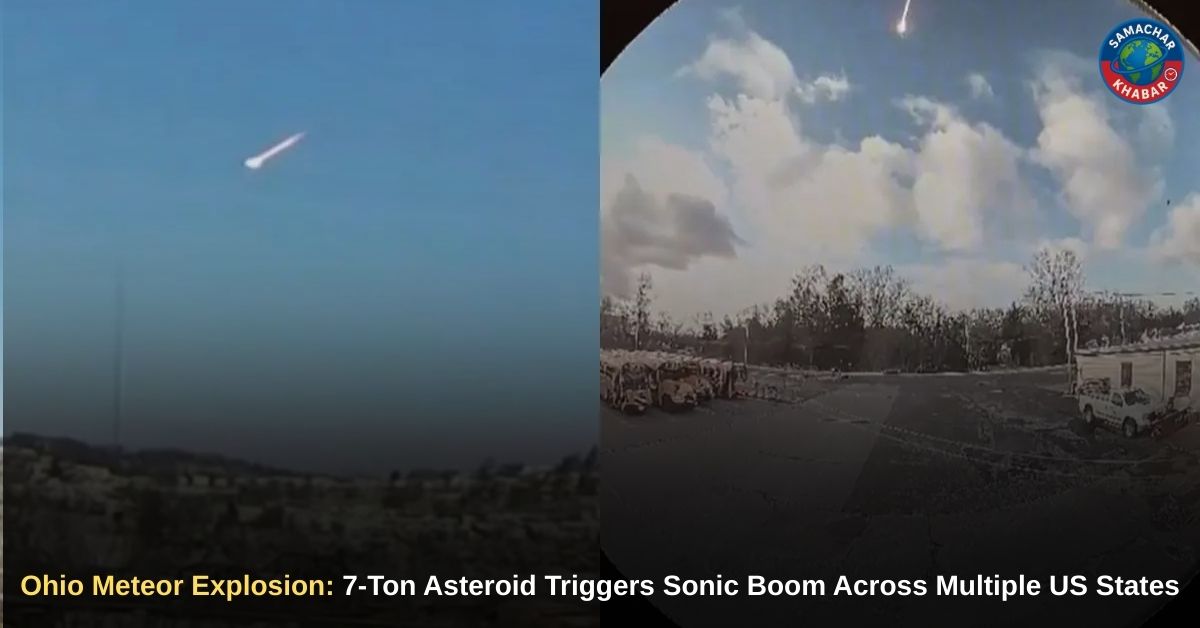
Ohio Meteor Explosion: On March 17, 2026, coinciding with St. Patrick’s Day, residents across Ohio and neighboring regions experienced a sudden and powerful disruption as a fast-moving asteroid exploded high in the atmosphere. What began as a bright fireball streaking across the sky quickly turned into a thunderous sonic boom that rattled homes and startled thousands.
Confirmed by NASA, the event was visible across more than ten U.S. states and parts of Canada. Captured on surveillance cameras, dashcams, and satellite systems, the Ohio meteor event has become one of the most widely witnessed atmospheric explosions in recent years.
Key Highlights of the Ohio Meteor Explosion and Sonic Boom Event
- A 7-ton asteroid, approximately 6 feet (≈2 meters) in diameter, entered Earth’s atmosphere
- First visible at 8:56–8:57 AM EDT above Lake Erie near Lorain, Ohio
- Traveled at speeds between 40,000 and 45,000 miles per hour
- Covered over 30–34 miles through the upper atmosphere
- Fragmented at an altitude of 30–34 miles above Valley City near Medina County
- Released energy equivalent to 250 tons of TNT, generating a powerful pressure wave
- Produced a massive sonic boom heard across Ohio, Pennsylvania, Michigan, and beyond
- Witnessed across 10+ U.S. states and Ontario, Canada
- More than 140 eyewitness reports logged by the American Meteor Society
- Event captured on CCTV (including Olmstead Falls bus stop), dashcams, and official recordings
- Detected by GOES satellites and the Geostationary Lightning Mapper (GLM)
- No confirmed injuries, crater, or verified meteorite debris reported
From Space to Shockwave: The Meteor’s Journey Across Ohio Skies
The asteroid first became visible at an altitude of approximately 50 miles above Lake Erie, near the shoreline of Lorain, Ohio. Traveling southeast at extraordinary speed, it appeared as a bright daylight fireball cutting through the clear morning sky.
As it descended, the intense friction between the meteoroid and Earth’s atmosphere generated heat and light, producing a glowing streak visible across hundreds of miles. The object then traveled more than 30 miles through the atmosphere before violently fragmenting at around 30–34 miles above Valley City, north of Medina County.
Following fragmentation, smaller pieces continued moving southward. While some fragments may have reached the ground as meteorites, no confirmed debris has been officially recovered. Experts believe that a significant portion of the object burned up during atmospheric entry.
Captured in Real Time: Cameras and Witnesses Document the Event
The Ohio meteor event was extensively documented through multiple sources. A security camera at a bus stop in Olmstead Falls captured dramatic footage of the fireball streaking across the sky. Additional video recorded by National Weather Service employee Jared Rackley in Pittsburgh showed the meteor entering the atmosphere with a glowing trail.
Dashcams and residential security systems across the region also captured the event, while satellite instruments tracked the meteor’s bright flash from space. The National Weather Service confirmed that imagery from the Geostationary Lightning Mapper (GLM) aboard GOES satellites detected the atmospheric entry, further validating the event.
These combined observations allowed scientists to reconstruct the meteor’s trajectory with remarkable accuracy.
A Thunderous Sonic Boom: Why Homes Shook Across Multiple States
The most dramatic effect of the meteor was the sonic boom produced when it fragmented. The explosion released energy equivalent to 250 tons of TNT, generating a powerful pressure wave that propagated downward to the ground.
Residents across northeastern Ohio, Pennsylvania, and surrounding areas reported:
- Loud explosive sounds described as “the loudest boom”
- Continuous rumbling similar to thunder
- Homes shaking as if struck by an object
- Windows rattling and household items falling
In Strongsville and other communities, people described the sensation as feeling like a vehicle had crashed into their homes. Some initially mistook the event for an earthquake or a nearby explosion.
One resident said it felt “like a car hit my house,” while others compared the sound to fireworks or dynamite. The intensity of the shockwave was enough to cause widespread alarm, with emergency lines receiving numerous calls.
Bill Cooke, head of NASA’s Meteoroid Environments Office, reacted to the event by saying, “I feel like Chicken Little right now,” reflecting the unexpected nature of the incident even among experts.
Widespread Sightings: A Multi-State and International Event
The meteor’s high altitude and brightness allowed it to be seen across a vast geographic region. Witness reports came from:
- Delaware, Illinois, Indiana, Kentucky
- Maryland, Michigan, New York
- Ohio, Pennsylvania, Virginia
- Washington, D.C.
- Ontario, Canada
The American Meteor Society recorded over 140 eyewitness accounts, many describing both visual sightings and delayed sonic effects. Some observers reported seeing the fireball first, followed by rumbling sounds seconds later — a typical phenomenon due to the speed of sound.
This widespread visibility made the event a shared experience across multiple states and even international borders.
Scientific Breakdown: What Was This Meteor?
Scientists classify such objects based on their stage of interaction with Earth:
- Meteoroid: A rocky or metallic object traveling through space
- Meteor: The visible streak of light produced when it enters Earth’s atmosphere
- Meteorite: Any fragment that survives and reaches the ground
The Ohio object began as a meteoroid and became a meteor upon atmospheric entry. While fragments likely continued toward Medina County, no confirmed meteorite recovery has been reported.
Also Read: Silverpit Crater Confirmed as Ancient Asteroid Impact Beneath the North Sea
Astronomers described the event as a rare, once-in-a-lifetime experience, particularly because it occurred over a populated area where it could be widely observed.
Why NASA Did Not Detect the Asteroid in Advance
Despite its dramatic impact, NASA did not detect the asteroid before it entered Earth’s atmosphere. This is due to the limitations of current monitoring systems.
The asteroid measured only about 2 meters in diameter, far below the 140-meter threshold used to track potentially hazardous near-Earth objects.
Smaller meteoroids:
- Reflect minimal sunlight
- Move unpredictably
- Are difficult to detect with existing telescopes
As a result, such objects are typically only observed once they interact with the atmosphere and produce visible light.
Satellite Detection and Atmospheric Data Analysis
Satellite systems played a crucial role in confirming the event. Instruments like the Geostationary Lightning Mapper (GLM) detected the bright flash associated with the meteor’s entry.
These systems are designed to observe lightning but can also detect meteors due to their intense bursts of light. Combined with eyewitness reports and ground-based recordings, satellite data helped scientists reconstruct the meteor’s path and energy release.
The explosion generated a pressure wave strong enough to shake buildings across parts of northern Ohio, particularly areas north of Medina County.
How Common Are Events Like This? Experts Weigh In
While the Ohio meteor drew widespread attention, experts emphasize that similar घटनाएँ occur frequently on a global scale.
- Thousands of small meteoroids enter Earth’s atmosphere each year
- Most burn up completely and go unnoticed
- Events over populated areas are relatively rare
Geological experts explained that such meteors can occur several times a day, but they are rarely visible to large populations. The Ohio event stood out due to its location, timing, and intensity, making it highly noticeable.
Damage Assessment and Current Status
Despite the powerful explosion and widespread reports of shaking:
- No injuries have been reported
- No confirmed impact crater has been identified
- No verified meteorite debris has been recovered
Experts believe that most of the asteroid disintegrated in the atmosphere, significantly reducing the risk of damage on the ground.
Spiritual Insight: True Knowledge of Saint Rampal Ji Maharaj
Events like the Ohio meteor explosion remind us of the immense forces of nature beyond human control. According to the teachings of Saint Rampal Ji Maharaj, such events are part of a divine system governed by Supreme Power.
He explains that the material world is temporary and uncertain. True peace and safety come only through spiritual knowledge (Tatvgyan) and devotion to the Supreme God. Such rare incidents encourage humanity to seek deeper truth and understand the real purpose of life.
A Rare Moment When Space Touched Everyday Life
The Ohio meteor explosion of March 17, 2026, serves as a powerful reminder of Earth’s constant interaction with space. In a matter of seconds, a relatively small asteroid traveling at immense speed created a dramatic atmospheric explosion that was seen and felt across vast distances.
While such events are scientifically routine, their occurrence over populated areas remains rare. For millions who witnessed it, the experience was unforgettable — a moment when the boundary between Earth and space briefly disappeared, and the sky itself seemed to come alive with sound and light.
FAQs on Ohio Meteor Explosion 2026
1. What caused the loud boom in Ohio on March 17, 2026?
The loud boom was caused by a meteor explosion when a 7-ton asteroid entered Earth’s atmosphere and created a powerful sonic boom over Ohio.
2. How big was the asteroid that exploded over Ohio?
The asteroid was about 6 feet (2 meters) in diameter and weighed approximately 6 to 7 tons before breaking apart in the atmosphere.
3. Did the Ohio meteor cause any damage or injuries?
No injuries or major damage were reported. There is also no confirmed crater or verified meteorite debris found on the ground.
4. Why didn’t NASA detect the Ohio asteroid before impact?
NASA couldn’t detect it because the asteroid was too small. Monitoring systems focus on objects larger than 140 meters, making small meteoroids difficult to track.
5. Where was the Ohio meteor seen and heard?
The meteor was seen and heard across Ohio, Pennsylvania, Michigan, over 10 US states, and even parts of Ontario, Canada.