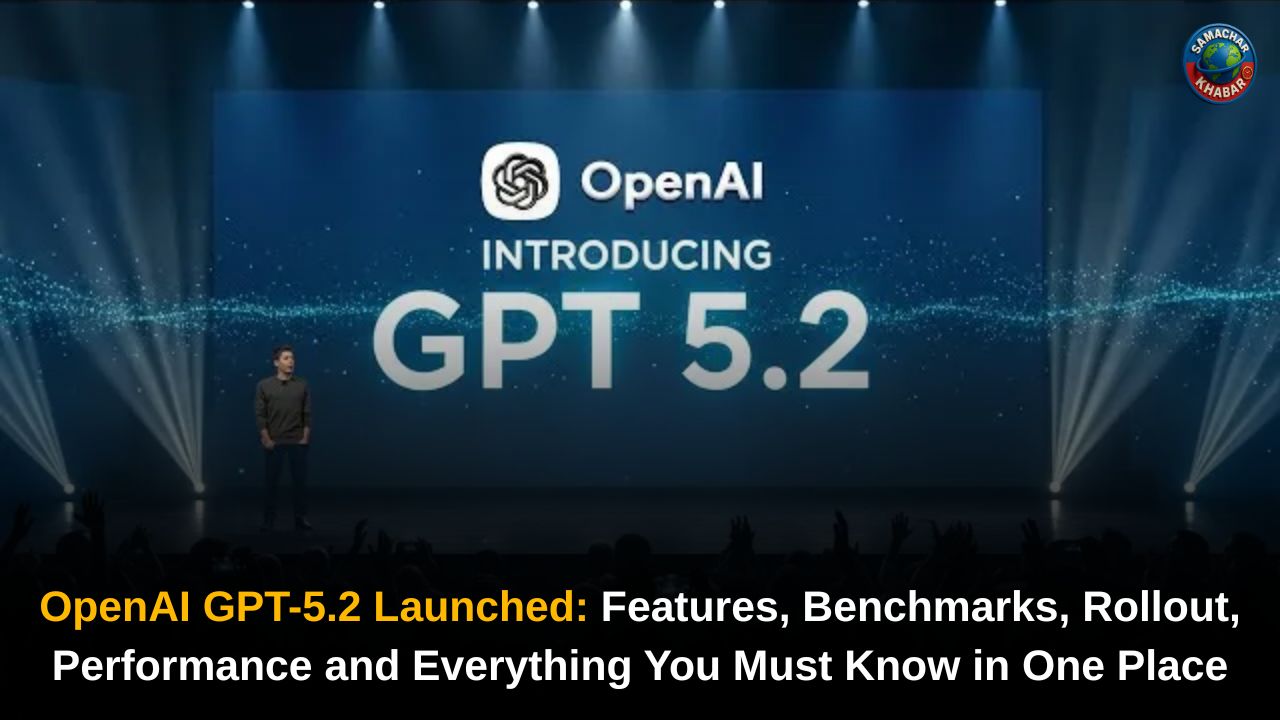
OpenAI has officially launched GPT-5.2, its most advanced AI model to date, marking a major strategic moment in the escalating race between ChatGPT and Google’s latest Gemini 3. The release comes barely a month after the company rolled out GPT-5.1 and just days after CEO Sam Altman reportedly issued a rare internal “Code Red,” urging teams to prioritize improvements to ChatGPT amid growing competitive pressure.
Despite speculation that the update was a direct response to Gemini 3, OpenAI executives say GPT-5.2 has been in development for several months—internally code-named “Garlic”—with extensive testing carried out by enterprise customers long before the Code Red call.
More than just an incremental update, GPT-5.2 represents a major leap in reasoning, coding, long-context handling, tool-use reliability, and scientific accuracy. Early reports from testers, enterprise partners, and benchmark evaluations indicate that GPT-5.2 outperforms not only GPT-5 and GPT-5.1 but also leading competitors including Google’s Gemini 3 Pro and Anthropic’s Claude Opus 4.5 across several critical dimensions of professional knowledge work.
With enhanced safety protections, reduced hallucination rates, and a massive 400,000-token context window, GPT-5.2 aims to position OpenAI back at the top of the AI performance leaderboard. Here is everything you need to know about the model’s features, rollout, benchmarks, enterprise results, and the competitive landscape driving OpenAI’s accelerated progress.
Key Takeaways: GPT-5.2 Brings Major Advances in Reasoning, Coding and Scientific Accuracy
- GPT-5.2 surpasses human experts on 70.9% of tasks across 44 occupations in OpenAI’s GDPval benchmark.
- Significant gains in coding performance, achieving 55.6% on SWE-Bench Pro and 80% on SWE-Bench Verified.
- Massive 400,000-token context window enables analysis of entire projects, research papers and code repositories.
- Hallucinations reduced by 38% compared to GPT-5.1, boosting reliability for real-world workflows.
- Three-tier release—Instant, Thinking and Pro—allows customization for speed, deep reasoning or maximum accuracy.
- Tested by companies like Box, Zoom, Notion, Shopify and Harvey before launch.
- Powerful scientific reasoning demonstrated by solving an open research problem in statistical learning theory.
- Safety strengthened across mental health responses, emotional support and sensitive topics.
- Launch follows Disney’s $1 billion investment in OpenAI and a three-year licensing deal for 200+ characters for Sora.
- OpenAI expects to exit Code Red by January as competition with Google intensifies.
Why OpenAI Declared Code Red—and Why GPT-5.2 Matters Now
OpenAI’s internal urgency was triggered by Google’s highly praised launch of Gemini 3 Pro, which topped several third-party AI leaderboards and demonstrated strong gains in multimodal reasoning. Analysts noted that Gemini 3’s release had a visible impact on stock movements: companies tied to OpenAI saw temporary declines, while Google-linked companies experienced rises. Meanwhile, partners and investors reportedly pushed OpenAI to accelerate improvements to ChatGPT to counter Google’s momentum.
Sam Altman’s Code Red directive temporarily paused various non-essential projects—including early advertising features and digital assistant initiatives—allowing the company to allocate more compute and engineering resources to ChatGPT. While the public interpreted this as an emergency response to Google, OpenAI leaders, including Fidji Simo and Max Schwarzer, have stressed that GPT-5.2’s timeline was planned months in advance. According to Simo, Code Red “helped focus the company,” but did not determine the release date.
Internally, the model was known as “Garlic,” a reference Altman appeared to tease when he posted a video cooking a garlic-heavy dish the day before launch.
Three New GPT-5.2 Models: Instant, Thinking and Pro
GPT-5.2 is structured as a three-model series tailored to different levels of complexity:
1. GPT-5.2 Instant
Optimized for speed, everyday tasks, quick writing, translation, summarization, and information lookup. This is the model best suited for fast-paced use cases that prioritize response time over deep reasoning.
2. GPT-5.2 Thinking
Built for long-form reasoning, math, planning, deep coding, agents, and structured workflows. This version utilizes deeper reasoning chains and performs best on technical and multi-step tasks.
3. GPT-5.2 Pro
The highest-accuracy, most advanced model designed for research-level work, complex queries, scientific analysis, and professional problem-solving. This tier is described by OpenAI as its “smartest and most trustworthy” model.
The rollout began December 11 for paid users across Plus, Pro, Go, Business, Team and Enterprise plans. GPT-5.1 will remain available for three months as a legacy option.
Benchmark Results: GPT-5.2 Outperforms Gemini 3 and Claude in Key Areas
GPT-5.2 demonstrates substantial benchmark gains across nearly every evaluation of knowledge work, reasoning and coding.
GDPval (44 occupations, professional tasks)
- GPT-5.2 Thinking: 70.9%
- GPT-5: 38.8%
- Claude Opus 4.5: 59.6%
- Gemini 3 Pro: 53.3%
This benchmark alone positions GPT-5.2 as one of the strongest professional-use AI models ever evaluated.
Coding and Software Engineering
| Benchmark | GPT-5.2 Thinking | GPT-5.1 Thinking |
| SWE-Bench Pro | 55.6% | 50.8% |
| SWE-Bench Verified | 80.0% | 76.3% |
GPT-5.2 not only surpasses its predecessors but also outperforms Gemini 3 Pro by more than 12 percentage points on SWE-Bench Pro.
Scientific and Mathematical Reasoning
| Test | GPT-5.2 | GPT-5.1 |
| GPQA Diamond | 92.4% | 88.1% |
| CharXiv | 88.7% | 80.3% |
| AIME 2025 | 100% | 94% |
| FrontierMath (Tier 1–3) | 40.3% | 31% |
| ARC-AGI-2 Verified | 52.9% | 17.6% |
These numbers reflect the model’s much stronger multi-step logic, abstraction and consistency, which underpin real-world scientific and financial workflows.
Enterprise Testing Shows Significant Efficiency Gains
OpenAI provided GPT-5.2 to select “Alpha customers” weeks before launch, including Notion, Harvey, Box, Shopify and Zoom. Their findings include:
- 40% faster extraction from lengthy documents
- Strong improvements in ambiguous and long-duration tasks
- Major upgrades in agentic coding; startups like Augment Code chose GPT-5.2 to power new code review agents
- Enhanced accuracy in screen understanding, jumping from 64.2% (GPT-5.1) to 86.3% on ScreenSpot-Pro
In legal, enterprise documentation and software development environments, testers reported that GPT-5.2 delivered materially more reliable and structured outputs.
Scientific Breakthroughs: GPT-5.2 Helps Solve an Open Problem
In a notable case study, GPT-5.2 Pro helped researchers resolve a previously unsolved question in statistical learning theory regarding learning-curve monotonicity. The model produced a workable proof without human scaffolding, which was later validated by subject-matter experts. Researchers further extended the logic into higher dimensional models with GPT-5.2’s assistance.
OpenAI says this demonstrates how frontier models can support scientific exploration, hypothesis testing and proof analysis—though not replace the need for human verification.
Strengthened Safety Measures Amid Legal Scrutiny
The GPT-5.2 release coincides with renewed attention to AI safety. A new lawsuit alleges that ChatGPT contributed to a murder-suicide in Connecticut, while other cases claim ChatGPT responses may have influenced self-harm. OpenAI called the events heartbreaking and emphasized that GPT-5.2 improves:
- distress recognition
- conversational de-escalation
- responses to mental health crises
- guidance toward real-world support
OpenAI is also developing an “Adult Mode,” backed by a new age-prediction system, set for release in early 2026.
What OpenAI Hopes to Achieve With GPT-5.2
Sam Altman told CNBC that Gemini 3 had “less impact than feared” and expects OpenAI to exit Code Red by January. Internally, executives believe GPT-5.2 will help restore OpenAI’s lead in enterprise coding, professional reasoning and scientific work—areas where competitors gained ground.
As enterprises accelerate AI adoption and investors respond to rapid progress, GPT-5.2 represents an effort to reassert OpenAI at the center of the AI industry’s evolution.
Exploring the Spiritual Perspective: The Unique Knowledge Shared by Saint Rampal Ji Maharaj Ji
Amid rapid technological progress and the race toward advanced artificial intelligence, many people also look toward deeper, timeless sources of clarity. One such source is the spiritual wisdom presented by Saint Rampal Ji Maharaj, whose teachings emphasize inner peace, moral living and a scientific understanding of the Supreme Power.
Unlike conventional philosophies, his knowledge highlights a practical path of devotion based on the eternal principles described in the scriptures of all major religions. Saint Rampal Ji Maharaj Ji explains that true freedom from suffering comes not from external advancements but from spiritual realization rooted in correct worship.
His discourses describe the nature of the soul, the purpose of human life and the way to attain permanent happiness through the guidance of a Complete Guru. As technology continues to transform society, his teachings remind followers that ultimate progress lies in achieving peace, compassion and spiritual truth — values that remain constant even as the world undergoes rapid change.
A Transformative Step in the AI Race
GPT-5.2 is more than another upgrade—it is the foundation of OpenAI’s broader strategy to maintain leadership in the face of unprecedented competition. With advances in reasoning, long-context performance, coding power, safety and scientific reliability, the model offers a tangible leap forward at a moment when market expectations are at their highest.
Whether GPT-5.2 shifts the balance in OpenAI’s favor will depend on its real-world adoption, but early signals from benchmarks and enterprise testers suggest the company has delivered one of the most capable AI models ever built.
FAQs on OpenAI GPT-5.2 Features and Performance
1. What is GPT-5.2 and why did OpenAI launch it?
GPT-5.2 is OpenAI’s most advanced model, launched to boost reasoning, coding, long-context handling and compete with Google’s Gemini 3 amid rising industry pressure.
2. What are the key features of GPT-5.2?
GPT-5.2 offers improved reasoning, better coding, 400k-token context, stronger tool use, reduced hallucinations and three model variants: Instant, Thinking and Pro.
3. How does GPT-5.2 perform in benchmarks?
GPT-5.2 outperforms GPT-5.1, Gemini 3 and Claude 4.5 on GDPval, SWE-Bench Pro, GPQA, ARC-AGI and major math and science benchmarks.
4. When will GPT-5.2 be available to users?
GPT-5.2 is rolling out gradually to paid ChatGPT plans—Plus, Pro, Go, Team and Enterprise—before expanding to wider availability.
5. How is GPT-5.2 safer than previous models?
GPT-5.2 reduces hallucinations by 38%, improves mental-health responses, enhances de-escalation and introduces stronger safeguards for sensitive conversations.