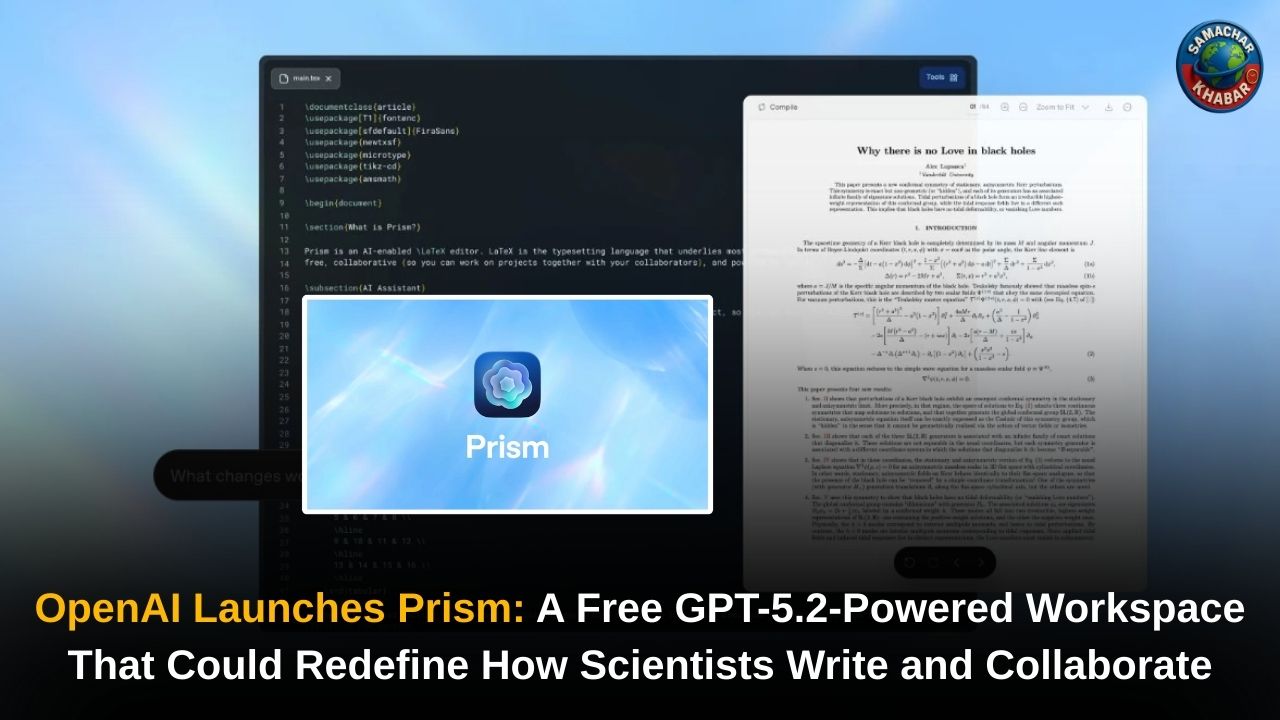
OpenAI has introduced Prism, a free, cloud-based workspace designed specifically for scientists, marking a significant step toward reducing the everyday friction of scientific research. Built as a LaTeX-native platform and powered by GPT-5.2 Thinking, Prism brings drafting, revision, collaboration, equations, citations, and literature discovery into a single integrated environment. Available immediately to anyone with a ChatGPT personal account, the tool reflects OpenAI’s belief that 2026 could become for science what 2025 was for software development — a year when AI meaningfully reshapes professional workflows.
Prism is not positioned as an autonomous “AI scientist.” Instead, OpenAI emphasizes that it is a productivity and collaboration tool designed to keep researchers firmly in control while accelerating the most time-consuming and mechanical parts of academic work.
Key Takeaways: What OpenAI’s Prism Means for Scientific Research
- OpenAI Prism is a free, LaTeX-native scientific workspace powered by GPT-5.2, available to all ChatGPT personal account users.
- Unlimited projects and collaborators are supported, with no seat limits or subscriptions required.
- Prism integrates AI directly into the manuscript, allowing GPT-5.2 to understand structure, equations, citations, and references in full context.
- The platform is built on Crixet, a cloud-based LaTeX system acquired by OpenAI and evolved into Prism.
- OpenAI plans to roll out Prism to Business, Team, Enterprise, and Education users soon.
- The tool aims to reduce fragmented workflows without replacing human scientific judgment.
Why OpenAI Built Prism Now
Scientific research underpins nearly every part of modern life, from medicine and energy to safety systems and technology. Yet despite rapid advances in artificial intelligence, much of the day-to-day work of science still relies on tools that have changed little in decades.
Researchers often move between multiple disconnected systems — text editors, PDFs, LaTeX compilers, reference managers, and separate AI chats — losing context and time in the process. OpenAI sees this fragmentation as a bottleneck that limits the pace of discovery.
According to the company, ChatGPT already receives around 8.4 million messages each week on advanced hard-science topics. That demand, OpenAI says, signals that AI is shifting from curiosity to a core part of researchers’ workflows. Prism is designed as a response to that shift.
What Prism Is and How It Works
Prism is a cloud-based, LaTeX-first workspace where scientific writing and collaboration happen in one place. Unlike traditional AI chat tools that operate alongside documents, Prism embeds GPT-5.2 directly into the research project itself.
This means the model can interact with:
- The full structure of the paper
- Equations and mathematical notation
- Citations and bibliographies
- Figures, diagrams, and surrounding text
Researchers can ask GPT-5.2 to draft or revise sections, assess claims against existing literature, reason through equations, or suggest improvements — all without leaving the document.
Built on Crixet, Designed for Real Research Work
Prism builds on Crixet, a mature cloud-based LaTeX platform that OpenAI acquired and has now folded into a single unified product. Crixet will no longer be offered separately.
While Crixet already supported collaborative LaTeX editing, Prism replaces its earlier AI agent with GPT-5.2 Thinking, OpenAI’s most advanced model for scientific and mathematical reasoning. This allows Prism to go far beyond formatting and typesetting.
In demonstrations, OpenAI showed GPT-5.2 identifying relevant academic papers, incorporating citations, and automatically generating bibliographies — while keeping researchers responsible for verification and final decisions.
Key Features That Set Prism Apart
Prism is designed to support the full research lifecycle, not just writing:
- In-context AI assistance that understands the entire manuscript
- Literature discovery, including pulling relevant work from sources like arXiv
- Equation and citation reasoning across the paper
- Whiteboard-to-LaTeX conversion, turning sketches or photos into structured equations and diagrams
- Real-time collaboration with co-authors, students, and advisors
- In-place edits, eliminating copy-paste between editors and chat tools
- Optional voice-based editing for quick changes
Because Prism is cloud-based, teams do not need local LaTeX installations or complex environment setup, reducing technical barriers to collaboration.
Not an AI Scientist, but an AI Accelerator
OpenAI has been careful to clarify what Prism is — and what it is not. The tool does not conduct research autonomously, generate discoveries on its own, or replace human expertise.
Kevin Weil, OpenAI’s Vice President for Science, has described Prism’s role as enabling thousands of small, incremental accelerations rather than a single dramatic breakthrough. The goal is to help scientists spend less time on mechanical tasks and more time engaging with ideas, interpretation, and verification.
Also Read: ChatGPT Introduces ‘ChatGPT Health’ With Enhanced Privacy and Physician-Guided Intelligence
This philosophy mirrors how AI tools transformed software engineering: not by replacing developers, but by deeply integrating into their workflows.
Expanding Access to Scientific Tools
A central part of Prism’s strategy is accessibility. The platform is free to use, with no limits on projects or collaborators. OpenAI believes removing cost and seat restrictions will allow researchers across institutions, disciplines, and career stages to adopt high-quality tools without procurement hurdles.
While more advanced AI capabilities may eventually be tied to paid ChatGPT plans, OpenAI has stated that Prism’s core workspace will remain free.
A Shift Toward Integrated Scientific Workflows
Prism arrives at a moment when AI-assisted research is becoming increasingly visible, particularly in mathematics and theoretical domains where models have already contributed to new proofs with human oversight.
By embedding GPT-5.2 directly into scientific writing and collaboration, OpenAI is betting that deep workflow integration, combined with advanced reasoning models, can reduce friction in everyday research — much as similar tools reshaped software development in 2025.
Spiritual Perspective: Saint Rampal Ji Maharaj Ji’s Teachings on True Knowledge and Responsible Use of Science
According to the unique spiritual knowledge of Saint Rampal Ji Maharaj, science and technology should always function within the boundaries of true wisdom and human accountability. His teachings emphasize that knowledge, when guided by ethical awareness and correct spiritual understanding, becomes a means for welfare rather than confusion.
In this context, tools like advanced technology or artificial intelligence are beneficial only when humans remain conscious decision-makers, using them to reduce suffering and improve collective well-being. Saint Rampal Ji Maharaj Ji explains that true progress is achieved when material advancement is balanced with spiritual clarity, ensuring that innovation serves humanity rather than distancing it from truth and responsibility.
Why Prism Signals a Turning Point for Research Productivity
Rather than promising automated discovery, Prism represents a more practical shift: bringing reasoning, writing, formatting, and collaboration into one shared, accountable space. If widely adopted, it could change how researchers manage their work, coordinate with collaborators, and move ideas from draft to publication.
OpenAI’s expectation is clear — not a sudden revolution, but a steady, compounding acceleration of scientific progress. Whether Prism becomes a long-term staple for researchers will depend on how well it delivers on that promise, but its launch signals that AI’s next major professional frontier may be science itself.
FAQs on OpenAI Prism AI Workspace for Scientific Research
Q1. What is OpenAI Prism and who can use it?
OpenAI Prism is a free, cloud-based, LaTeX-native research workspace powered by GPT-5.2, available to anyone with a ChatGPT personal account.
Q2. Is OpenAI Prism free for researchers and scientists?
Yes, Prism is completely free with unlimited projects and collaborators, and no seat limits for users with a ChatGPT personal account.
Q3. How does GPT-5.2 work inside OpenAI Prism?
GPT-5.2 is embedded directly into the manuscript, allowing full-context drafting, revision, equation reasoning, citation management, and literature integration.
Q4. Can OpenAI Prism replace human scientists or conduct research autonomously?
No, Prism does not conduct research independently; it assists scientists by reducing mechanical workload while keeping human judgment and verification central.
Q5. When will OpenAI Prism be available for organizations and institutions?
OpenAI plans to make Prism available soon for ChatGPT Business, Team, Enterprise, and Education plan users.