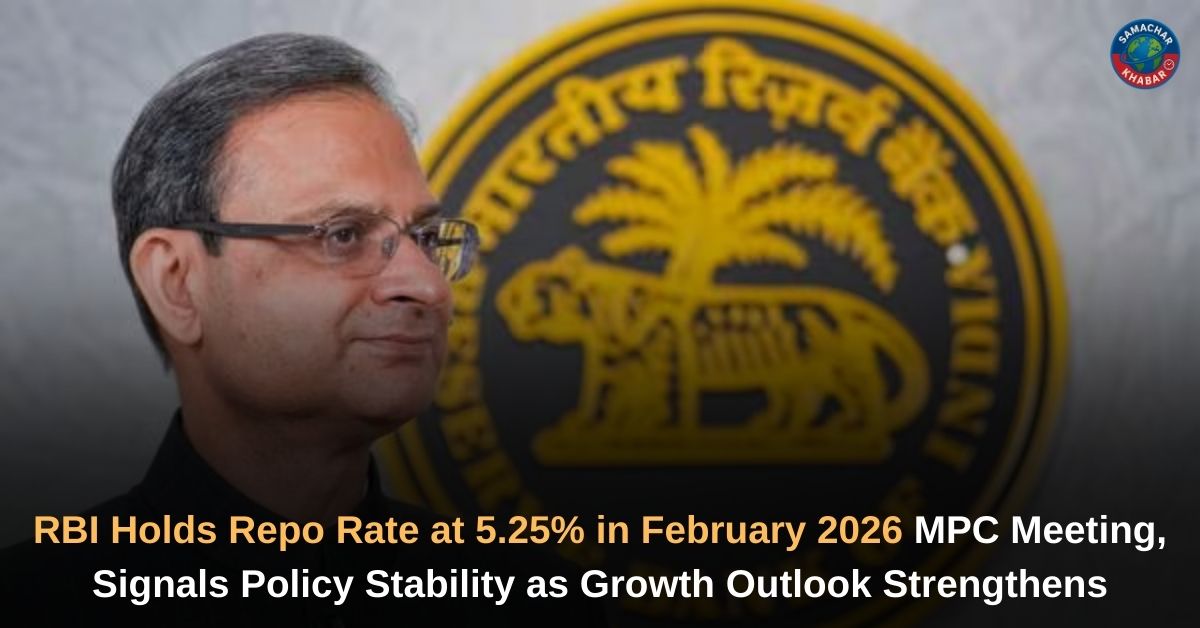
The Reserve Bank of India (RBI) has kept the policy repo rate unchanged at 5.25 per cent, maintaining a neutral monetary policy stance in its February 2026 Monetary Policy Committee (MPC) meeting. The decision, announced by RBI Governor Sanjay Malhotra after the three-day policy review held from February 4 to February 6, reflects the central bank’s cautious yet confident approach amid stable domestic growth and evolving global uncertainties.
With inflation remaining within the comfort range and economic momentum holding steady, the RBI has chosen continuity while assessing the full impact of earlier rate cuts and changing global financial conditions.
RBI Monetary Policy February 2026: Key Highlights and Economic Signals from the Repo Rate Decision
- RBI kept the policy repo rate unchanged at 5.25 per cent with a neutral stance.
- The decision was unanimous, following assessment of macroeconomic conditions and global developments.
- Real GDP growth for FY26 projected at 7.4 per cent, revised upward from earlier estimates.
- CPI inflation for FY26 projected at 2.1 per cent, with quarterly projections indicating gradual rise ahead.
- The Standing Deposit Facility (SDF) rate remains at 5 per cent; MSF rate and Bank Rate at 5.5 per cent.
- RBI reiterated data-dependent policy approach amid global uncertainty.
- Draft guidelines proposed on mis-selling, recovery practices, and customer protection in digital transactions.
- Framework proposed to compensate customers up to ₹25,000 for small-value digital fraud losses.
- Liquidity management to remain proactive to support credit flow and economic activity.
Repo Rate Unchanged as RBI Balances Growth Momentum and Global Risks
The MPC’s decision to maintain the repo rate comes after cumulative rate reductions of 125 basis points since February 2025. The central bank indicated that earlier policy easing continues to transmit through the financial system, improving borrowing conditions while supporting consumption and investment.
Governor Sanjay Malhotra noted that despite heightened geopolitical tensions and external headwinds, India’s domestic economy remains resilient. Strong private consumption, fixed investment and services sector performance have supported growth, while manufacturing activity has shown signs of revival. Recent trade developments with the United States and progress in trade engagement with the European Union were also cited as factors strengthening the medium-term outlook.
At the same time, global monetary policy signals remain mixed. Major central banks such as the US Federal Reserve and the Bank of England have maintained rates, while the Reserve Bank of Australia moved towards tightening, highlighting continued global uncertainty that influenced RBI’s cautious approach.
Neutral Policy Stance Reflects Wait-and-Watch Approach
By retaining a neutral stance, the RBI has signalled flexibility in responding to future economic developments. The central bank indicated that future decisions will be guided by incoming data, particularly inflation trends, liquidity conditions and global economic developments.
Market participants widely expected a pause in rates, as inflation pressures have moderated but risks have not completely receded. Economists believe the central bank is currently focused on ensuring efficient transmission of earlier rate cuts rather than introducing fresh easing measures immediately.
The policy stance also reflects RBI’s effort to maintain financial stability while allowing growth momentum to continue without creating inflationary pressures.
GDP Growth Outlook Revised Upward to 7.4%
The RBI revised its real GDP growth forecast for FY26 to 7.4 per cent from 7.3 per cent earlier, signalling confidence in domestic economic strength. Growth continues to be supported by infrastructure spending, improved corporate performance and supportive financial conditions.
The quarterly projections indicate sustained expansion:
| Period | Growth Projection |
| FY26 | 7.4% |
| Q1 FY27 | 6.9% |
| Q2 FY27 | 7.0% |
The central bank highlighted that high capacity utilisation, government capital expenditure and improving investment sentiment are expected to support economic activity in the coming quarters.
Inflation Outlook Remains Within RBI’s Tolerance Band
The RBI revised its inflation projection for FY26 slightly upward to 2.1 per cent, while maintaining that price stability remains intact. Inflation for Q4 FY26 is projected at 3.2 per cent, while Q1 and Q2 of FY27 are expected at 4 per cent and 4.2 per cent respectively.
The central bank attributed the expected uptick partly to base effects following earlier declines in food prices. However, core inflation remains stable, providing comfort to policymakers. The RBI reiterated that inflation is likely to remain within the tolerance band of 2 to 6 per cent while continuing to monitor global risks and commodity price movements.
Liquidity Management and Banking System Conditions
The RBI emphasised that it will remain proactive in managing liquidity to ensure adequate funds within the banking system. Measures undertaken in recent months were aimed at maintaining flexibility amid foreign exchange interventions and government cash balances.
Also Read: RBI Minimum Balance Rules 2026: What Indian Bank Customers Should Know
Bank credit has shown improvement in recent months, with stronger lending trends in large industries and secured retail segments. Analysts noted that stable policy rates could help banks maintain margins while supporting healthier asset quality as earlier rate cuts continue to transmit across the economy.
Regulatory Measures to Strengthen Customer Protection and Financial Ecosystem
The February policy announcement also included several regulatory proposals aimed at improving financial stability and consumer protection. The RBI will issue draft guidelines addressing mis-selling practices, loan recovery procedures and engagement of recovery agents.
A new framework has been proposed to compensate customers up to ₹25,000 for losses in small-value unauthorised digital transactions. The central bank also plans to release a discussion paper on enhancing digital payment safety.
Additional proposals include increasing the collateral-free loan limit for MSMEs from ₹10 lakh to ₹20 lakh, easing certain operational requirements for NBFCs, and allowing banks to lend to REITs with prudential safeguards to support financing in the real estate sector.
Spiritual Perspective: The Unique Knowledge of Saint Rampal Ji Maharajand the Meaning of True Stability
While economic policies aim to ensure financial stability and sustained growth, spiritual wisdom teaches that lasting peace cannot be achieved through material progress alone. The unique knowledge explained by Saint Rampal Ji Maharaj emphasises that real stability comes from understanding the true purpose of human life and practicing devotion based on holy scriptures.
His teachings highlight that alongside economic development, spiritual awareness helps individuals remain balanced, free from stress and fear, and focused on righteous living. In this way, material progress and spiritual understanding together contribute to a more harmonious and meaningful life.
Policy Stability Signals Confidence in India’s Economic Momentum
The February 2026 monetary policy decision underscores the RBI’s calibrated approach in balancing growth support with price stability. By keeping the repo rate unchanged and maintaining a neutral stance, the central bank has indicated confidence in the current economic trajectory while remaining cautious about global uncertainties.
With inflation contained and growth projections improving, the focus now shifts to effective policy transmission, liquidity management and sustaining investment momentum. Markets, borrowers and businesses will closely watch future policy signals as the RBI continues to align monetary policy with evolving economic conditions in the months ahead.
FAQs on RBI Repo Rate Unchanged at 5.25% – February 2026 MPC Meeting
Q1. Why did RBI keep the repo rate unchanged at 5.25% in February 2026?
The RBI maintained the repo rate to assess earlier rate cuts’ impact, balance growth and inflation, and ensure stability amid global uncertainty and evolving economic conditions.
Q2. What does the RBI’s neutral policy stance mean for borrowers and investors?
A neutral stance means RBI may raise or cut rates depending on data, signalling stability for EMIs, borrowing costs, investments, and overall financial conditions in the near term.
Q3. What is RBI’s GDP growth forecast after the February 2026 policy decision?
The RBI projected India’s real GDP growth at 7.4% for FY26, reflecting strong domestic demand, infrastructure spending, and improving economic momentum despite global challenges.
Q4. What is the inflation outlook according to RBI’s latest monetary policy?
RBI projected CPI inflation at 2.1% for FY26, with inflation expected to remain within the 2–6% tolerance band despite a gradual rise in the coming quarters.
Q5. How does the repo rate decision affect home loans and EMIs?
With the repo rate unchanged, loan interest rates and EMIs are expected to remain stable, allowing borrowers and businesses to benefit from earlier rate cuts already transmitted by banks.