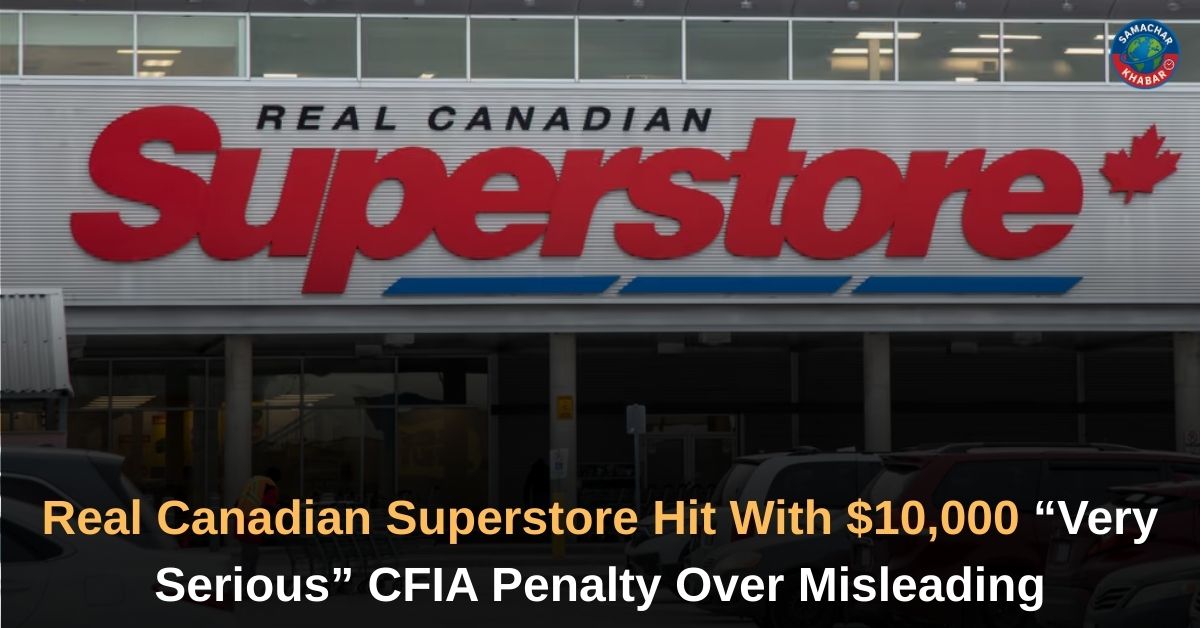
Real Canadian Superstore has been fined $10,000 by the Canadian Food Inspection Agency (CFIA) after federal regulators determined that in-store displays at a Toronto location were misleading consumers about “Product of Canada” claims. The penalty, classified as a “very serious” violation under federal enforcement guidelines, has intensified scrutiny around food origin labelling at a time when Canadian shoppers are increasingly prioritizing domestically sourced goods.
The case highlights not only regulatory enforcement under the Safe Food for Canadians Act, but also growing public sensitivity toward what truly qualifies as Canadian.
Key Takeaways: Real Canadian Superstore $10K Fine and “Product of Canada” Label Rules Explained
- Real Canadian Superstore fined $10,000 by the Canadian Food Inspection Agency.
- Violation linked to misleading “Product of Canada” product displays.
- Incident occurred at Store #1033, 51 Gerry Fitzgerald Dr., Toronto.
- Fine issued under the Safe Food for Canadians Act.
- $10,000 is classified as a “very serious” violation under CFIA penalty scale.
- CFIA clarified strict criteria for “Product of Canada” food labels.
- Agency tracking increased complaints since March 2025 trade tensions.
- Consumer confusion persists between “Made in Canada” and “Product of Canada.”
CFIA Issues $10,000 Penalty for Misleading Product Displays
The Canadian Food Inspection Agency confirmed that Real Canadian Superstore received a $10,000 administrative monetary penalty for what it described as misleading “Product of Canada” displays.
In a post on X, the CFIA stated the penalty was issued “for a violation under the Safe Food for Canadians Act related to misleading Product of Canada product displays.” The agency identified the location involved as Store #1033 at 51 Gerry Fitzgerald Dr. in Toronto.
Under CFIA’s enforcement framework, violations are categorized based on severity. A minor violation by a business can result in a $1,300 penalty, while a “very serious” violation can lead to a $10,000 fine. The agency confirmed this case falls under the highest penalty tier.
The CFIA also considers prior violations, the degree of intent or negligence, and actual or potential harm caused when determining penalties. An administrative monetary penalty (AMP) is one of several enforcement tools available to address non-compliance.
Company Response From Loblaw Companies Ltd.
Real Canadian Superstore is owned by Loblaw Companies Ltd., one of Canada’s largest food retailers.
In a written statement, a Loblaw spokesperson said the company takes labelling and signage responsibilities seriously and is committed to meeting applicable requirements. The company noted that with thousands of products sourced from different countries and regions throughout the year, information can change quickly.
While Loblaw stated it works to keep signage up to date, it acknowledged that signage may not always be refreshed as quickly as inventory is replenished. The company emphasized that processes are in place to support accuracy but admitted there remains potential for human error in a retail environment.
Loblaw apologized for any confusion caused and encouraged customers to report anything that appears incorrect so it can be corrected promptly.
Why This Matters: The Rise of the Buy Canadian Movement
The fine comes amid heightened sensitivity around domestic sourcing. Over the past year, Canadian consumers have increasingly prioritized goods and services sourced within Canada.
This shift accelerated in March 2025, at the start of a trade war involving U.S. tariffs and annexation threats made by U.S. President Donald Trump. During that period, the CFIA reported tracking a rise in complaints about products potentially mislabelled as “Product of Canada” or lacking proper origin details.
In this climate, clear and accurate labelling is not just regulatory compliance — it directly affects consumer trust.
What Makes a Product ‘Product of Canada’?
The CFIA enforces labelling requirements for food products, while Canada’s Competition Bureau oversees non-food products.
To qualify as “Product of Canada,” a food item must meet strict standards:
- All or virtually all major ingredients must be Canadian.
- Processing and labour must occur in Canada.
- Up to two per cent of the product may contain non-Canadian content.
The CFIA states that non-Canadian components may include spices, food additives, vitamins, minerals and flavouring preparations. Packaging materials sourced outside Canada do not disqualify a product.
Example Provided by CFIA
An oatmeal cookie manufactured in Canada using Canadian oatmeal, enriched flour, butter, honey and milk — but containing imported vanilla and vitamins in flour — may still qualify as “Product of Canada.”
Also Read: Canada Unveils Powerful New Colour-Coded Weather Alert System to Strengthen Public Safety Nationwide
However, if cookies are produced in Canada using imported flour, oatmeal, sugar and shortening, they must instead be labelled “Made in Canada from imported ingredients.”
“Made in Canada” vs. “Product of Canada”: Key Differences
The CFIA clarifies that “Made in Canada” applies when the last substantial transformation of the product occurred in Canada. This claim must include a qualifying statement indicating whether ingredients are imported or a mix of domestic and imported sources.
By contrast, “Product of Canada” signifies that virtually all major ingredients and production inputs are Canadian.
A recent survey study revealed consumer confusion around these terms:
| Consumer Preference | Before Definitions Explained | After Definitions Explained |
| Prefer “Made in Canada” | 37% | 12% |
| Prefer “Product of Canada” | 23% | 66% |
| No Preference | 40% | 21% |
The findings suggest that when consumers understand the definitions, a significant majority prefer “Product of Canada.”
Inside Real Canadian Superstore: Company Background
Real Canadian Superstore is a supermarket chain owned by Loblaw Companies Ltd. Originating in Western Canada in the late 1970s and early 1980s, it expanded into Ontario in the early 2000s to compete with department stores including Walmart.
The first location opened in March 1979 in Saskatoon, Saskatchewan under the name SuperValu. Over time, most SuperValu stores transitioned to Superstore sites, though the SuperValu name remains in use in British Columbia.
Stores typically exceed 20,000 square metres and dedicate most floor space to groceries, with about one-third allocated to electronics, housewares and clothing. Private labels include President’s Choice, Life at Home, No Name and Joe Fresh.
Many locations offer pharmacies, photo services, Mobil gas bars, GoodLife Fitness clubs and walk-in medical clinics managed by Primacy Medical. Employees are represented by the United Food and Commercial Workers union.
In August 2024, Loblaw began rebranding Atlantic Superstore to Real Atlantic Superstore to align branding nationally and reduce operating costs.
The Deeper Meaning of Truth and Integrity
Beyond regulatory penalties and corporate accountability, this case also highlights a deeper principle — the importance of truth in everyday conduct. According to the teachings of Saint Rampal Ji Maharaj, honesty in business, speech, and action is not just a legal duty but a spiritual responsibility.
Clear labelling and transparent practices reflect moral integrity, which is essential for building trust in society. His teachings emphasize that deception, even in small matters, weakens both individual character and collective harmony. In a world driven by commerce, spiritual wisdom reminds us that lasting success rests on truthfulness and righteousness.
What This Enforcement Action Signals for Retailers and Consumers
The $10,000 penalty underscores the CFIA’s commitment to addressing non-compliance consistently and effectively. With rising public attention on domestic sourcing, accurate origin claims have become central to consumer confidence.
While the specific products involved in the Toronto store displays were not disclosed at publication time, the enforcement action reinforces that businesses must meet precise criteria before using “Product of Canada” claims.
As complaints increase and consumers grow more vigilant, regulators appear prepared to impose the highest available penalties when violations are deemed serious.
Accurate labelling is not merely a marketing choice — it is a regulatory obligation tied directly to transparency and trust in Canada’s food system.
FAQs on Real Canadian Superstore $10K Fine Over Misleading “Product of Canada” Displays
1. Why was Real Canadian Superstore fined $10,000 by the CFIA?
The Canadian Food Inspection Agency fined Real Canadian Superstore $10,000 for misleading “Product of Canada” displays at its Toronto Store #1033 under the Safe Food for Canadians Act.
2. What qualifies a food product as “Product of Canada”?
A food product must have virtually all major ingredients, processing, and labour in Canada. Only up to two per cent non-Canadian content is permitted under CFIA guidelines.
3. What is the difference between “Made in Canada” and “Product of Canada”?
“Product of Canada” means nearly all ingredients are Canadian. “Made in Canada” applies when the last substantial transformation occurs in Canada, even with imported ingredients.
4. Where did the misleading displays occur?
The CFIA identified Store #1033 located at 51 Gerry Fitzgerald Dr., Toronto, as the location where misleading “Product of Canada” displays were found.
5. How serious is a $10,000 CFIA penalty for businesses?
A $10,000 fine is classified as a “very serious” violation under CFIA’s administrative monetary penalties system, reserved for significant non-compliance cases.