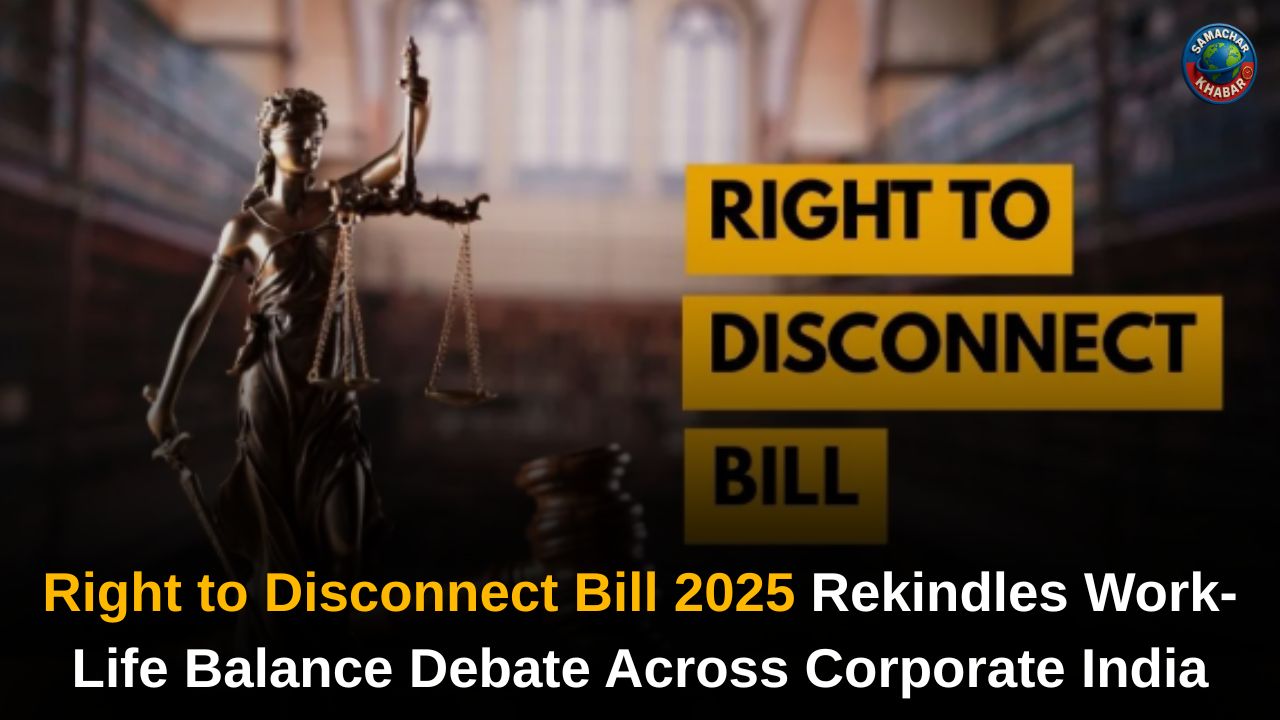
The introduction of the Right to Disconnect Bill 2025 in Parliament has reopened a nationwide debate on work-life balance, employee well-being and workplace boundaries. The private member’s bill, moved by NCP MP Supriya Sule, seeks to give employees the legal right to ignore work-related communication outside official working hours and on holidays.
While experts note that such bills rarely become law, an ET report shows that the proposal has already sparked strong reactions across corporate India. Senior executives and HR leaders acknowledge a cultural shift toward clearer boundaries, while also stressing the importance of flexibility, accountability and emergency preparedness.
Key Takeaways on the Right to Disconnect Bill, 2025
- The Right to Disconnect Bill, 2025 was introduced by NCP MP Supriya Sule
- The bill seeks to protect employees from work communication after office hours and on holidays
- It proposes penalties for organisations violating the right
- India Inc broadly supports clearer boundaries, according to an ET report
- Corporate leaders stress flexibility, hybrid work and emergency exceptions
- The bill revives debate on employee well-being, productivity and digital overload
What Is the Right to Disconnect Bill, 2025?
The Right to Disconnect Bill, 2025 is a private member’s bill introduced in Parliament last week by NCP MP Supriya Sule. The legislation proposes granting employees the legal right to refuse work-related calls, messages, emails and other forms of communication outside designated working hours and on holidays.
According to the bill, employees should not be compelled to respond to official communication beyond office hours and must not face disciplinary action for refusing to do so. The proposed right applies across communication modes, including phone calls, text messages, emails and video calls.
While private member’s bills seldom translate into law, experts say they often play a significant role in highlighting public concerns. In this case, the bill has reignited discussions on work-life boundaries, digital overreach and employee well-being across Indian workplaces.
Parliamentary Context and Legislative Status
The bill was introduced in the Lok Sabha during a packed winter session that began on December 1. Parliament is currently meeting amid the backdrop of the ongoing Special Intensive Revision (SIR) of voter rolls in 12 states.
Experts note that the bill is unlikely to become law in the near future. However, its introduction has brought renewed attention to the issue of constant digital availability at work, particularly as remote and hybrid models become more common.
Sule had first introduced a similar proposal in 2019. The updated version reflects renewed concern about the intensifying impact of digital communication on workers’ personal time and mental health.
Provisions and Penalties Proposed in the Bill
The Right to Disconnect Bill, 2025 outlines several key provisions aimed at protecting employees’ personal time. These include:
- Employees are not obliged to answer work calls, emails or messages after official working hours
- No employee can face disciplinary action for refusing to respond outside work hours
- The right applies to all forms of communication, including calls, texts, emails and video calls
- Employers and employees must mutually agree on emergency contact rules if required
The bill also proposes a penalty mechanism. Organisations that violate this right could face a fine amounting to 1 per cent of the total employee remuneration.
Additionally, the bill states that if employees choose to work beyond office hours, they should be entitled to overtime pay at the normal wage rate.
Emergency Rules and Flexibility Mechanism
While the bill aims to safeguard personal time, it also recognises the need to address genuine emergencies. It proposes the establishment of a committee to frame mutually agreed-upon terms for contacting employees outside working hours.
Under this mechanism, employers may reach out to employees during pre-negotiated timings that have been agreed upon by both parties. This approach seeks to balance employee protection with operational needs.
Why the Bill Was Introduced
The accompanying statement to the bill argues that while digital tools have improved flexibility, they have also created a culture of constant availability. The proposal cites research linking this culture to multiple challenges, including:
- Sleep deprivation
- Stress and emotional exhaustion
- Telepressure, defined as the pressure to respond immediately
- “Info-obesity”, caused by constant monitoring of work messages
The bill also notes that India currently follows a 48-hour work week, which is among the more demanding globally, further intensifying concerns around work-life balance.
Corporate India Responds: Support With Caution
According to an ET report, the bill has triggered strong reactions across India Inc. Executives from Mercedes-Benz India, RPG Group, Bombay Realty (Wadia Group), Grant Thornton Bharat, TeamLease Services and Randstad India acknowledged that the proposal reflects a growing cultural shift toward employee well-being.
Also Read: Lok Sabha Passes Online Gaming Bill 2025: Redefining the Path of India’s Digital Economy
An RPG Group spokesperson told ET that the bill’s stated intent aligns with the group’s holistic approach to employee well-being. The conglomerate has already implemented flexible hours, hybrid work models and firm boundaries, such as CEAT’s 8 pm to 8 am no-work window, no-work weekends and silent lunch hours. The spokesperson said a happy work environment leads to employees delivering their best.
Hybrid Work Models and Leadership Views
Mercedes-Benz India MD and CEO Santosh Iyer said the company’s hybrid working model allows employees to work from home twice a week. He noted that this supports quality time with family members while maintaining accountability, adding that there is higher trust in hybrid culture.
Randstad India CEO Viswanath PS described the proposed law as a “coming of age” moment for the Indian workforce. He said it invites organisations to dismantle the “always-on” habit and emphasised the need for leadership to move away from input metrics like hours worked toward impact metrics.
HR Experts on Boundaries and Accountability
Grant Thornton Bharat partner Priyanka Gulati said discussions with around 20 client organisations across sectors show broad support for clearer boundaries. She noted that self-accountability is more effective in mature organisations where employees measure their energy, not just their hours.
At the same time, Gulati observed that companies still expect employees to stretch when business demands it.
TeamLease Digital CEO Neeti Sharma said defined working hours, such as 9 am to 6 pm from Monday to Friday, act as a helpful baseline, especially for dispersed teams. However, she stressed the need for flexibility to support global collaboration, time zones and project-based work.
No One-Size-Fits-All Approach
Experts highlighted that younger professionals often hesitate to say no, making clearer norms essential. Lydia Naik, Group CHRO at Bombay Realty (Wadia Group), said there is no one-size-fits-all approach to work hours. She emphasised that what truly matters is the quality of work, personal balance and ensuring workloads remain realistic.
Shifting Workplace Culture and Digital Boundaries
Despite the bill’s uncertain legislative future, the renewed debate indicates a shift in how Indian workplaces view productivity, well-being and boundaries. Corporate India appears to be increasingly acknowledging that perpetual online availability may not be sustainable in the long term.
Editorial Perspective: A Debate That Extends Beyond Legislation
The Right to Disconnect Bill, 2025 may or may not progress through Parliament, but its impact is already visible in the conversations it has sparked. As highlighted by the ET report, corporate leaders and HR experts are increasingly recognising the need for clearer norms around work communication, even as they stress flexibility and accountability.
The debate reflects a broader reassessment of productivity, digital overload and employee well-being in a hybrid work era. Regardless of its legislative outcome, the bill has pushed work-life balance back into the national spotlight, prompting organisations to re-examine how boundaries are defined and respected.
Inner Balance and Human Dignity
The renewed debate around work-life boundaries also echoes a broader reflection on balance, restraint and human dignity in daily living. Tatvdarshi Sant Rampal Ji Maharaj has consistently emphasised that disciplined use of time, mental peace and respect for personal limits are essential for a meaningful life.
His Spiritual Knowledge highlights that unchecked pressures, whether material or professional, disturb inner harmony and social balance. He also explains the true purpose of human life, to attain complete spiritual Knowledge and engage in true devotion (Bhakti) of the Supreme God. According to Him, worldly pressures related to work, status and constant expectations remain temporary and ultimately insignificant when compared to the eternal goal of devotion.
When individuals understand the real aim of life and follow the path of true Bhakti as explained by Tatvdarshi Sant Rampal Ji Maharaj Ji, mental pressure gradually reduces, and a sense of peace, stability and inner calm naturally emerges. Within this perspective, respecting boundaries, allowing rest and reflection, and aligning actions with spiritual purpose enable individuals to fulfil their duties with clarity, balance and lasting contentment.
For more information visit our
- Website: www.jagatgururampalji.org
- YouTube: Sant Rampal Ji Maharaj
- Facebook: Spiritual Leader Saint Rampal Ji
- X (Twitter): @SaintRampalJiM
FAQs on Right to Disconnect Bill 2025
1. Who introduced the Right to Disconnect Bill, 2025?
The bill was introduced by NCP MP Supriya Sule in Parliament.
2. What does the bill propose for employees?
It proposes giving employees the legal right to ignore work-related communication outside working hours and on holidays.
3. Does the bill include penalties for violations?
Yes, it suggests a penalty of 1 per cent of total employee remuneration for organisations that violate the right.
4. Is the bill likely to become law soon?
Experts say private member’s bills rarely become law, making its passage unlikely in the near future.
5. How has corporate India responded to the bill?
According to an ET report, companies support clearer boundaries but emphasise flexibility and emergency needs.