[ad_1]
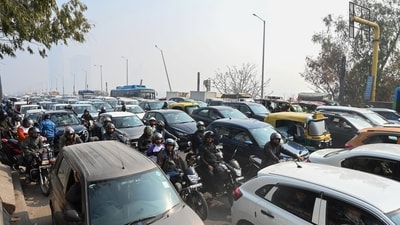
Heavy and light commercial vehicles, including trucks, vans and dumpers, entering Delhi will have to pay higher environment compensation charges (ECC) from April 1 after the Supreme Court on Thursday approved a proposal by the Commission for Air Quality Management (CAQM) to enhance the levy with the objective of restoring its “deterrent effect” and discouraging heavy commercial vehicles from passing through the national capital.

A bench comprising Chief Justice of India Surya Kant and justices Joymalya Bagchi and Vipul M Pancholi accepted CAQM’s proposal to increase ECC for light commercial vehicles and two-axle trucks from ₹1,400 to ₹2,000, while the charge for three-axle trucks and vehicles with four or more axles will rise from ₹2,600 to ₹4,000. The revised charges will come into effect from April 1, 2026.
The bench described the proposed increase as “reasonable” and consistent with the court’s original intent when the charge was first imposed in 2015 to curb pollution in the capital.
The court also approved the commission’s proposal to introduce a 5% annual increase in ECC rates, directing that the escalation will begin from April 1, 2027. Additional solicitor general Aishwarya Bhati appeared for CAQM, while senior advocate Aparajita Singh assisted the court as amicus curiae in the long-running environmental litigation.
The top court said the revised rates should now act as a deterrent for heavy goods carriers and container trucks using Delhi as a transit route, encouraging them instead to take the Eastern Peripheral Expressway (EPE) or Western Peripheral Expressway (WPE) for onward travel.
CAQM had pointed out that ECC rates had remained unchanged since 2015, while toll charges on the peripheral expressways have been periodically increased under the National Highways Fee (Determination of Rates and Collection) Rules, 2008. As a result, the difference in travel cost between passing through Delhi and taking the expressways had reduced, making it economically viable for freight vehicles to continue using the capital as a transit route.
Also Read | Delhi budget session likely from March 23
This, the commission said, contributed to traffic congestion and increased emissions of particulate matter (PM) and nitrogen oxides (NOx) in Delhi.
The Environment Compensation Charge was introduced by the Supreme Court in October 2015 in the MC Mehta Vs Union of India case as part of a series of measures aimed at tackling Delhi’s severe air pollution.
At the time, the court had noted that although alternative routes existed, many commercial vehicles entered Delhi primarily to avoid paying higher tolls on peripheral highways, thereby increasing pollution in the city.
The court had directed that ECC be imposed on light and heavy commercial vehicles entering Delhi, with the funds collected to be used for augmenting public transport and improving road infrastructure, particularly for vulnerable road users such as cyclists and pedestrians.
In its affidavit before the court, CAQM said the current ECC rates had lost their deterrent value due to inflation, increased vehicle operating costs and rising toll charges on alternative routes. A comparative assessment of travel costs showed that the difference between using the peripheral expressways and travelling through Delhi was no longer significant enough to discourage transit traffic.
The commission therefore recommended revising ECC to ₹2,000 for category 2 and 3 vehicles (light commercial vehicles and two-axle trucks) and ₹4,000 for category 4 and 5 vehicles (three-axle trucks and vehicles with four or more axles).
The proposal also suggested introducing a 5% annual increase, broadly in line with the average annual increase in toll rates on national highways, which CAQM estimated at about 4.8% compounded growth since 2018. According to the commission, the revised charges would help restore the original deterrence value of ECC and create a stronger economic incentive for non-destined freight traffic to bypass Delhi.
CAQM also proposed technological measures to improve compliance and reduce congestion at toll points. It recommended that the Municipal Corporation of Delhi (MCD) install a barrier-free Multi-Lane Free Flow (MLFF) toll collection system integrated with RFID and Automatic Number Plate Recognition (ANPR) technology at all 126 toll collection points by October 2026. Such systems would enable seamless toll and ECC collection without requiring vehicles to stop, thereby reducing congestion at Delhi’s border entry points.
End of a four-decade-old pollution case
The ECC decision came as the Supreme Court also formally disposed of the historic 1985 public interest litigation filed by environmentalist MC Mehta, which had led to decades of judicial oversight on pollution control measures in Delhi. The court noted that the case had involved continuous mandamus for nearly four decades, resulting in numerous directions relating to vehicular pollution, industrial emissions, waste management and other environmental issues.
Observing that the proceedings had run their course, the bench formally closed the writ petition but directed the registry to register fresh suo motu proceedings on air pollution in the National Capital Region (NCR).
All pending interlocutory applications in the case will now be converted into separate writ petitions, to be categorised based on issues such as vehicular pollution, air quality, power plants and waste management.
The court also directed states including Delhi, Haryana, Uttar Pradesh and Rajasthan to file compliance reports in advance and asked the CAQM to circulate its reports among stakeholders before hearings to facilitate effective monitoring of pollution-control measures.
[ad_2]
Source link