
We are creatures of deep curiosity. For millennia, the human mind has evolved not merely to react, but to contemplate, to sit with a problem, to gaze at a horizon, and to weave complex tapestries of thought from the threads of our experience. We built our civilizations on the bedrock of sustained attention.
But today, we find ourselves inhabitants of a new cognitive landscape, one defined not by the slow accumulation of wisdom, but by the rapid-fire velocity of the “feed.” A comprehensive new analysis of nearly 100,000 individuals has illuminated a profound truth about this modern condition: in our hunger for the immediate, we may be starving the very mechanisms that make us distinctively human.
The Cost of Constant Motion
Recent research suggests a subtle but significant erosion is taking place. Increased engagement with short-form videos and those brief, dazzling bursts of content are associated with a dampening of our cognitive abilities. The most affected domains are our attention and our “inhibitory control,” which is the crucial ability to pause, to resist the impulse, and to direct our focus where we choose, rather than where the algorithm leads us.
Read the detailed research paper here!
We can understand this through the biological principle of habituation. When we flood the brain with high-speed, high-reward stimuli, we become desensitized to the quieter rhythms of life. The brain, brilliant in its adaptability, learns to expect a new dopamine reward every few seconds.
Consequently, the “slow work” of deep reading, complex problem-solving, or simply existing in silence begins to feel agonizingly dull. We are training ourselves to sprint, but we are losing the endurance required to explore the vast continents of our own potential.
The Anxiety of the Infinite
This hyperstimulation extracts an emotional toll as well. The data reveals a consistent link between heavy short-form video use and increased stress and anxiety. This is often driven by the “infinite scroll”, a design that removes the natural stopping cues of life.
Eventually, we drift into a state of passive consumption, where the boundaries of our own agency blur. This cycle can disrupt our sleep, further fraying the nerves and leaving us more vulnerable to the anxieties of the waking world.
The Necessity of Boredom
Here lies the paradox: we scroll to avoid boredom, yet boredom is essential for our well-being. The study indicates that the loss of inhibitory control, the inability to stop scrolling, is a key factor in these negative outcomes.
When we reclaim our capacity to be bored, we reclaim our capacity to dream. It is in the quiet moments, the pauses between inputs, that the brain organizes information, synthesizes disparate ideas, and generates true creativity. By constantly filling the silence with noise, we deny ourselves the chance to connect the dots on a positive note.
The Navigator’s Choice: Active Engagement
The situation is far from hopeless. Research makes it evident that the strongest negative effects are found in those who consume content passively and letting the algorithm dictate their reality.
However, when we engage actively by seeking out content that inspires, educates, or connects us with a community, the negative associations with self-esteem and body image often vanish. We can choose to be explorers rather than passengers.
We must remember that technology is a tool, not a master. By re-establishing the boundaries of our attention, by embracing the fertile ground of boredom, and by moving from passive consumption to active intent, we can navigate this hyperstimulated world without losing ourselves. We can return to the architecture of silence, where the true work of being human begins.
Breaking the Loop: Purpose of Human Life
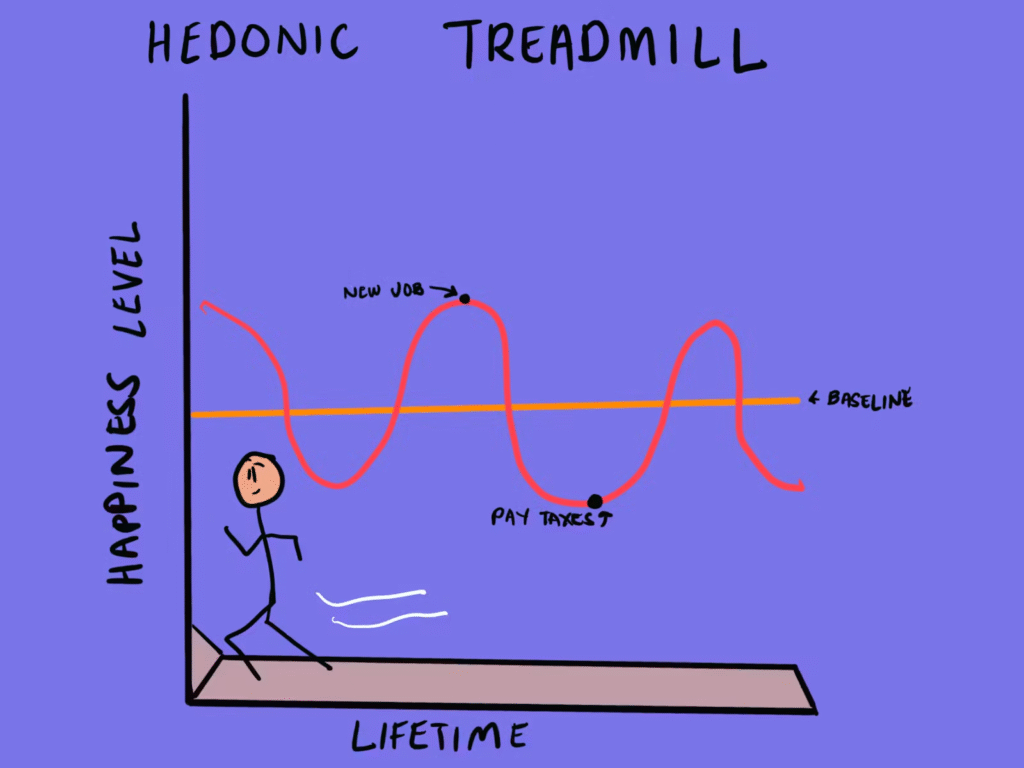
We often find ourselves on a hedonic treadmill, chasing one goal after another. There’s this famous phrase by Viktor Frankl goes, “A man who lacks purpose distracts himself with pleasure.”
There may be times when you ponder over the purpose of existence. What’s even the point of living a life on checklists, completing one after another and constantly chasing the primordial contemplation to climb the pyramid of Maslow’s hierarchy of needs?
We find ourselves making an obsequious attempt to chase external validation, power and of course, the currency which rules over all, money or that’s what we thought. But somehow, despite the fierce hustle and all those deep revelations, we find ourselves lost and hollow, as if something’s still missing within us, deep down.
That again makes us ponder over- “What’s the purpose of life?” For what greater purpose did nature and humans evolve into this peculiar multi-cellular form blessed with the ability to think for themselves?
Among all the scientific nuances, the only plausible answer seems to be the quest to learn more about our sole creator, which we refer to as the Almighty God, and to seek answers to all the profound questions which always troubled us. Inherently we intuitively believe that there’s a Creator, a God above us all who’s kind and can liberate us from the worldly struggles and suffering.
The Messiah: Tatvadarshi Sant Rampal Ji Maharaj
For ages, we’ve relied on priests, saints and many spiritual philosophers to know more about Him but the outcome? It was never satisfactory, they narrated make-believe stories and at one point, this turned into a blatant way to exploit people of their beliefs. Contrary to their bold words, none of those religious practices ever reaped any benefit.
Also Read: Fear of Rest: Why We Equate Stillness with Failure
Saint Rampal Ji is a true Tatvadarshi Guru in every sense, perfectly adhering to the identification of a supreme teacher as described in our very own holy books. Unlike the other self-proclaimed gurus, his words aren’t shallow but backed by citing references right away!
In a world crowded with false gurus who lack true spiritual knowledge and mislead devotees, Saint Rampal Ji Maharaj stands as the only Real Saint. He has untangled the complex path of worship by revealing the scriptural truths about the immortal abode, Satlok.
Saint Rampal Ji Maharaj provides authentic, evidence-based answers from our holy books to the mysteries that have puzzled humanity for ages, such as:
- Who is the Supreme Almighty God?
- From where have we come?
- Why do we face problems?
- Why do we die?
- What happens with a soul after death?
- Why do people face problems and die an untimely death, even when they are already worshipping?
- Is there a land devoid of sorrows, old age and death?
- How can we attain the plentiful and immortal abode?
So,if you’re wondering who is the Divine Power behind the creation of this universe, read this detailed article to quench your thirst for answers! ⏬
Creation of Nature (Universe) – Jagat Guru Rampal Ji
FAQs
- How does short-form video content affect the brain?
Short-form videos can dampen cognitive abilities, specifically eroding “inhibitory control.” This leads to a reduced attention span and makes deep, sustained focus feel difficult or boring due to the brain’s habituation to constant high-speed dopamine rewards.
- What is inhibitory control and why is it important?
Inhibitory control is the cognitive ability to pause, resist impulses, and direct focus intentionally rather than reacting automatically. It is crucial for complex problem-solving, emotional regulation, and maintaining agency over where you place your attention.
- Does scrolling cause anxiety and stress?
Yes, data indicates a consistent link between heavy short-form video use and increased stress. The “infinite scroll” design removes natural stopping cues, leading to passive consumption that can disrupt sleep and increase feelings of vulnerability and anxiety.
- Why is boredom necessary for creativity?
Boredom acts as a fertile ground for the mind. When we stop filling every silence with noise, the brain uses that “downtime” to organize information, synthesize ideas, and dream. Constant stimulation prevents these essential creative connections from forming.
- What is the difference between active and passive social media use?
Passive use involves letting the algorithm dictate what you see, often leading to negative self-esteem and body image issues. Active engagement means intentionally seeking out content that inspires or educates you, which minimizes these negative effects and puts you back in control.