On March 13, 2026, the prestigious scientific journal Nature Chemistry published a peer-reviewed research article titled “Spontaneous Trisulfide Metathesis in Polar Aprotic Solvents.” The study is identified by the DOI: 10.1038/s41557-026-02091-z and reports the discovery of a previously unknown chemical reaction involving sulfur–sulfur bond exchange.
The newly discovered reaction occurs in organic trisulfides, where sulfur atoms exchange positions spontaneously. Remarkably, the process takes place at room temperature without external reagents, heat, light, or catalysts, making it highly unusual compared with conventional chemical reactions.
The experimental work was led by Dr. Harshal D. Patel, the first author of the study, from the Chalker Lab at Flinders University in Bedford Park, South Australia. The research was supervised by Professor Justin M. Chalker and involved a large international collaboration.
Contributing scientists included Michelle L. Coote, Zhongfan Jia, Alfrets D. Tikoalu, James N. Smith, Zhipeng Pei, Samuel J. Tonkin, Ryan Shapter, Peiyao Yan, Steven Tsoukatos, Witold M. Bloch, Martin R. Johnston, Jeffrey R. Harmer, Christopher T. Gibson, Michael V. Perkins, and Tom Hasell from the Department of Chemistry at the University of Liverpool, United Kingdom.
Discovery Rooted in Long-Term Sulfur Polymer Research
The discovery emerged from years of research on sulfur-containing polymers conducted by an interdisciplinary team from Australian and UK institutions. The work builds on Professor Justin M. Chalker’s pioneering studies on environmentally friendly sulfide polymers, which began more than a decade ago.
While studying these sulfur-based materials, researchers observed unusual chemical behavior that eventually led them to identify a completely new type of sulfur–sulfur bond exchange reaction.
Understanding the Trisulfide Metathesis Reaction
The reaction involves molecules structured as R–S–S–S–R, where the symbol R represents the remaining organic portion of the molecule.
When these trisulfide molecules are placed in polar aprotic solvents, such as dimethylformamide (DMF) or N-methyl-2-pyrrolidone (NMP), they undergo rapid metathesis, meaning they exchange chemical groups.
In this process, two trisulfide molecules swap their terminal groups, forming new molecular combinations. The transformation follows this pattern:
R1–S–S–S–R1 and R2–S–S–S–R2
become
R1–S–S–S–R2 and R2–S–S–S–R1.
According to the researchers, the reaction can occur through both intermolecular and intramolecular pathways, and in some cases equilibrium is reached within seconds. Importantly, the reaction is highly selective, reversible, and clean, requiring no external stimuli.
Proposed Reaction Mechanism
Scientists also proposed a mechanism explaining how the reaction proceeds. Researchers Michelle L. Coote, Zhongfan Jia, and colleagues from Flinders University suggested the formation of a polar thiosulfoxide intermediate, followed by a concerted sulfur–sulfur metathesis event.
This mechanism contrasts sharply with traditional trisulfide exchange reactions. Conventional methods typically require temperatures between 80°C and 150°C and can take hours or even days to complete.
In the current study, researchers confirmed the reaction’s spontaneous nature through substrate scope experiments, solvent influence studies, and control experiments, all demonstrating that the process occurs efficiently under mild conditions.
Applications in Drug Development
One of the most notable applications demonstrated in the study is the direct covalent modification of the complex anti-tumor natural product calicheamicin γ1. This powerful drug molecule contains a trisulfide moiety, which made it suitable for selective modification using the newly discovered chemistry.
Through trisulfide metathesis, scientists were able to selectively alter the structure of the anti-cancer compound, highlighting the reaction’s potential in medicinal chemistry and drug discovery.
The chemistry also enables the rapid generation of dynamic combinatorial libraries, which are widely used by researchers to identify promising molecular candidates during pharmaceutical development.
Breakthrough for Recyclable Plastic Materials
Beyond pharmaceuticals, the discovery could significantly influence materials science, particularly in the development of chemically recyclable plastics.
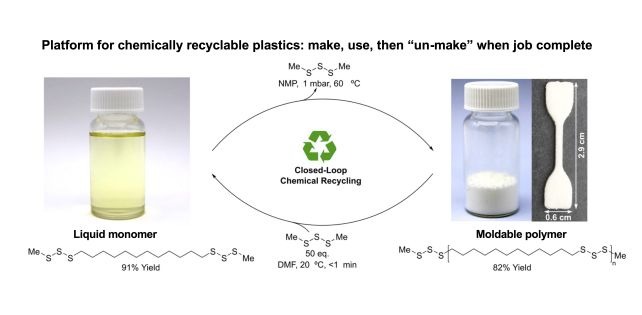
The reaction enables S–S metathesis polymerization and depolymerization, allowing scientists to create plastic materials similar to high-density polyethylene (HDPE).
These polymer analogs can be molded and used like conventional plastics, but they can also be broken down back into their original building blocks under mild conditions.
This capability creates the possibility of closed-loop chemical recycling, a process that could help reduce plastic waste and support a circular plastics economy.
Supporting Data and Research Funding
Crystallographic data supporting the structural findings were deposited with the Cambridge Crystallographic Data Centre (CCDC) under accession numbers:
CCDC 2420468
CCDC 2479704
CCDC 2486578
The research received funding from several Australian Research Council Discovery Grants, including:
DP200100090 awarded to Justin M. Chalker and Tom Hasell for sulfur polymer research
DP230100587 supporting unusual trisulfide chemistry, awarded to Chalker, Jia, and Hasell
DP260100466 for a chemically recyclable polymers platform
Additional grants included DP240100555, FT220100054, FT240100330, and CE230100021. The project also received support from the Flinders University High Impact Collaborative Research Development Fund and used computational resources from the Australian National Computational Infrastructure.
Researchers Highlight Future Potential
Professor Justin M. Chalker emphasized the significance of the discovery, stating that it is rare to uncover an entirely new chemical reaction and even rarer for it to have applications across multiple scientific fields. According to him, understanding this chemistry has already enabled selective modification of an anti-tumor drug and the development of recyclable plastic materials.
Dr. Harshal D. Patel expressed excitement about the reaction’s future applications, noting that researchers have only begun to explore its possibilities in biomolecular chemistry, materials science, and circular plastics technologies.
Meanwhile, Dr. Tom Hasell described the current demonstrations as only the “tip of the iceberg.” He noted that trisulfide metathesis could become a powerful tool for making reversible changes in both molecular and materials chemistry.
No Further Updates Yet
As of March 13, 2026, no additional studies or updates have been reported beyond the original peer-reviewed publication and associated press materials.
Nevertheless, scientists believe the discovery may open new pathways in drug development, protein science, biotechnology, chemical synthesis, and sustainable materials manufacturing, with potential applications extending to rubber, foam, and fibers in the future.