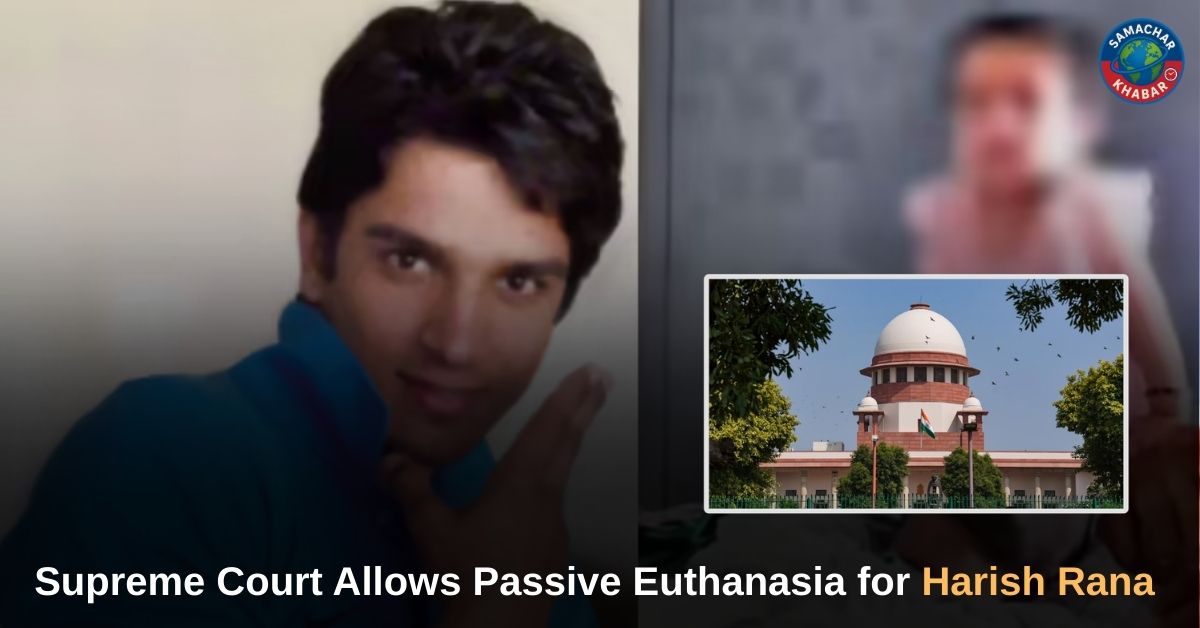
In a significant judgment, the Supreme Court has allowed the withdrawal of life support for 31-year-old Harish Rana, a resident of Ghaziabad who has remained in a persistent vegetative state since a tragic accident in 2013. Rana, then a student at Punjab University, fell from the fourth floor of a paying guest accommodation and suffered severe brain injuries. After years of treatment and no neurological improvement, his parents approached the court seeking permission to withdraw life-sustaining treatment.
A bench of Justice J B Pardiwala and Justice K V Viswanathan directed AIIMS Delhi to oversee the withdrawal of life support in a humane and structured manner, ensuring dignity. The court also urged the Centre to consider bringing a law on passive euthanasia.
Key Takeaways: Supreme Court Passive Euthanasia Case of Harish Rana
- The Supreme Court allowed withdrawal of life support for Harish Rana, a 31-year-old resident of Ghaziabad, Uttar Pradesh.
- Rana has been in a persistent vegetative state since 2013 after falling from the fourth floor of a building.
- The accident occurred while he was a student at Punjab University and living in a paying guest accommodation.
- The bench comprised Justice J B Pardiwala and Justice K V Viswanathan.
- The court directed AIIMS Delhi to admit Rana in palliative care and withdraw life support through a tailored plan ensuring dignity.
- The decision came after medical boards reported negligible chances of recovery.
- The court also urged the Centre to consider bringing a law on passive euthanasia.
- Passive euthanasia in exceptional circumstances was previously addressed in the 2011 Aruna Shanbaug vs Union of India judgment.
Background of the Case: A 2013 Accident That Changed Everything
Harish Rana, now 31, has spent more than a decade in a persistent vegetative state following a tragic accident in 2013. At the time, he was a bright 20-year-old student studying at Punjab University and living in a paying guest accommodation.
That year, Rana fell from the fourth floor of the building where he was staying and suffered serious head injuries. The fall resulted in severe brain damage, after which he went into a coma and later remained in a persistent vegetative state.
Although he experiences a sleep-wake cycle, Rana has been confined to a bed and is dependent on others for all care. Medical records show that he has not demonstrated neurological improvement over the past 13 years.
Also Read: क्या है यह मृत्यु, क्यों मरते हैं हम सब?
His medical condition requires continuous assistance and long-term medical management.
Medical Condition and Life Support
Harish Rana has been dependent on medical support since the accident.
His medical condition includes:
- A tracheostomy tube for respiration
- A gastrojejunostomy tube for feeding
- Dependence on feeding tubes for nutrition and hydration
- Requirement of round-the-clock care
While he is not on mechanical ventilation, he relies on life-sustaining medical support and has remained bedridden for more than a decade.
The medical report presented before the court indicated that there had been no improvement in his neurological condition for over 10 years.
Family’s Plea Before the Supreme Court

After years of treatment and therapy without improvement, Rana’s parents approached the Supreme Court seeking permission to withdraw life-sustaining treatment.
They argued that continued medical intervention served no therapeutic purpose and merely prolonged suffering.
The court also interacted with Rana’s family before delivering its decision. His parents and younger brother expressed their anguish and unanimously urged that he should not be made to suffer further if medical treatment could not improve his condition.
According to a PTI report cited by the court:
“What they tried to convey, in their own way, was that the medical treatment imparted over a period of almost two years be discontinued and nature be allowed to take its own course.”
The bench noted the family’s view that continued treatment was not making any difference.
The court recorded that the family believed Rana was suffering and should be relieved of further pain and suffering if recovery was not possible.
Medical Board Assessment and Court Observations
The decision followed an assessment by a primary medical board that examined Rana’s condition.
The board concluded that there was a negligible chance of recovery.
In December 2025, the Supreme Court referenced the board’s findings and described the patient’s condition as “pathetic”.
The bench emphasised that medical treatment must serve the patient’s best interests.
The court stated that two principles must guide the withdrawal of life support:
- The intervention must qualify as medical treatment
- It must be in the best interests of the patient
The judges observed that while doctors have a duty to treat patients, that duty does not continue when there is no hope of recovery.
Supreme Court Orders Withdrawal of Life Support
The bench of Justice J B Pardiwala and Justice K V Viswanathan allowed the withdrawal of life support on the request of Rana’s parents.
The court directed the All India Institute of Medical Sciences (AIIMS) Delhi to admit Rana into palliative care and supervise the process.
The court emphasised that the withdrawal must be carried out in a humane and structured manner.
The bench stated:
“The withdrawal has to be carried out in a humane and sensitive manner. It cannot be an abandonment of a patient, but it has to be done in a structured manner that minimises pain and ensures dignity.”
AIIMS has been directed to implement a tailored plan to ensure that the process maintains the patient’s dignity.
Court’s Reflections on Life, Choice and the Right to Die
In its order, the court reflected on the philosophical questions surrounding the right to die.
Justice Pardiwala quoted a well-known line from US minister Henry Ward Beecher, stating:
“Gods ask no man if he accepts life, you must take it.”
He also referred to the famous line from William Shakespeare’s Hamlet, “To be or not to be”, while discussing the issue of whether individuals can choose to die.
The court acknowledged the emotional dimension of the case, especially the role of Rana’s family.
The bench noted that his elderly parents had cared for him selflessly for years.
It observed:
“His family never left his side… to love someone is to care for them even in the darkest times. Our decision today does not neatly fit in logical lines, but love, life and loss.”
Legal Context: Passive Euthanasia in India
Passive euthanasia in exceptional circumstances was recognised in India in the Aruna Shanbaug vs Union of India judgment in 2011.
Aruna Shanbaug, a nurse, had remained in a vegetative state for over four decades after a sexual assault left her paralysed and caused severe brain damage.
In that case, the Supreme Court rejected a plea to withdraw life support after reviewing medical evidence that suggested she should continue to live.
However, the judgment eased the norms surrounding passive euthanasia and allowed it in exceptional cases.
In the present case, the court also urged the Central government to consider bringing a law on passive euthanasia.
A Case That Highlights Medical Ethics and Family Devotion
The case of Harish Rana reflects the complex intersection of medical ethics, legal principles and family decisions.
For more than a decade, Rana’s parents continued to care for him despite the absence of medical improvement.
The Supreme Court acknowledged their unwavering commitment and the emotional burden carried by the family.
By allowing the withdrawal of life support under medical supervision and with safeguards for dignity, the court emphasised the importance of humane care in cases where recovery is not possible.
The judgment also renewed attention on the broader legal framework surrounding passive euthanasia in India and the need for clearer legislative guidance.
Spiritual Perspective on Life and Death
Cases like that of Harish Rana also lead many people to reflect on deeper spiritual questions about life, suffering and death. In ancient spiritual texts such as the Rigveda, references are found that the Supreme God (Purna Parmatma) is described as Omnipotent and capable of even postponing death. The scriptures state that when a person comes under the protection of the Complete God and follows true spiritual practice, the Supreme Power is capable of granting the full human lifespan, traditionally described as 100 years, even in difficult circumstances.
However, many people remain unaware of who the Complete God is and how true devotion should be practiced. Without correct spiritual knowledge, families often face extreme suffering and uncertainty during difficult situations such as severe illness. Spiritual teachings emphasise that understanding the identity of the Supreme God and performing true devotion (Sat Bhakti) can provide both liberation (moksha) and guidance in life.
According to the spiritual knowledge explained by Tatvdarshi Saint Rampal Ji Maharaj, true devotion begins with listening to His Spiritual Discourses (Satsang) and studying scriptures with proper understanding. Books such as “Gyan Ganga” and “Way Of Living” explain the path of correct spiritual practice based on scriptural evidence. Spiritual wisdom suggests that when people gain the correct knowledge about the Supreme God, they can approach Him with faith and seek both spiritual peace and ultimate liberation.
For more information visit our
Website:www.jagatgururampalji.org
YouTube: Sant Rampal Ji Maharaj
Facebook: Spiritual Leader Saint Rampal Ji
X (Twitter): @SaintRampalJiM
FAQs on Supreme Court Passive Euthanasia Case of Harish Rana
1. Who is Harish Rana?
Harish Rana is a 31-year-old resident of Ghaziabad who has been in a persistent vegetative state since a 2013 accident.
2. What happened to Harish Rana in 2013?
He fell from the fourth floor of a paying guest accommodation while studying at Punjab University and suffered severe brain injuries.
3. What did the Supreme Court decide in this case?
The court allowed withdrawal of life support and directed AIIMS Delhi to supervise the process in a humane and structured manner.
4. What role did the medical board play?
The medical board reported negligible chances of recovery, which was considered by the court in its decision.
5. What earlier case shaped passive euthanasia law in India?
The 2011 Supreme Court judgment in Aruna Shanbaug vs Union of India addressed passive euthanasia in exceptional circumstances.