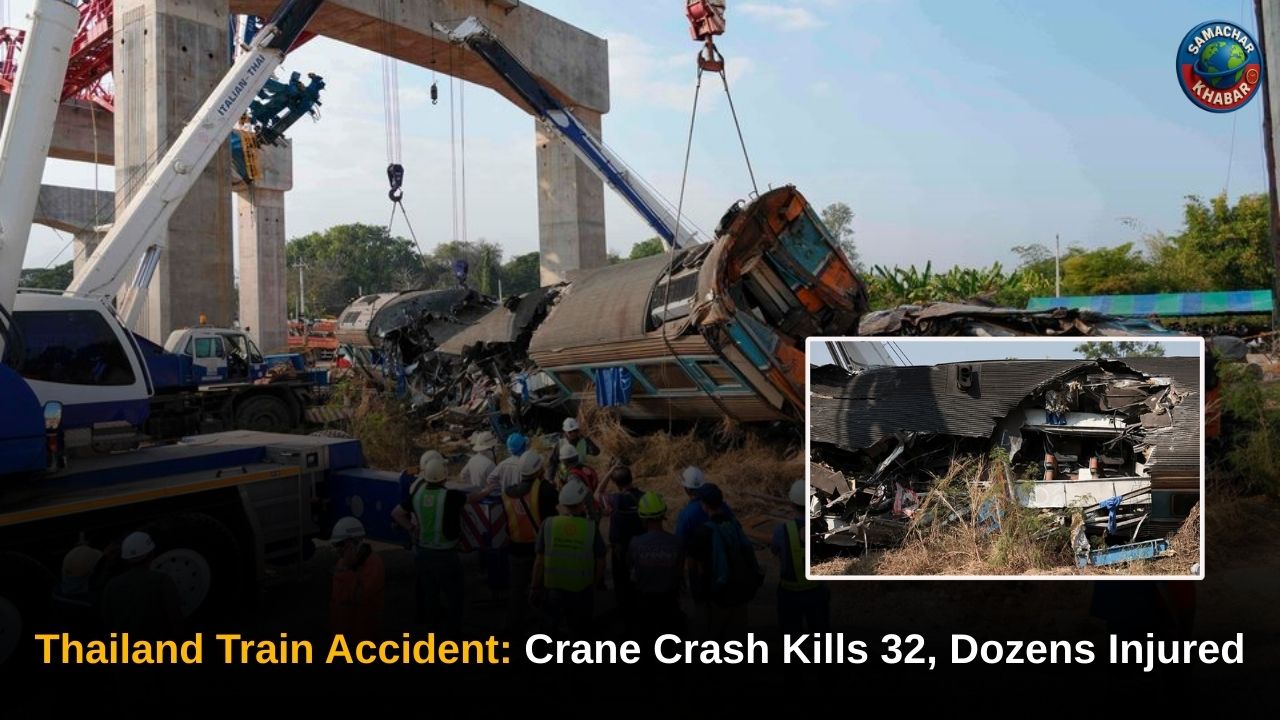
Thailand Train Accident: A devastating Thailand train accident unfolded on Wednesday morning when a construction crane collapsed onto a moving passenger train in Nakhon Ratchasima province, killing 32 people and injuring 66 others, according to Thailand’s Health Ministry. The tragedy has triggered nationwide grief, disrupted rail services, and renewed scrutiny of construction safety standards linked to major infrastructure projects.
The train was travelling from Bangkok to Ubon Ratchathani with around 195 passengers on board when the crane — part of a high-speed rail construction project — fell onto two carriages, derailing the train and igniting a fire.
Timeline: How the Crane Collapse Unfolded
Key moments from the incident:
- 09:00–09:30 local time: The train departs Nong Nam Khun station and approaches Sikhio district
- Crane collapses while lifting a large concrete segment above the active rail line
- Two carriages crushed, multiple coaches derail, one catches fire
- Passengers thrown into the air, according to survivor accounts
- Emergency responders evacuate all passengers within hours
Eyewitnesses described concrete fragments falling seconds before the crane slid down and struck the train, with the entire incident lasting less than a minute.
Casualties and Injuries: The Human Cost
| Category | Number | Details |
| Deceased | 32 | 31 at the scene, 1 during transit |
| Missing | 3 | Currently Unaccounted |
| Injured | 66 | 7 (Critical), 7 (Serious), 14 (Minor) and rest probably discharged |
| Onboard | 195 | – |
Among the injured are a one-year-old child and an 85-year-old passenger, underscoring the indiscriminate nature of the disaster.
Source: Thailand Ministry Public Health
Survivor Accounts Paint a Grim Picture
Thirasak Wongsoongnern, a staff member on the train, told local media he was “thrown into the air” by the impact. He rushed to assist passengers but could not access one carriage due to flames.
Another eyewitness, Maliwan Nakthon, said she saw “small concrete fragments falling” before the crane collapsed entirely. “It struck hard and crushed the train,” she recalled.
These first-hand accounts highlight the suddenness and severity of the crash.
Investigation Ordered as PM Demands Accountability
Thai Prime Minister Anutin Charnvirakul has ordered a thorough investigation, stating that “someone must be punished and held accountable.” Authorities are examining whether negligence, skipped safety steps, or deviations from design standards played a role.
The State Railway of Thailand has:
- Launched a formal probe
- Announced legal action against the construction firm
- Cancelled or rerouted more than a dozen train services
- Offered full refunds to affected passengers
Who Was Responsible for the Construction?
The crane was part of the US$5.4 billion Bangkok–Nong Khai high-speed rail project, intended to link Thailand with China via Laos. While the project uses Chinese technology, officials confirmed the affected section was built by a Thai company, Italian-Thai Development Public Company Limited (ITD).
ITD has issued a statement expressing regret and pledging compensation and relief to victims’ families. The company has previously faced scrutiny after a Bangkok building it constructed collapsed during an earthquake last year.
The Chinese Embassy in Thailand stated that no Chinese companies or workers were involved in this incident.
Thailand’s Troubling Construction Safety Record
The Thailand train accident has reignited debate over the country’s construction safety enforcement. Deadly incidents have occurred repeatedly:
- 2024: Crane collapse at a steel factory in Rayong killed six workers
- 2024: Expressway construction accident on Rama II Road killed six
- 2023: Freight train collision killed eight people
A Workmen’s Compensation Fund study (2022) reported that over 4,500 workers were killed or injured in construction accidents in a single year, pointing to systemic safety gaps. [BBC]
Also Read: UK Train Stabbing: 10 Injured in Suspected Terror Attack Near Huntingdon, Two Arrested
Why This Accident Has Wider Implications
Beyond the immediate loss of life, the crash raises critical questions:
- Should heavy construction be allowed over active rail lines?
- Are safety audits sufficient for mega infrastructure projects?
- Who bears accountability when private contractors fail?
As Thailand pushes forward with ambitious transport links, including cross-border high-speed rail, public confidence hinges on transparent investigations and real reforms.
The Illusion of Technical Safety
We often believe that modern engineering is our ultimate shield. However, as we witness such devastation, we must ask: Why does a ‘random’ accident occur to specific people at a precise second? If science is so advanced, why can it never predict or prevent the ‘timing’ of death? These gaps suggest that our safety is governed by forces far deeper than steel and bolts.
The Karmic Ledger and True Protection
Jagatguru Tatvdarshi Sant Rampal Ji Maharaj reveals that while science explains how a crane falls, only spiritual knowledge explains why it happened to those souls. This world is part of the 21 universes ruled by Kaal Brahm (Satan), where every suffering is a balancing of past karmic debts. As the sacred verse states:
“Drishti pade so dhokha re. Khand pind brahmand chalenge thir nahi rahsi loka re. thir nahi rahsi loka re.”
Everything visible is temporary and destined for decay. True safety lies in the worship of Supreme God Kabir, which can dissolve karmic bonds and lead us to Satlok, our eternal home. Don’t wait for the next tragedy; seek the path to ultimate salvation today.
FAQs: Thailand Train Accident
Q1. Where did the Thailand train accident occur?
In Sikhio district, Nakhon Ratchasima province, about 230 km northeast of Bangkok.
Q2. What caused the train derailment?
A construction crane collapsed while lifting a concrete segment, falling onto the moving train.
Q3. How many people were killed and injured?
32 people were killed and 66 injured, according to official sources.
Q4. Was China involved in the construction accident?
No. Authorities and the Chinese embassy confirmed the section was built by a Thai company.