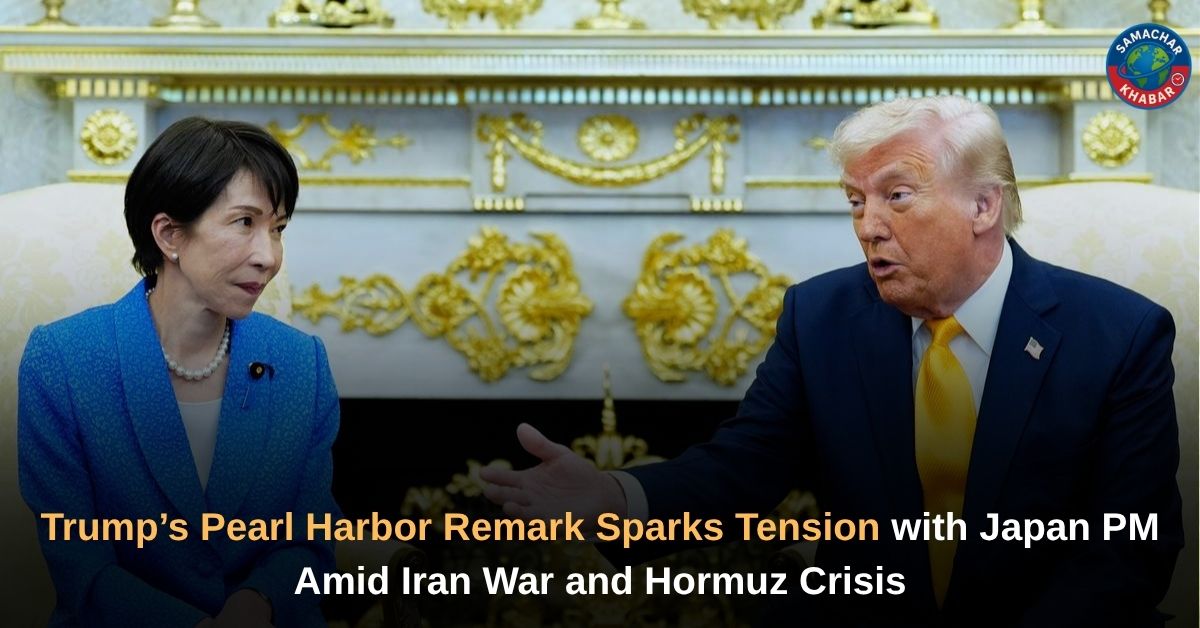
A high-stakes White House meeting between US President Donald Trump and Japanese Prime Minister Sanae Takaichi turned unexpectedly tense as a historical reference to Pearl Harbor overshadowed discussions on the ongoing Iran war and global energy security. The talks, held on March 19, focused on the escalating conflict triggered by US-Israeli strikes on Iran and the resulting disruption in the Strait of Hormuz—one of the world’s most critical oil routes.
While both leaders emphasized cooperation, the meeting exposed deep strategic pressures, legal constraints and global economic concerns, with Japan carefully balancing its alliance with the US and its constitutional limitations.
Key Highlights: Trump–Japan Meeting, Iran War and Strait of Hormuz Crisis
- Trump invoked Pearl Harbor to justify secrecy of Iran strikes, creating diplomatic discomfort
- US–Israel war on Iran, which began on February 28, has intensified regional tensions
- Strait of Hormuz disruption affecting nearly 20% of global oil supply
- Trump urged allies, including Japan, to deploy ships and secure the waterway
- Japan expressed willingness to help but highlighted constitutional and legal limits
- 82% of Japanese public opposes involvement in the war
- Energy markets shaken after attacks on Iran’s South Pars and Qatar’s Ras Laffan facilities
- IEA plans release of 400 million barrels from emergency reserves
- US and Japan discussed $40 billion nuclear reactor deal and broader economic cooperation
- China, Taiwan and Indo-Pacific security also key topics in talks
Awkward Diplomacy: Pearl Harbor Remark Shifts Tone of White House Meeting
The Oval Office meeting began with routine exchanges, including Trump praising Takaichi’s English and joking about skipping translation. However, the tone shifted sharply when a Japanese reporter asked why the United States did not inform allies before launching strikes on Iran.
Trump responded by defending the need for secrecy and surprise in military operations, saying:
“Who knows better about surprise than Japan? Why didn’t you tell me about Pearl Harbor?”
The remark, referencing the December 7, 1941 attack that killed over 2,400 Americans and led to US entry into World War II, created an immediate sense of discomfort.
Reports noted that Takaichi’s expression changed visibly—her smile faded, her eyes widened and she shifted in her seat, reflecting the sensitivity of the historical reference. The room’s initial laughter quickly subsided.
Iran War Escalation and Global Energy Shock
The meeting took place against the backdrop of the ongoing Iran conflict, now in its third week, which began with US and Israeli strikes on February 28.
Iran’s retaliatory actions have severely disrupted the Strait of Hormuz, a strategic chokepoint through which nearly one-fifth of global oil supply flows.
Shipping traffic has dropped sharply, with vessels avoiding the region due to security threats, including missile and drone attacks. Oil prices have surged globally, marking one of the most significant disruptions in modern energy markets.
The situation intensified further after an Israeli strike on Iran’s South Pars gas field triggered retaliatory Iranian attacks on Qatar’s Ras Laffan facility, which accounts for roughly 20% of global liquefied natural gas supply.
In response to the growing crisis, the International Energy Agency pledged to release 400 million barrels of oil from emergency reserves to stabilise markets.
Trump Pressures Allies While Sending Mixed Signals
President Trump has repeatedly called on US allies—including Japan, NATO members and China—to help secure the Strait of Hormuz. He argued that countries heavily dependent on energy imports from the region should take responsibility for protecting it.
“I expect Japan to step up… because we have that kind of relationship,” Trump said, noting that more than 90% of Japan’s oil imports pass through the strait.
At the same time, Trump delivered conflicting messages. While demanding support, he also insisted that the United States could handle the situation alone, stating that it does not “need anything from anyone.”
Earlier, speaking aboard Air Force One, he said it would be “nice to have other countries police” the strait, reinforcing his push for shared responsibility.
Also Read: Trump Announces First New US Oil Refinery in 50 Years
He also criticised NATO allies for not participating, while European leaders such as Germany and France made clear they would not engage militarily in the conflict.
Japan’s Dilemma: Strategic Alliance vs Constitutional Limits
Prime Minister Sanae Takaichi entered the meeting acknowledging it would be “very difficult,” as Japan faces a complex strategic dilemma.
On one hand, Japan relies heavily on energy imports through the Strait of Hormuz—nearly 90–95% of its crude oil passes through the route. On the other hand, its 1947 pacifist constitution strictly limits military engagement abroad.
Takaichi told Trump that Japan is ready to contribute to ensuring safe passage through the strait but explained in detail what the country can and cannot do under its legal framework.
Japan’s Self-Defense Forces have previously participated in non-combat roles such as anti-piracy missions and minesweeping, but direct involvement in a conflict would require crossing a high political and legal threshold.
Public opinion further constrains the government. A recent poll showed that 82% of Japanese citizens oppose involvement in the Iran war.
Diplomatic Balancing: US Alliance, Iran Outreach and China Concerns
Japan is attempting to strike a delicate balance between supporting the United States and maintaining its diplomatic relationships in the region.
Takaichi reiterated that Iran must not be allowed to develop nuclear weapons while also confirming that Japan has reached out to Tehran in recent days in an effort to ease tensions.
She described the current situation as a “very severe security environment” and warned that the global economy is likely to face a major shock due to the ongoing conflict.
At the same time, Japan continues to navigate tensions with China, which it considers its biggest strategic challenge. Issues related to Taiwan and regional security were also discussed during the meeting.
Both leaders reaffirmed their commitment to maintaining peace and stability in the Indo-Pacific and opposing unilateral attempts to change the status quo by force.
Economic and Energy Cooperation Strengthened
Despite geopolitical tensions, the meeting also produced significant economic developments.
A major highlight is a $40 billion nuclear reactor deal involving US-based GE Vernova and Japan’s Hitachi Ltd., which will build advanced small modular reactors in Tennessee and Alabama.
In addition, both sides discussed:
- A joint oil reserve initiative
- Expansion of US energy exports
- Japanese investments worth tens of billions of dollars in US infrastructure
These initiatives aim to stabilise energy supplies and strengthen economic ties amid global uncertainty.
Defence Cooperation and Strategic Security Developments
The leaders agreed to deepen defence cooperation, including:
- Joint missile development and production
- Expansion of advanced defence systems
- Increased production of Standard Missile-3 Block 2A interceptors
Japan also expressed interest in participating in the US-led Golden Dome missile defence project, with initial funding estimated at $25 billion.
However, concerns remain in Tokyo that the US may shift military focus from the Indo-Pacific to the Middle East, especially as reports indicate redeployment of US forces and assets to the region.
Global Response Remains Cautious
In a joint statement, Japan, the UK, France, Germany, Italy and the Netherlands expressed readiness to contribute to “appropriate efforts” to ensure safe passage through the Strait of Hormuz.
However, the nature of these efforts remains unclear, and several countries have ruled out direct military involvement.
Germany stated it would not participate militarily, while France also signalled reluctance, highlighting the limits of international support for the US-led effort.
A Meeting That Captured the Complexity of Modern Diplomacy
From light-hearted exchanges to moments of visible tension, the Trump–Takaichi meeting reflected the complexities of navigating global crises where history, energy security and military strategy intersect.
Spiritual Perspective: Teachings of Saint Rampal Ji Maharaj Ji
Amid global conflicts and rising tensions, true peace cannot be achieved through war or power alone. The ongoing crisis highlights a deeper lack of spiritual understanding and direction in human society.
According to Saint Rampal Ji Maharaj, lasting peace comes through true devotion, righteousness and God-centered living. His teachings explain that violence, ego and material desires lead to suffering, while following the path of Satbhakti brings inner peace, harmony and stability. Only through spiritual wisdom can humanity move from conflict toward lasting unity and global peace.
Global Tensions Rise as Alliances Face a Defining Test
The meeting underscores a critical moment in global geopolitics, where the Iran conflict, energy security concerns and shifting alliances are deeply intertwined. As the Strait of Hormuz crisis continues to disrupt global oil supplies, pressure on US allies is expected to grow. Japan’s cautious stance highlights the challenge of balancing international expectations with domestic legal and political constraints.
At the same time, Trump’s Pearl Harbor remark illustrates how historical sensitivities can quickly influence modern diplomacy. With rising uncertainty and economic risks, the path forward will depend on coordinated international efforts and careful strategic decisions.
FAQs on Trump’s Pearl Harbor Remark, Iran War and Strait of Hormuz Crisis
1. Why did Donald Trump mention Pearl Harbor during the meeting?
Trump referenced Pearl Harbor to justify keeping Iran strike plans secret, arguing that surprise was crucial in military operations when responding to a reporter’s question.
2. What is the significance of the Strait of Hormuz in the Iran war?
The Strait of Hormuz carries nearly 20% of global oil supply. Its disruption by Iran has caused rising energy prices and global economic concerns.
3. Why is Japan hesitant to support US military efforts in the Iran war?
Japan is restricted by its 1947 pacifist constitution, which limits military action. Strong public opposition also makes direct involvement politically difficult.
4. What did Trump expect from Japan during the meeting?
Trump urged Japan to “step up” and help secure the Strait of Hormuz, suggesting countries dependent on the route should protect their energy supplies.
5. How has the Iran conflict affected global energy markets?
The conflict has disrupted oil and gas supply routes, triggered attacks on major energy facilities, and pushed global prices higher, raising fears of economic instability.